AI outreach personalization
Using an AI model to tailor recruiter messages to individual candidates at scale, drawing on profile data, shared context, and role specifics to improve reply rates without per-send manual research.
Michal Juhas · Last reviewed May 29, 2026
What is AI outreach personalization?
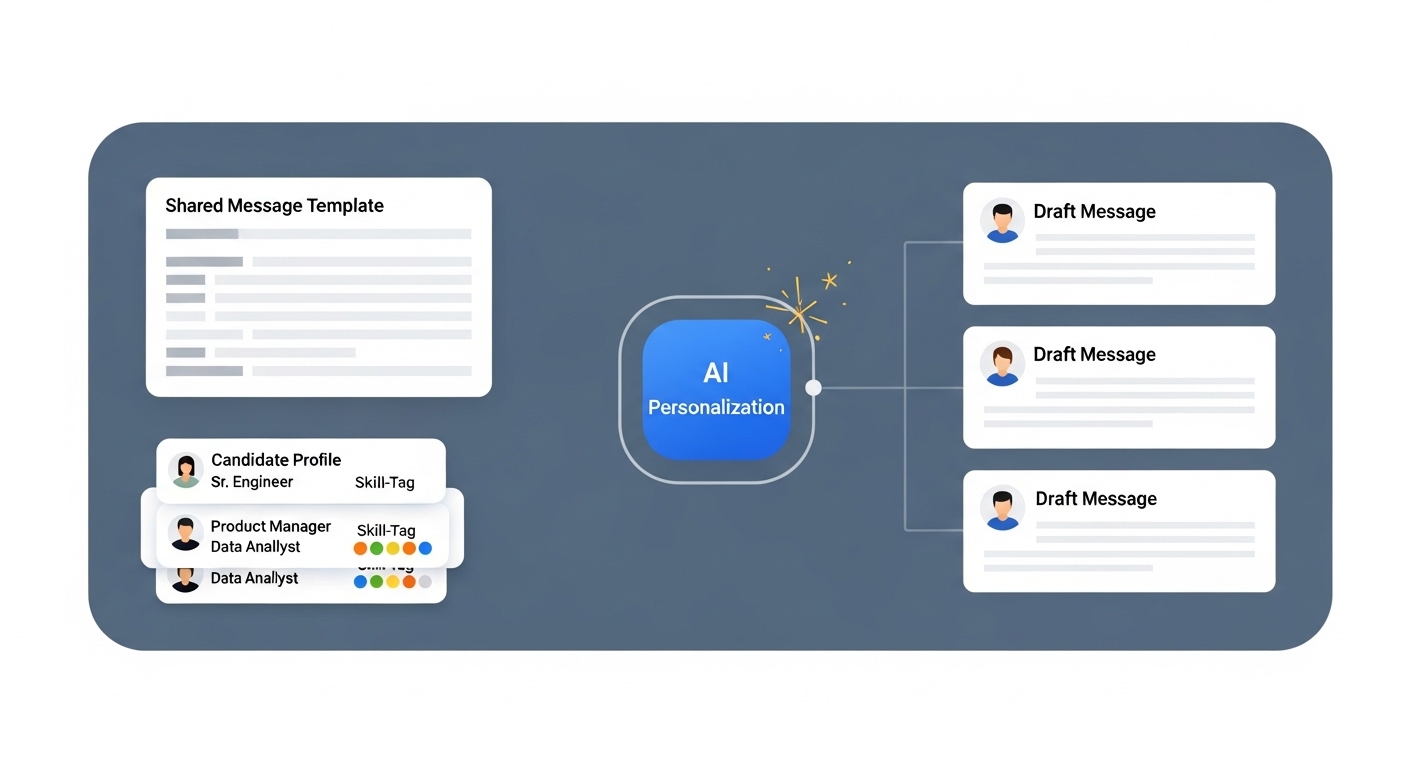
AI outreach personalization is the practice of using a language model to generate recruiter messages that reference specific details from a candidate's profile, shared context between the candidate and the role, or relevant recent activity, at a scale that would not be possible with manual research per send.
The goal is to move beyond copy-paste templates while keeping per-message effort low. A template says "I think you'd be a great fit." A personalized message says "I noticed you led the migration from monolith to microservices at your last company, which is exactly the challenge this team is working through now." The second message gets more replies. The risk is that AI generates plausible-sounding but inaccurate details that damage credibility immediately.
In practice
- A sourcer generates 40 first-touch messages in under 20 minutes by feeding a candidate list, a role brief, and a system prompt into a model, then reviews each draft for accuracy before queuing sends.
- A team discovers that personalizing only one detail (the candidate's current company project) outperforms messages that try to reference three or four things, because the focused version reads as genuine rather than over-researched.
- A recruiter tracks which variable (school, project, mutual connection, recent post) produces the highest reply rate over 90 days and tightens the prompt to use only that signal.
Quick read, then how hiring teams use it
This is for recruiters and sourcers who send outreach at volume and want to improve reply rates without spending 10 minutes per candidate on manual research. Skim the first section for shared vocabulary. Use the second when you are deciding how to build a personalization step into your sourcing workflow.
Plain-language summary
- What it means for you: An AI model reads a candidate's profile and your role brief, then writes a first-touch message that sounds like you researched this specific person, because it did.
- How you would use it: Provide a profile excerpt, a one-paragraph role description, and a prompt that tells the model which type of detail to reference. Review each draft before sending.
- How to get started: Take 10 templates you already use. Ask a model to rewrite each one to reference one specific thing from a sample profile. Compare the personalized versions to the originals and send both in an A/B test on 30 candidates.
- When it is a good time: For outbound sourcing campaigns where you have 20 or more first-touch messages to send in one session.
When you are running live reqs and tools
- What it means for you: At scale, AI personalization is a multiplier on sourcer time, not a replacement for judgment about which candidates are worth reaching out to in the first place.
- When it is a good time: After your templates are stable, your role brief is clear, and you have a review step before any message leaves the queue.
- How to use it: Build a prompt chain that takes profile data, passes it through a personalization step, and routes each draft to a review queue. Do not auto-send. Log which drafts get edited before send so you can improve the prompt.
- How to get started: Start with one req. Use a simple prompt: "Write a 3-sentence LinkedIn message to [name] referencing [one specific thing from their profile] and connecting it to [role]." Review all drafts before sending. Track reply rates separately from non-personalized sends.
- What to watch for: Hallucinated details, outdated profile data feeding inaccurate references, and data minimization requirements under GDPR. Personalization that references data the candidate did not share publicly creates legal and trust risk.
Where we talk about this
On AI with Michal live sessions, outreach personalization comes up in sourcing automation blocks where we build and test prompt templates against real candidate profiles. The emphasis is on review gates and error logging before any message scales. Start at Recruiting OS and bring sample profiles and role briefs for hands-on prompt work.
Around the web (opinions and rabbit holes)
Third-party creators move fast. Treat these as starting points, not endorsements, and do not copy outreach scripts that move candidate data through unvetted third-party services.
YouTube
- Search for "AI recruiting outreach personalization" or "recruiter message personalization ChatGPT" on YouTube for practitioner demonstrations of prompt setups and reply rate experiments with before-and-after comparisons.
- Some TA operations channels publish detailed breakdowns of what personalization variables actually moved reply rates in their specific market, which is more useful than vendor benchmarks.
- r/recruiting has candid threads on whether AI-personalized outreach gets flagged as spam or feels inauthentic to candidates, with practitioner responses from both sides.
- r/sales covers AI personalization in outbound sales contexts that are directly applicable to sourcing workflows, with more data on what works at volume.
Quora
- Searches for "how to personalize recruiting outreach at scale" surface a mix of practitioner approaches and tool recommendations; focus on answers that cite actual reply rate data rather than general advice.
Related on this site
- Glossary: AI outreach drafting, Prompt chain, Candidate data enrichment, GDPR recruiting data, Workflow automation
- Blog: AI sourcing tools for recruiters
- Live cohort: Recruiting OS
- Membership: Become a member