Best practices in recruitment
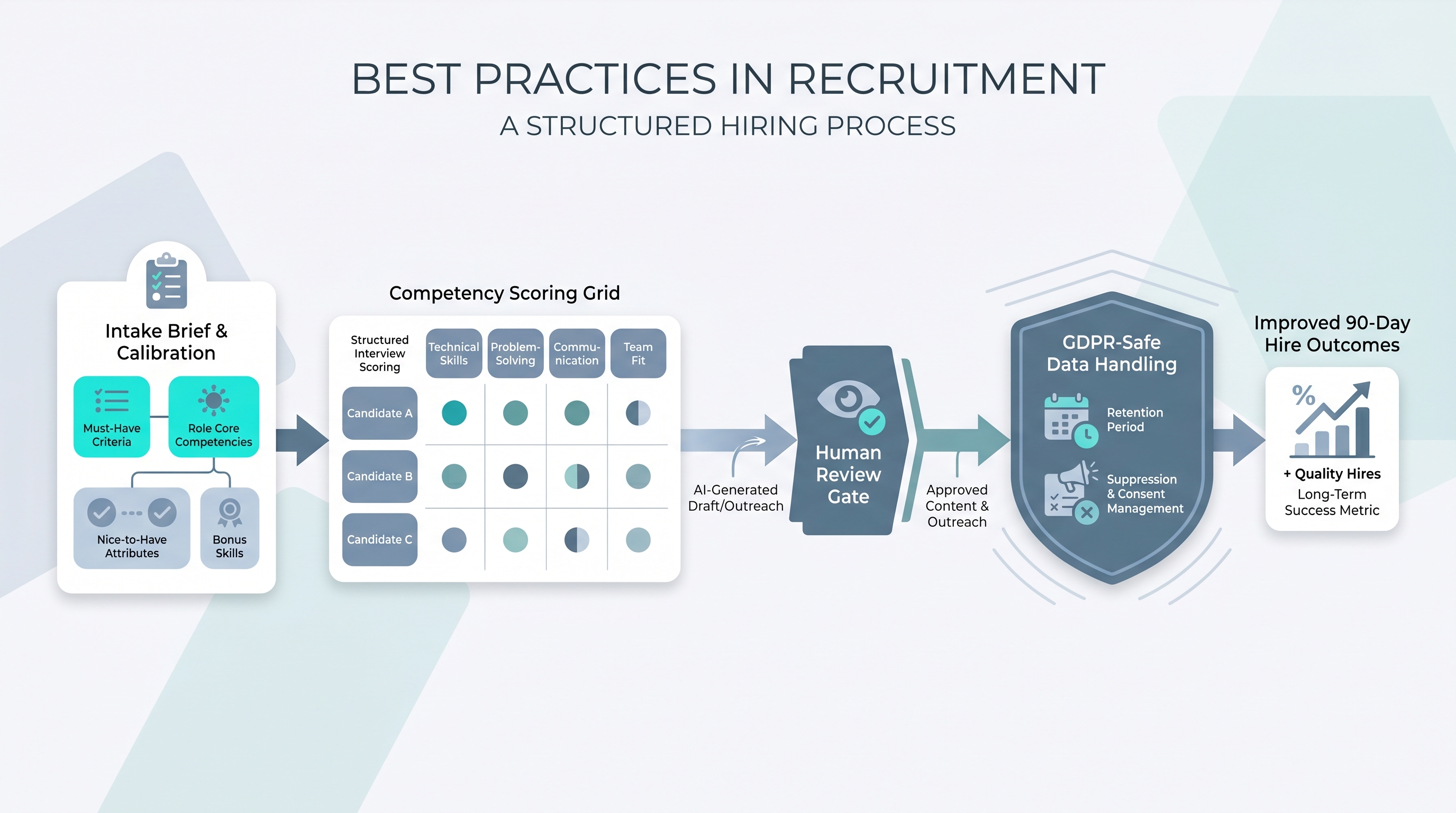
Proven approaches that maintain fairness, speed, and quality across every hiring stage: structured intake, consistent scorecards, GDPR-safe data handling, and a deliberate human review layer for AI-generated content.
Michal Juhas · Last reviewed May 5, 2026
What are best practices in recruitment?
Best practices in recruitment are the documented behaviors and process standards that hold up across hiring conditions: how the intake meeting is run, how candidates are scored, how data is handled, and how human judgment stays in the loop when AI is involved.
The challenge is not knowing the practices. Most TA teams can list them. The challenge is maintaining them under pressure from hiring managers who want to skip steps or from vendors who promise that their tool makes the process automatic. Practices that survive scrutiny are usually built around reducing noise in decisions, not reducing the number of steps.
In practice
- A sourcing team uses "best practice" to mean that every candidate in the pipeline has a recorded reason for rejection before the requisition closes, so a six-month debrief can show which criteria actually predicted success and which were comfort factors.
- An HR business partner tells a hiring manager that best practice requires a structured debrief before deciding, to create distance between a subjective first impression and a hire decision that will be hard to undo.
- A TA ops person building an ATS workflow asks which fields are required for a role to be closed, because best-practice definitions often live in required ATS fields rather than a document anyone actually reads.
Quick read, then how hiring teams use it
This is for recruiters, TA partners, and HR leaders who need a shared definition of recruitment best practices that holds in debriefs, vendor evaluations, and process audits. Skim the first section for a fast shared picture; use the second when deciding what to change in your live process.
Plain-language summary
- What it means for you: Recruitment best practices are the behaviors that reduce noise in hiring decisions: structured intake, scored interviews, GDPR-safe data handling, and a review step before AI-generated content reaches candidates.
- How you would use it: Pick one stage of your current process where decisions feel inconsistent. Add one practice (a scored intake, a shared rubric, a required ATS note) and measure whether panel disagreement drops over the next four to six hires.
- How to get started: Pull the last five reqs where the hire did not work out in the first 90 days. Look for what the intake brief said versus what the role actually required. That gap is where practice improvement pays off first.
- When it is a good time: When you are onboarding new hiring managers, when a role family has high turnover, or when AI tools are being added and you need to define what human review actually means at each stage.
When you are running live reqs and tools
- What it means for you: Best practices translate into system configuration: required fields in the ATS, mandatory review steps before AI-generated messages can send, and structured debrief templates tied to the scorecard. When they live in tools rather than documents, they are harder to skip under deadline pressure.
- When it is a good time: When a role takes more than three interview rounds for the team to agree, when sourced outreach reply rates fall below 10 percent, or when the same role opens repeatedly because early hires did not last past 90 days.
- How to use it: Wire the must-have criteria from the intake into your screening template. Use workflow automation to block stage progression until required notes are recorded. Apply human-in-the-loop gates before any AI draft reaches candidates. Log which model version ran each AI step so a future audit can explain the decision.
- How to get started: Audit one closed req end to end: intake notes, screen notes, interview scores, and offer. Identify the first point where the process deviated from the defined best practice. That deviation is the first one to fix in the ATS configuration, not the last.
- What to watch for: Best practices that exist only in documentation decay fast under hiring pressure. Track compliance by measuring completion rates on required ATS fields, not by counting how many people attended a training session.
Where we talk about this
On AI with Michal live sessions, recruitment best practices come up across both the AI in recruiting and sourcing automation tracks: AI in recruiting covers how practices like structured intake, scored interviews, and human review gates hold up when AI tools are added at each stage, and sourcing automation covers the data-handling and compliance practices that prevent automation from creating GDPR risk or quality gaps. If you want the full room conversation with real stack questions, start at Sourcing Lab and bring one recent req where the process broke down.
Around the web (opinions and rabbit holes)
Third-party creators move fast. Treat these as starting points, not endorsements, and double-check anything before you wire candidate data.
YouTube
- Search for "structured interviewing recruiting" and "talent acquisition best practices" on YouTube for practitioner-led walkthroughs. Channels from TA ops specialists and sourcing coaches typically cover process specifics rather than vendor demos, which is more useful for calibration.
- "Adverse impact in hiring" and "bias in screening" searches return academic and practitioner content that connects directly to the GDPR and structured interview sections above.
- r/recruiting has ongoing threads on intake meetings, panel calibration, and what "best practice" actually means when a hiring manager pushes back. Practitioner debate is more useful than any framework document for understanding where practices break down in real companies.
- r/humanresources covers policy-level practices around data retention, candidate feedback obligations, and onboarding that complement the TA-side process practices covered here.
Quora
- Search "recruitment best practices for small teams" and "how to improve hiring process" for a range of practitioner answers spanning startup through enterprise. Cross-check any specific numbers against your own data before acting on them.
Best practices versus skipping for speed
| Dimension | Following best practices | Skipping for speed |
|---|---|---|
| Intake quality | Must-haves defined before sourcing | Criteria emerge during interviews |
| Interview consistency | Scored rubric, independent notes | Impression-based debrief |
| AI review gate | Human checks output before sending | AI draft fires directly |
| GDPR compliance | Lawful basis documented per candidate | Assumed from ATS usage |
| 90-day outcomes | Tracked and fed back to intake | Not measured systematically |
Related on this site
- Glossary: Scorecard, Human-in-the-loop (HITL), Async screening, Workflow automation, GDPR first touch outreach, AI bias audit, Hallucination, Candidate data enrichment, AI outreach drafting, Talent acquisition metrics
- Blog: AI sourcing tools for recruiters
- Guides: Sourcers
- Live cohort: Sourcing Lab
- Course: Starting with AI: the foundations in recruiting
- Membership: Become a member