Standard operating procedures for AI recruiting
Step-by-step procedures that tell recruiting teams how to use AI tools at each hiring stage: which prompt template to run, what to review before output leaves the system, how to log AI involvement, and when a human decision is required.
Michal Juhas · Last reviewed May 5, 2026
What are standard operating procedures for AI recruiting?
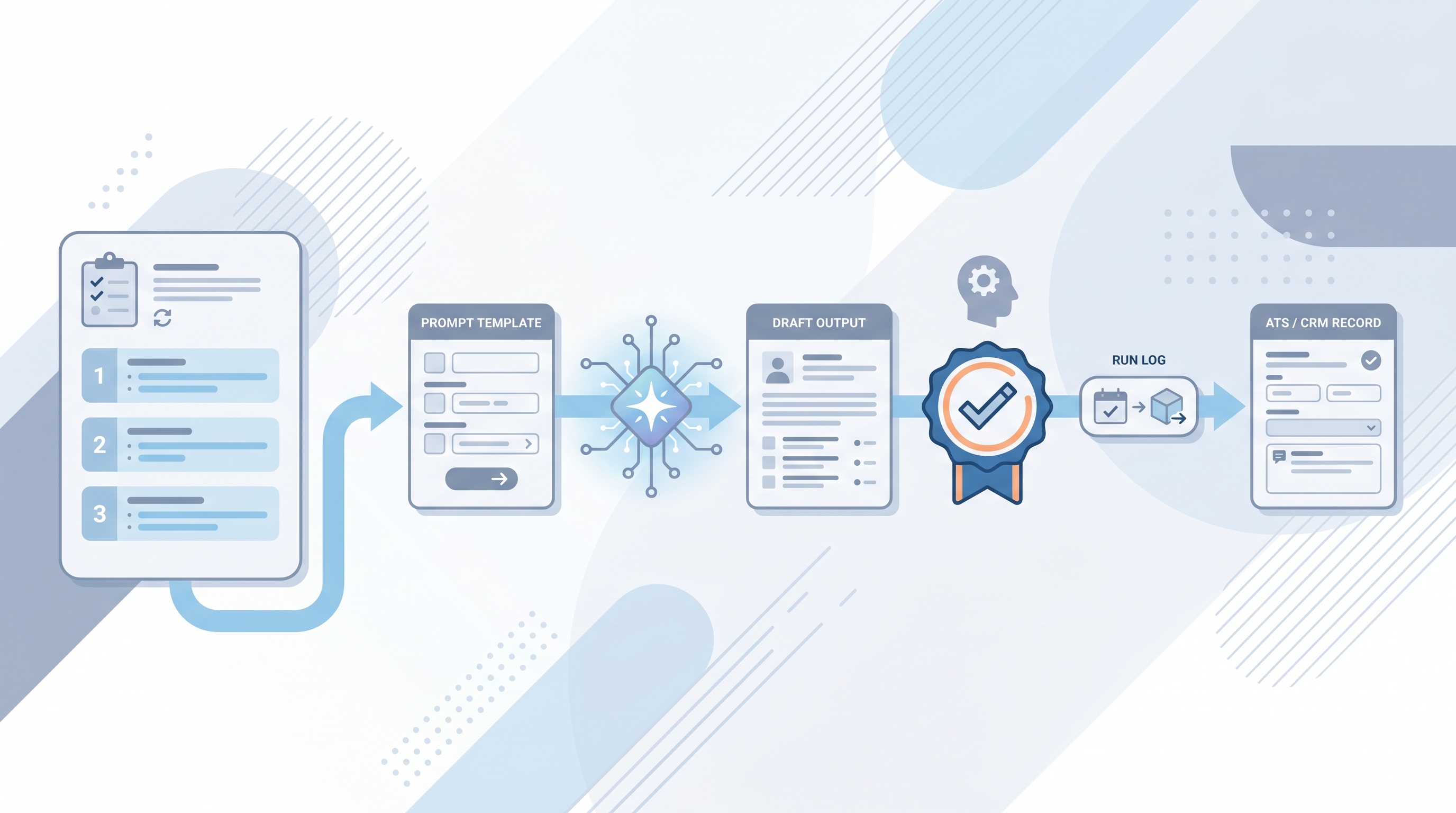
An SOP for AI recruiting is a step-by-step procedure that tells your team exactly how to use an AI tool at a specific hiring stage: which model to run, which prompt template to use, what a reviewer must check before output leaves the system, and how to log the run. It is not a policy statement or a vendor guide. It is the operational document that makes AI-assisted work repeatable, auditable, and recoverable when something goes wrong.
The gap most teams experience is not a lack of AI tools. It is the absence of any shared agreement on how those tools are used. Without an SOP, AI use varies recruiter to recruiter: different prompts, different review habits, different logging or no logging at all. That variability becomes a GDPR risk, a candidate experience inconsistency, and a training problem when a new team member joins.
In practice
- A TA ops manager reviewing a data protection audit discovers that three recruiters used three different AI tools for the same outreach campaign with no logs showing which version ran. That is the problem an SOP prevents.
- A sourcer onboarding a new teammate explains the outreach process: we use this prompt template from the library, review the name and role claim before sending, and drop the run ID into the ATS note field. That is an SOP working in practice.
- A recruiting lead tells their team that using AI is not defined until the SOP covers which tool, which prompt, who reviews, and where the log goes. Anything less is a habit, not a procedure.
Quick read, then how hiring teams use it
This is for recruiters, TA partners, and HR leaders who need a shared definition of AI recruiting SOPs that holds in compliance reviews, tool onboarding, and process audits. Skim the first section for a fast shared picture; use the second when deciding what to document for your live stack.
Plain-language summary
- What it means for you: An SOP tells every team member exactly how to use a specific AI tool at a specific hiring step: which prompt, who reviews it, what to check, and where to record that it ran.
- How you would use it: Pick one AI-assisted task you already run every week (outreach drafting is the most common) and write the five steps as a one-page document: who runs the prompt, which template, what the reviewer checks, where the log goes, and who to escalate to when output fails.
- How to get started: Pull your three most recent AI-assisted outreach sequences. List what you actually did: tool, prompt, review step (if any), log location. The gaps between what you did and what you would want to repeat every time are the SOP sections to write first.
- When it is a good time: When a new recruiter joins and AI habits vary across the team, when a compliance review asks how candidate data was processed, or when a tool update breaks an existing prompt and the team needs a decision process.
When you are running live reqs and tools
- What it means for you: SOPs translate tool adoption into reproducible process. Without a written procedure, AI use on live reqs depends on who is on shift and what they remember from the last training session. That is how outreach quality drifts and GDPR gaps accumulate across a quarter.
- When it is a good time: When an AI tool moves from pilot to standard use across more than one recruiter, when a candidate or DPA asks for documentation of AI involvement, or when a model version changes and you need to decide whether the current procedure still applies.
- How to use it: Wire the SOP into your actual tools: link the approved prompt template from the prompt library directly in the SOP document, add a required note field in the ATS for AI run logs, and set the review step as a non-optional gate in your workflow automation before any message can be sent.
- How to get started: Draft the SOP for your highest-volume AI task in one page. Review it with your DPO or legal contact before it goes live. Run it on the next five live reqs and log every deviation. Deviations are the places to clarify the procedure, not to blame the recruiter.
- What to watch for: SOPs that live only in a shared document become irrelevant within a quarter. Attach the review cycle to something that already happens, such as a monthly TA ops call or a quarterly business review. Log model versions and prompt template versions in the SOP itself, not just the tool name, so a six-month-old run can be reconstructed when needed.
Where we talk about this
On AI with Michal live sessions, SOPs for AI recruiting come up across both the AI in recruiting and sourcing automation tracks: AI in recruiting covers how to define review gates and log AI involvement at each funnel stage, and sourcing automation covers the data-handling and compliance procedures that prevent automation from creating GDPR risk. If you want the full room conversation with real stack questions, start at Sourcing Lab and bring your current tool list and one recent req where process broke down.
Around the web (opinions and rabbit holes)
Third-party creators move fast. Treat these as starting points, not endorsements, and double-check anything before you wire candidate data.
YouTube
- Search for "AI recruiting process documentation" and "TA ops standard operating procedures" on YouTube. Content from TA operations specialists and HR technology practitioners typically covers procedure design in more grounded terms than vendor demos.
- "GDPR recruiting compliance" and "data protection hiring process" return academic and practitioner content that connects directly to the logging and retention sections of an AI recruiting SOP.
- r/recruiting and r/humanresources have ongoing threads on process documentation, AI tool governance, and how to tell new recruiters what to do when habits vary across the team.
- r/RecruitmentAgencies has practical discussion on tool standardization across multi-recruiter environments, directly relevant to SOP design for agency and RPO teams.
Quora
- Search "how to document AI recruiting process" and "recruitment SOP template" for a range of practitioner perspectives across startup and enterprise. Cross-check any specific advice against your own stack and data protection obligations before adopting it.
SOP versus ad hoc AI use
| Dimension | With SOP | Ad hoc AI use |
|---|---|---|
| Prompt consistency | Shared approved template per task | Varies recruiter to recruiter |
| Review gate | Named reviewer, defined checklist | Optional or skipped under pressure |
| AI run logging | Logged per req (tool, version, date) | Not tracked |
| GDPR audit readiness | Documentation available on request | Requires memory reconstruction |
| Onboarding new team member | Follow the SOP | Shadow existing habits |
Related on this site
- Glossary: Recruiting prompt library, Human-in-the-loop (HITL), Hallucination, Workflow automation, GDPR first touch outreach, Candidate data enrichment, Scorecard, AI outreach drafting, Best practices in recruitment
- Blog: AI sourcing tools for recruiters
- Guides: Sourcers
- Live cohort: Sourcing Lab
- Course: Starting with AI: the foundations in recruiting
- Membership: Become a member