Grounded outputs in hiring assistants
AI responses tied to specific cited source documents, reducing the risk that a model fabricates facts about candidates, roles, or compliance requirements during hiring workflows.
Michal Juhas · Last reviewed May 27, 2026
What are grounded outputs in hiring assistants?
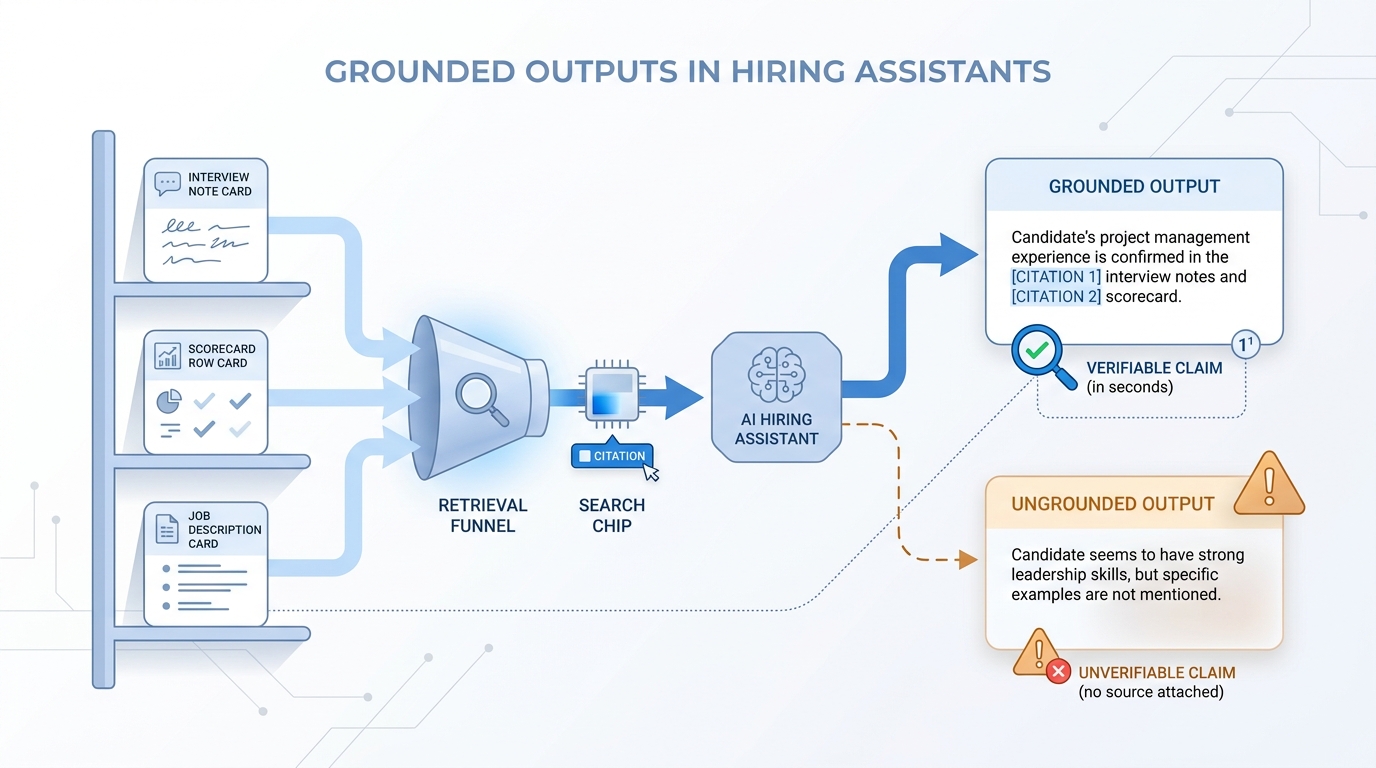
A grounded output is an AI response tied to a specific document or data source in your system, so the claim can be verified. In hiring, this means an assistant that summarises a candidate's interview performance cites the actual interview notes rather than generating a plausible-sounding summary from scratch.
In practice
- A recruiter asks "why was this candidate advanced?" and the assistant returns a summary with footnotes linking to the scorecard rows and interview notes it drew from, rather than a confident narrative invented by the model.
- A sourcing assistant that surfaces candidates from an internal talent pool explains each recommendation by citing specific fields from the candidate profile, not inferring skills the profile does not mention.
- TA ops team checks a batch of AI-generated screening summaries against source notes and finds two cases where the model drew from the wrong candidate record due to a retrieval mismatch.
Quick read, then how hiring teams use it
This is for recruiters, TA operations, and HR teams evaluating or running AI-assisted hiring tools. Skim the first section when you need a fast shared vocabulary. Use the second when you are configuring, auditing, or explaining AI tools to compliance or legal stakeholders.
Plain-language summary
- What it means for you: A grounded AI assistant can show you its work. An ungrounded one cannot, which means you cannot verify its claims before acting on them.
- How you would use it: When reviewing AI summaries of candidate evaluations, check that the source document is cited and accessible. If it is not, treat the output as a draft requiring manual verification.
- How to get started: Ask any AI tool vendor you are evaluating: "Can the system show which document each sentence in a summary came from?" If the answer is no, budget extra review time for outputs that will affect candidate decisions.
- When it is a good time: Before deploying an AI assistant for screening summaries, offer justifications, or any output that will be shared with hiring managers or stored in the ATS as a record.
When you are running live reqs and tools
- What it means for you: Grounding is an infrastructure question, not just a model quality question. The retrieval system, chunk size, and document freshness all affect whether outputs stay on-source.
- When it is a good time: Configure grounding requirements during tool procurement and pilot, not as a retrofit after the assistant is already in production use.
- How to use it: Define which documents are authoritative for each use case (scorecards for evaluations, benchmarks for compensation, JDs for screening criteria) and ensure only those documents are in the retrieval index.
- How to get started: Run a citation audit on a sample of real outputs. Log which outputs had traceable citations, which had none, and which cited documents that did not match the claim.
- What to watch for: Vendors who describe their tool as "grounded" but cannot show you the retrieval architecture. Also watch for stale knowledge bases where retrieved documents are months out of date, causing the assistant to surface outdated job requirements or expired policies.
Where we talk about this
On AI with Michal live sessions, grounded outputs come up in the context of workflow automation and AI tool evaluation. When cohorts build sourcing or screening assistants, the RAG module explains how retrieval connects to grounding in practice. For teams deploying AI in interview intelligence or offer management, the grounding question is tied directly to explainable AI in hiring. Join a AI Recruiting Accelerator to walk through a real tool evaluation that includes a grounding check.
Around the web (opinions and rabbit holes)
Third-party creators move fast. Treat these as starting points, not endorsements, and test any recommendations against your own system before relying on them in candidate-facing workflows.
YouTube
- Search "RAG grounding LLM" on YouTube for technical explainers on how retrieval-augmented generation produces grounded outputs; many are vendor-neutral and show the citation mechanism in practice.
- "AI hallucinations in enterprise" videos from ML practitioners often cover grounding as the primary mitigation strategy.
- r/LocalLLaMA and r/MachineLearning have practitioner threads on RAG quality and citation accuracy that apply directly to building hiring assistants.
Quora
- What is RAG in AI and how does it reduce hallucinations? collects accessible answers from ML practitioners that translate well to non-technical recruiting stakeholders.
Grounded vs ungrounded outputs
| Aspect | Grounded output | Ungrounded output |
|---|---|---|
| Source | Cited document chunk | Model weights only |
| Verifiability | Traceable in seconds | Cannot be verified |
| Hallucination risk | Reduced | High |
| Audit trail | Present | Missing |
Related on this site
- Glossary: RAG (retrieval-augmented generation), Hallucination, Explainable AI in hiring, Human-in-the-loop (HITL), System instructions, Scorecard
- Live cohort: AI Sourcing Lab
- Membership: Become a member