High-volume hiring
Recruiting dozens to thousands of similar roles in a short window, using automation, structured screening, and consistent scoring to manage large candidate flows without sacrificing quality or compliance.
Michal Juhas · Last reviewed May 27, 2026
What is high-volume hiring?
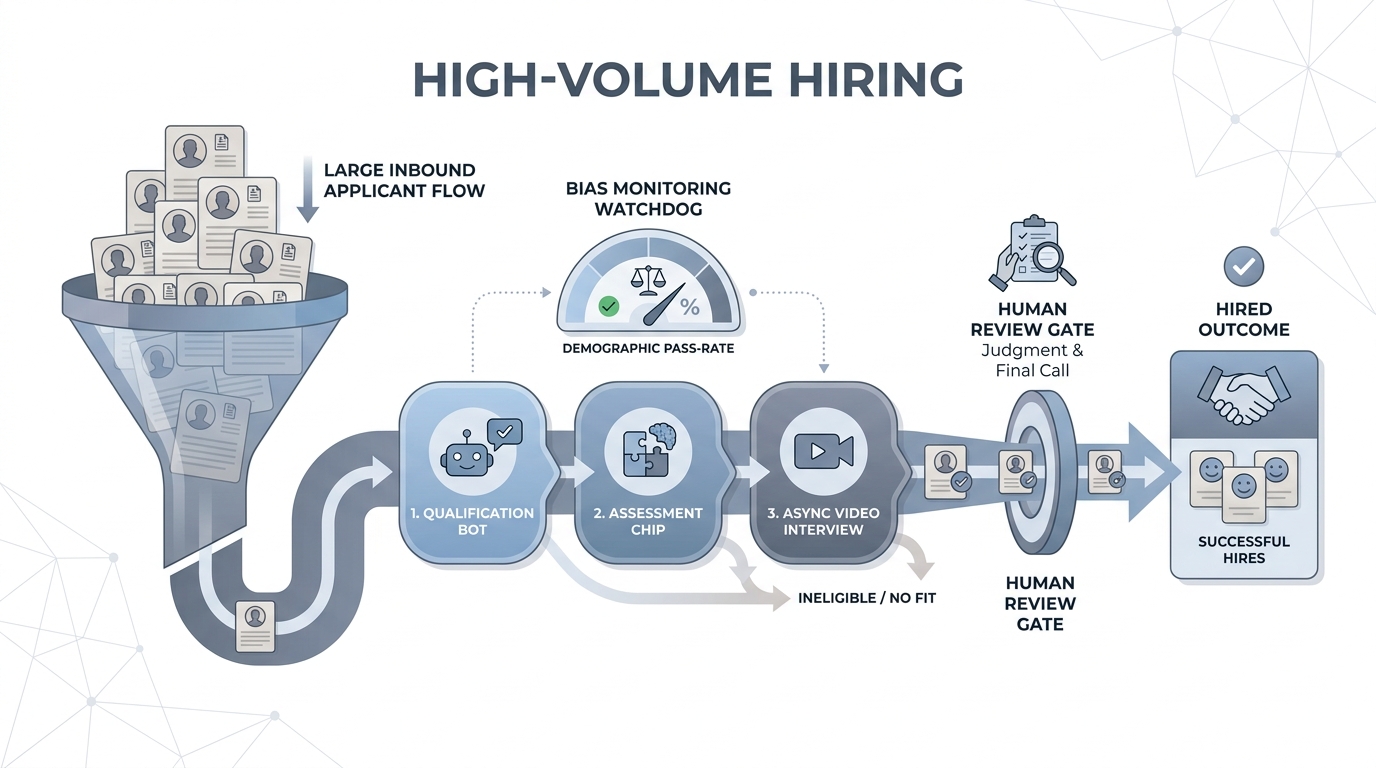
High-volume hiring is recruiting at scale: dozens to thousands of similar roles within a defined window, where the challenge is maintaining consistency and quality across a pipeline too large to manage manually. It is common in retail, logistics, customer service, seasonal operations, and fast-growth tech companies hiring the same role repeatedly across multiple locations.
In practice
- A logistics company opening a new fulfilment centre needs 500 warehouse associates hired in 90 days. Every step, from application to background check, must run on a consistent workflow that recruiters did not build candidate by candidate.
- A tech company running a graduate programme for 200 software engineering interns applies the same async video interview and coding assessment to every candidate before any human reviews a profile, ensuring no applicant is accidentally skipped.
- A retail chain discovers its AI screening tool is passing significantly fewer candidates from certain postcodes after a model update, triggering an adverse impact review and a temporary manual screen while the cause is investigated.
Quick read, then how hiring teams use it
This is for recruiters, TA ops teams, and HR leaders running or evaluating high-volume programmes. Skim the first section for shared vocabulary. Use the second when you are configuring tools, reviewing metrics, or preparing compliance documentation for a scaled hiring programme.
Plain-language summary
- What it means for you: When you hire at volume, individual recruiter judgment does not scale. Consistent criteria, automated early-stage filtering, and clear human review gates replace the intuition-driven approach that works for executive search.
- How you would use it: Define the screening criteria before configuring any tool. Use automation for qualification, not for the final hire decision. Monitor funnel conversion at every stage for anomalies.
- How to get started: Map your current high-volume funnel on a whiteboard: where does each application go, who touches it, at what volume does the process break? Then identify which steps are genuinely consistent and rule-based enough to automate safely.
- When it is a good time: Before a large programme launch, when you can configure and test tools on a pilot batch before going live at full scale.
When you are running live reqs and tools
- What it means for you: At high volume, tool failures and biased screening criteria create legal and reputational problems at scale that do not exist in low-volume search. Monitoring is not optional.
- When it is a good time: Set up conversion rate dashboards and demographic breakdowns before the programme opens, not after the first complaint.
- How to use it: Configure alerts for stage conversion drops above a threshold (e.g., screen-to-interview rate falls more than 10 percentage points week-over-week). Investigate any drop before the next batch runs.
- How to get started: Pull your last high-volume programme data: application volume, each stage conversion rate, time-in-stage, and offer acceptance rate. Find the stage with the biggest unexplained drop-off and start there.
- What to watch for: Chatbot screening questions that screen out candidates with non-standard availability, address-based filtering that correlates with ethnicity in certain markets, and async video tools that disadvantage candidates with unstable internet or non-native accents.
Where we talk about this
On AI with Michal sessions, high-volume hiring comes up when cohorts discuss chatbot screening, async assessment platforms, and AI bias audits. The AI Recruiting Accelerator cover where automation adds consistent value versus where it creates compliance risk, using real volume hiring scenarios. Join a AI Sourcing Lab to discuss your programme specifics with practitioners who have run these funnels.
Around the web (opinions and rabbit holes)
Third-party creators move fast. Treat these as starting points, not endorsements, and check any tool recommendations against your own compliance requirements before deployment.
YouTube
- Search "high volume recruiting automation" on YouTube for practitioner walkthroughs of end-to-end high-volume funnels using tools like Paradox, Greenhouse, or Lever.
- "AI in retail hiring" and "logistics recruiting at scale" case study videos from talent tech vendors show real configurations, though check for promotional framing.
- r/recruiting has threads on high-volume hiring pain points, particularly around chatbot reliability and candidate drop-off at the automation stage.
- r/humanresources covers the compliance and adverse impact side of high-volume screening more thoroughly than most recruiting forums.
Quora
- How do companies hire hundreds of people at once? collects practitioner answers across different industries and programme types.
Automation fit by funnel stage
| Funnel stage | Automation fit | Human role |
|---|---|---|
| Application receipt and acknowledgement | High | Alert review only |
| Initial qualification screening | High with documented criteria | Bias audit |
| Skills or async video assessment | High | Results review |
| Interview scheduling | High | Exception handling |
| Offer decision | Low | Full human ownership |