Pre-hire assessment test
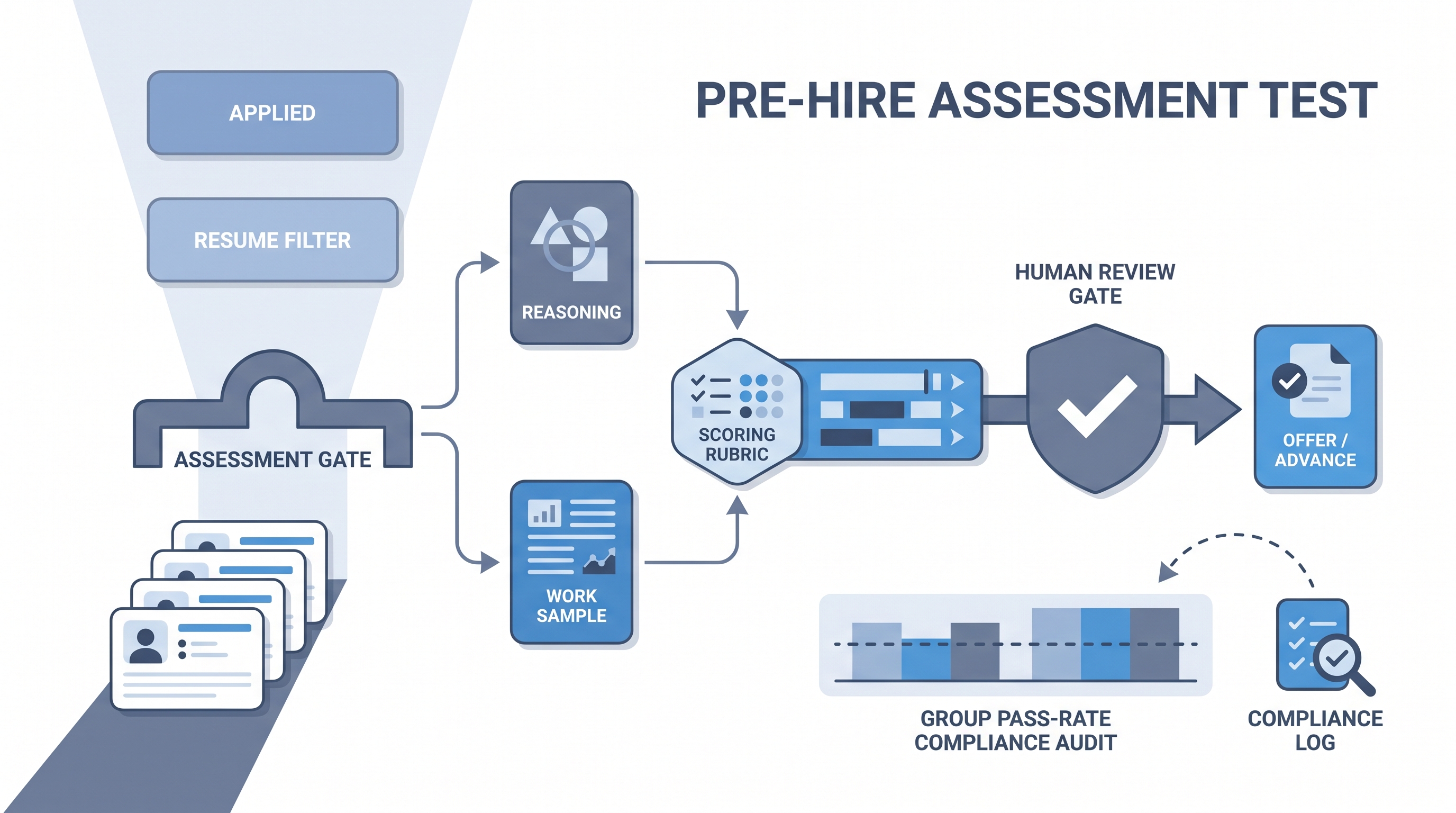
A scored evaluation placed at the decision gate before a hiring offer, using cognitive screens, work samples, or situational judgment tasks to give the team objective data while they still have options and the result can genuinely influence the hire-or-pass call.
Michal Juhas · Last reviewed May 15, 2026
What is a pre-hire assessment test?
A pre-hire assessment test is a scored evaluation placed at the decision gate before a hiring offer. The phrase "pre-hire" pins the timing precisely: results are available while the team still holds options, so the data actually influences the hire-or-pass call rather than rationalizing a decision already made in conversation.
The evaluation form varies. A short cognitive screen before the recruiter call checks reasoning speed without a long form. A work sample placed after the first call asks the candidate to produce output matching real job tasks. A situational judgment test presents role-relevant scenarios and scores how the candidate frames a response. What all of these share is standardization: every candidate receives identical conditions, and the score does not shift based on who administered the assessment that afternoon.
The gap between a test that is deployed and a test that is valid is wider than most vendor pitches suggest. A pre-hire assessment with no criterion validity study for the specific role family is measuring something, just not necessarily job performance. Run a retroactive validation on past hires before treating any score as a decision input.
In practice
- A recruiter at a 300-person SaaS company sends a 20-minute written communication screen to all customer success applicants after the resume filter. Candidates who clear the rubric bar advance to the phone screen; those below receive a standard decline without a call. The team reviews group pass rates each quarter and adjusts the cut score when gaps exceed the four-fifths threshold.
- A TA ops lead piloting a new pre-hire test for an operations role asks the vendor for a criterion validity study tied to that role family. The vendor can supply only a general norm report across industries. The TA lead runs a 30-person retroactive pilot on recent hires instead and uses those results to set the cut score.
- An HRBP notices that completed assessments correlate weakly with 90-day manager ratings for one role family. Rather than raising the cut score, the team replaces the test with a structured scenario task drawn from an actual process the role runs in week two. The new task produces a stronger predictive correlation with performance data from the next cohort.
Quick read, then how hiring teams use it
This is for recruiters, sourcers, TA, and HR partners who need the same vocabulary in intake calls, vendor briefings, and compliance reviews. Skim the first section for a fast shared picture. Use the second when you are deciding where a test fits in a live req or evaluating a new scoring vendor.
Plain-language summary
- What it means for you: A pre-hire assessment test is any scored evaluation given to candidates before an offer. It gives the team a consistent data point that does not shift based on who reviewed the resume that morning.
- How you would use it: Pick one test that measures a skill gap that causes early failures in this role. Validate it on a small sample of current employees in similar roles before using it to screen new candidates.
- How to get started: Ask what skill gap most often causes a new hire to struggle in the first 90 days. Design or buy a test that measures that specific attribute, not a general proxy for intelligence or cultural fit.
- When it is a good time: After you have documented what the role actually requires, after your team agrees on a scoring rubric, and after a compliance partner has confirmed the lawful basis and data routing.
When you are running live reqs and tools
- What it means for you: A pre-hire test layer in your ATS sends assessments automatically when a candidate reaches a trigger stage, collects scores, and routes results back to the recruiter dashboard. When the vendor updates the scoring model, historical scores shift unless you log model versions and score dates with each result.
- When it is a good time: After your sourcing pass-through rate is stable enough to separate a screening bottleneck from a sourcing problem, and after IT has reviewed the data routing between your ATS and the vendor.
- How to use it: Set one cut score threshold per role family, document the rationale in writing, and run a four-fifths adverse impact check on each cohort before acting on results. Keep the scoring output in a separate field from the recruiter stage decision so you can show the two inputs were independent in a future audit.
- How to get started: Pilot on a closed req with 40 or more past hires. Score them retroactively and check whether the assessment result correlates with your own performance ratings. If the correlation is weak, the test is not measuring what you think.
- What to watch for: Vendors who claim their tool measures "job fit," "culture match," or "potential" without a named psychometric construct. Any scoring product that cannot show group pass-rate data for your role family is a liability, not a tool. AI scoring modules with no documented rubric version log become incomparable across cohorts once the vendor updates the model.
Where we talk about this
On AI with Michal live sessions we cover pre-hire testing in the legal and compliance modules of the AI in recruiting track. Participants work through vendor evaluation exercises, practice reading validity reports, and discuss where an assessment layer adds signal versus where it creates friction with no predictive gain. The sourcing automation track adds the operational side: wiring ATS stage triggers to assessment invites and routing scores back without manual data entry. Join a session at Sourcing Lab for peer discussion with real vendor names and live pipeline examples.
Around the web (opinions and rabbit holes)
Third-party creators move fast. Treat these as starting points, not endorsements, and verify before you wire any assessment into a candidate-facing process.
YouTube
Search with Filters → Upload date to surface recent IO psychology and employment law content alongside vendor demos.
- Pre-hire assessment validity criterion validity (what criterion validity actually means in selection science and how to evaluate vendor claims)
- Work sample test vs cognitive ability test hiring (comparison of predictive validity and adverse impact patterns across the main assessment categories)
- Pre-employment testing cut score adverse impact (how to document cut score rationale and run four-fifths rule checks before go-live)
- AI automated scoring pre-employment bias legal (what regulators and IO psychologists are saying about AI-scored assessments)
- r/IOPsychology has practitioner debate on which pre-hire test types hold up under validity scrutiny versus which are vendor marketing, with research citations.
- r/recruiting surfaces real recruiter discussions on candidate drop-off from long tests, mobile completion rates, and which assessment placements cost the team strong prospects.
- r/humanresources captures HRBP and legal partner perspectives on GDPR documentation and group pass-rate reporting obligations.
Quora
- Quora search: pre-hire assessment test has practitioner answers on test placement, vendor selection, and candidate experience; verify specific claims before acting on them.
Pre-hire test versus two common alternatives
| Selection step | Standardized? | Predictive validity | Candidate experience cost |
|---|---|---|---|
| Pre-hire assessment test (valid, role-matched) | Yes | High when validated | Low if short and well-placed |
| Unstructured interview | No | Low (interviewer drift) | High (scheduling, time) |
| Reference check | Partial | Low to moderate | Low for candidate |
Related on this site
- Glossary: Pre-employment assessment test, Pre-employment skills assessment, Pre-employment assessment software
- Glossary: Adverse impact, AI bias audit, Human-in-the-loop (HITL), Explainable AI hiring
- Glossary: Scorecard, Hiring funnel conversion rates, Sourcing pass-through rate
- Glossary: Candidate assessment tools, Hiring assessment tools
- Blog: AI sourcing tools for recruiters
- Live cohort: Sourcing Lab
- Membership: Become a member
- Course: Starting with AI: the foundations in recruiting