Recruitment sourcing tools
The full set of platforms and features that sourcers use to find and contact passive candidates, spanning Boolean and semantic search engines, profile databases, enrichment providers, and AI-powered outreach sequencers.
Michal Juhas · Last reviewed May 9, 2026
What are recruitment sourcing tools?
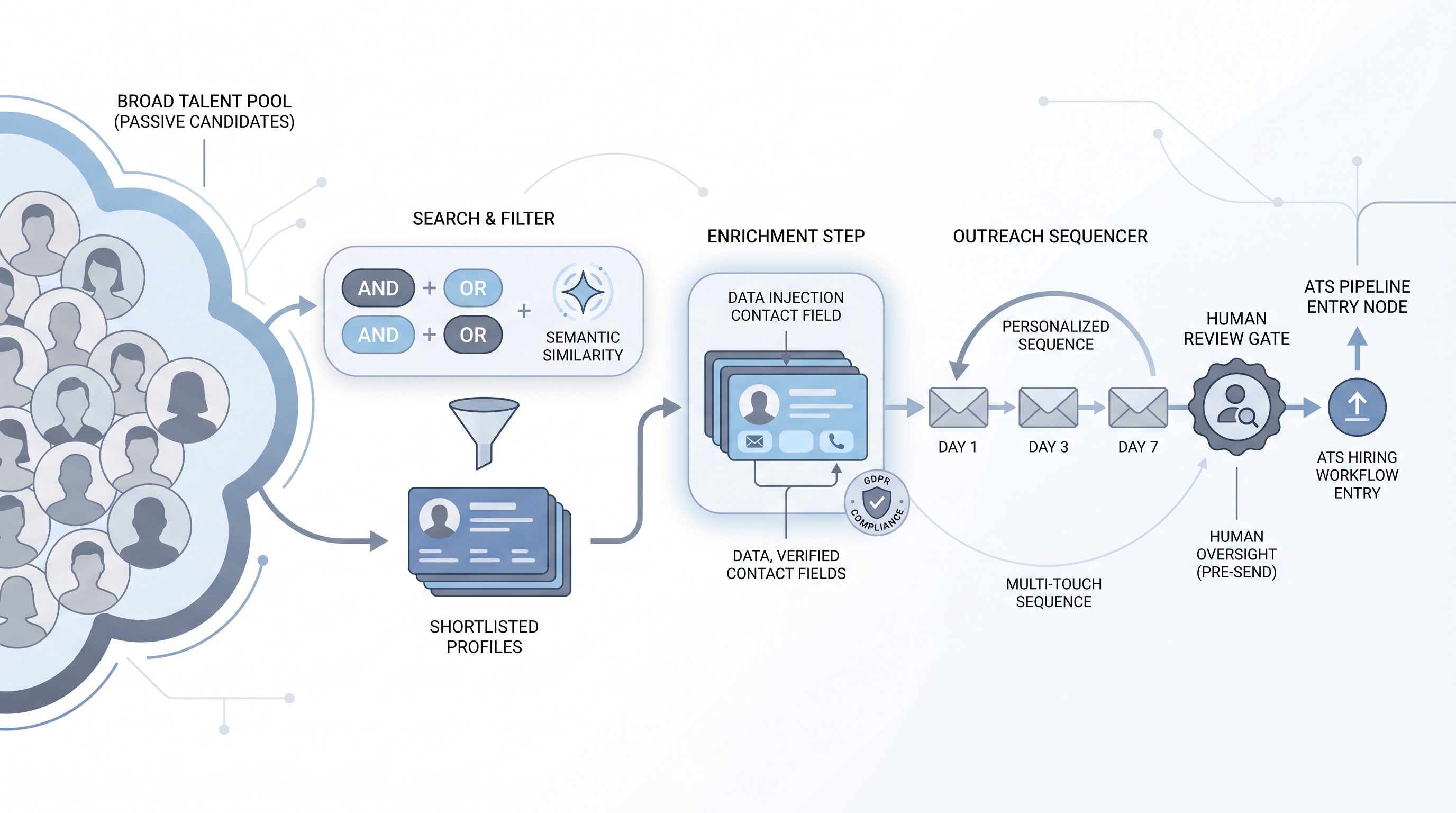
Recruitment sourcing tools are the platforms and features that help sourcers find and engage candidates before those candidates have applied. Unlike an applicant tracking system, which manages people already in your pipeline, sourcing tools work at the very top of the funnel: they surface passive candidates from professional networks, technical repositories, enrichment databases, and specialist directories, then help sourcers send a personalized first message.
The category covers a wide range of instruments. Boolean search operators and semantic search engines filter large talent pools to a relevant shortlist. Profile databases on LinkedIn, GitHub, and specialist platforms hold contact information at scale. Candidate data enrichment providers verify or supplement email addresses before outreach begins. Outreach sequencers track message delivery and reply rates across a sourcing campaign. What these tools share is a single goal: build a qualified shortlist before the inbox opens.
In practice
- A sourcer building a pipeline for a senior data role says "I ran a Boolean string on LinkedIn and then used AI semantic search to catch profiles using the title machine learning infrastructure rather than data engineering," meaning the two tool types found different but complementary profiles from the same target pool.
- A TA lead reviewing an enrichment vendor trial says "the bounce rate on EU emails is 22%, not the 8% they quoted," meaning database size claims mean little if verified email accuracy in the target region does not hold up under real conditions.
- A recruiter asking "where did this contact come from and what lawful basis do we have?" is raising the GDPR question that every sourcing tool workflow needs a documented answer for before a single message goes out.
Quick read, then how hiring teams use it
This is for sourcers, recruiters, TA leads, and HRBPs who evaluate, combine, or audit sourcing tools and need shared vocabulary for vendor conversations, stack decisions, and compliance reviews. Skim the first section for a quick shared picture. Use the second when you are selecting a new tool, integrating it into a stack, or auditing a sourcing workflow that has grown without a clear architecture.
Plain-language summary
- What it means for you: Recruitment sourcing tools are any platform or feature that helps you find and reach candidates who have not applied, rather than waiting for inbound applications to fill the pipeline.
- How you would use it: Pick one hard-to-fill role, run a sourcing search in the tool you are evaluating, and compare the top 20 results to what you would have found manually. That gap in speed and coverage is the real value of the tool for your team.
- How to get started: Map the channels where your target candidates actually spend professional time (LinkedIn, GitHub, Dribbble, conference lists) and check whether the tools you are evaluating index those channels before committing to a contract.
- When it is a good time: Before any search where inbound volume is historically low, when time-to-first-contact on passive roles is consistently above benchmark, or when a sourcer is spending the majority of the week on research rather than conversations.
When you are running live reqs and tools
- What it means for you: Every profile a sourcing tool surfaces came from somewhere: a public network, a data broker, or an enrichment API. That provenance determines your GDPR lawful basis, your data retention window, and what you can legally say at first touch.
- When it is a good time: Before any sourced contact enters your outreach sequence without a documented source-of-data record and a lawful basis assessment. The EU AI Act adds an additional layer for automated ranking features used in hiring decisions.
- How to use it: Pair sourcing tools with a proprietary talent pool strategy so first-party relationships build over time and reduce dependence on paid data. Log model versions if the tool uses AI matching. Run a human review gate before AI-drafted messages reach candidates.
- How to get started: Pull a one-line audit of each sourcing tool your team currently runs: which data sources it indexes, whose DPA covers the enrichment vendor, and whether contact data is refreshed or stale. Stale email lists drive bounce rates that damage your sending domain over time.
- What to watch for: Vendors who cite large database numbers without specifying verified-email accuracy by region. AI match scores that rank profiles without surfacing the features that drove the score. Outreach sequencers that can send automatically once configured, with no human review gate before first contact.
Where we talk about this
On AI with Michal live sessions, recruitment sourcing tools come up in both tracks. Sourcing automation sessions cover how individual tool types connect: how data flows from a sourcing platform to an ATS, which fields break across APIs, and what happens when an enrichment provider updates their schema mid-campaign. AI in recruiting sessions cover tool evaluation, vendor questions on model explainability, and where human review belongs in a sourcing workflow. Bring your current tool stack and the search brief you find hardest to fill to Sourcing Lab for a room-tested comparison.
Around the web (opinions and rabbit holes)
Third-party creators move fast on this topic. Treat these as starting points, not endorsements, and verify data compliance postures and contact accuracy directly with vendors before committing candidate data to any platform.
YouTube
- LinkedIn Recruiter sourcing tutorial covers the platform most teams start with, including advanced filter combinations and project management features for tracking sourcing campaigns.
- AI sourcing tools comparison for recruiters pulls practitioner walkthroughs showing real workflows across multiple platforms rather than marketing demos.
- Boolean search strings for recruiters covers the foundational skill that all sourcing tools build on and that AI-powered search should complement, not replace.
- Sourcing tools discussion in r/recruiting collects candid practitioner views on which platforms deliver in production and which disappoint after the trial period.
- What sourcing tools do you use? in r/recruiting is a recurring thread where sourcers compare current stacks and explain what moved them from one tool to another.
- ATS and sourcing tool integrations surfaces real integration failures and workarounds that vendor documentation rarely addresses.
Quora
- What are the best sourcing tools for recruiters? collects practitioner recommendations across company size and hiring context (read critically and cross-reference with recent sources as tool quality and pricing change regularly).
Recruitment sourcing tools by type
| Tool type | Primary function | Key risk |
|---|---|---|
| Boolean search engine | Exact-match filtering of profile databases | Misses candidates with different but equivalent titles |
| Semantic search | Meaning-based matching across titles and skills | Harder to audit; can amplify historical bias |
| Profile database | Index of candidate profiles with contact details | Data freshness; accuracy varies by region |
| Enrichment provider | Adds verified emails and contact fields to profiles | GDPR chain coverage across all enrichment vendors |
| Outreach sequencer | Sends and tracks personalized multi-touch messages | Automated send without a human review gate |
| AI sourcing assistant | Combines search, enrichment, and draft generation | Hallucinated credentials; opaque ranking logic |
Related on this site
- Glossary: Boolean search, Semantic search, Candidate data enrichment, Talent sourcing software, Applicant tracking software, Human-in-the-loop, Hallucination, AI bias audit, GDPR first-touch outreach, Proprietary talent pool, Outbound talent sourcing, AI sourcing tools, Talent acquisition metrics
- Blog: AI sourcing tools for recruiters
- Guides: Sourcers
- Workshops: Sourcing Lab
- Membership: Become a member
- Course: Starting with AI: foundations in recruiting