Secondment and loaned staff arrangements
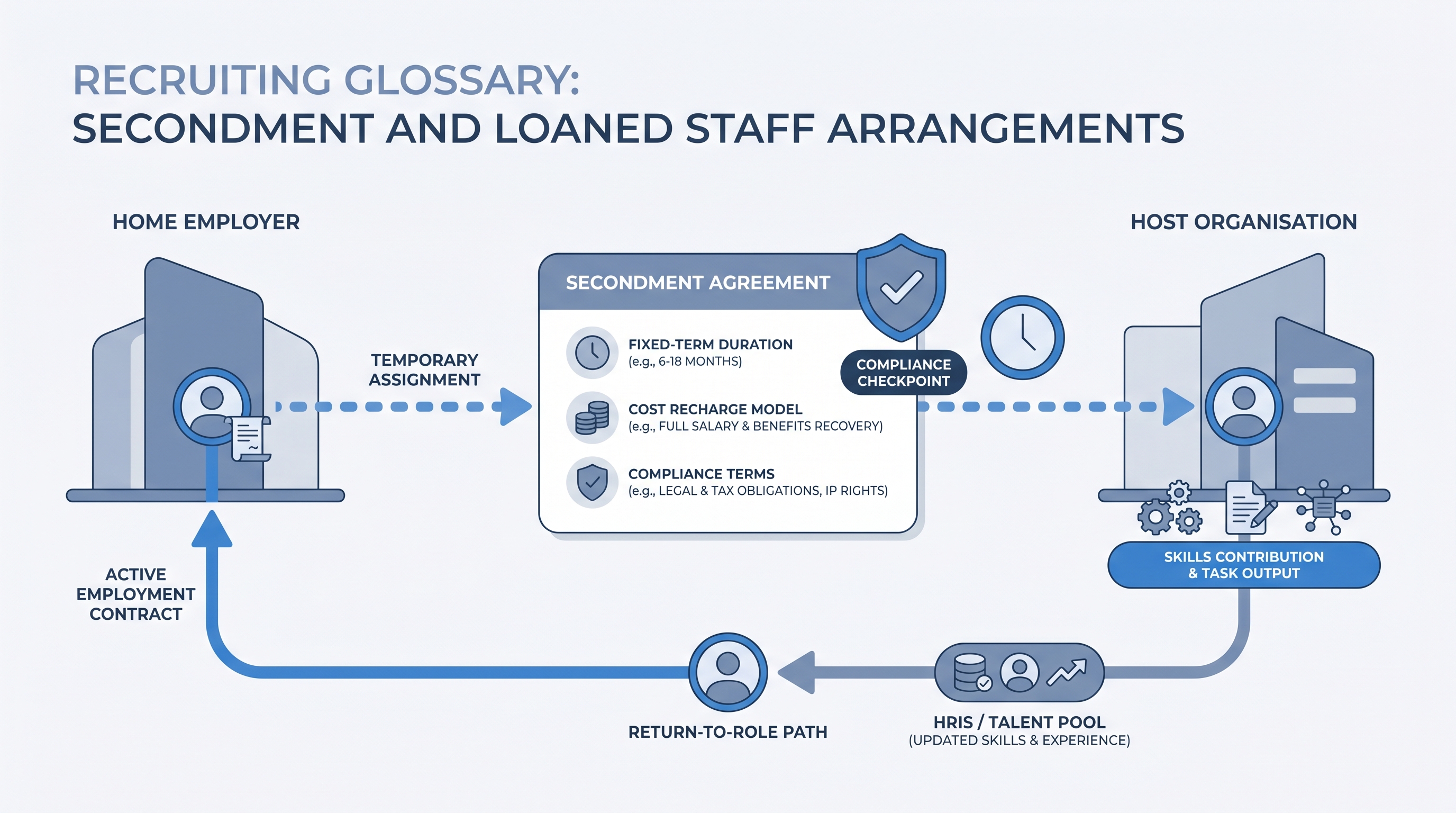
A secondment or loaned staff arrangement is a fixed-term agreement where an employee moves temporarily to another team, site, or organisation while their original employment contract stays in force, used to fill skills gaps, develop talent, or provide contracted labour without a permanent hire.
Michal Juhas · Last reviewed May 8, 2026
What is secondment and loaned staff?
A secondment is a fixed-term arrangement where an employee moves to another team, department, or organisation while their home employment contract stays in force. Loaned staff is the broader term used when a company provides workers temporarily to a partner, client, or group entity, often with a cost recharge rather than a new contract.
The core difference from a permanent transfer: the secondee returns. The home employer keeps the contract, the employment history, and the headcount. The host gets the skills for a defined window and pays an agreed recharge rate for them.
For TA and HR teams, secondments matter because they are often faster and cheaper than an external hire for roles where the required skill already exists inside the organisation. They also create cross-functional talent development paths that retain people who might otherwise leave to find broader experience.
In practice
- A fintech with a 12-month regulatory project borrows a compliance analyst from its parent group for the duration. No external agency, no new headcount required. The secondee returns to the parent entity once the project closes.
- An agency recruiter spots that a client keeps reposting a data engineering role that no contractor fills for more than six months. The recruiter suggests the client look internally: a business analyst in another team has been upskilling in Python for two years. The secondment is cheaper, productive within three weeks, and the analyst asks to stay permanently after the project ends.
- A TA leader at a multinational seconding employees across EU entities discovers that the arrangement triggers GDPR data processing obligations she had not mapped. She adds a data processing addendum to the standard secondment agreement and logs the legal basis before the next cross-border transfer.
Quick read, then how hiring teams use it
This is for recruiters, TA leaders, HR business partners, and ops people who need to explain, evaluate, or set up a secondment without reading employment law from scratch. Skim the first section for the vocabulary. Use the second when you are deciding whether a secondment makes sense for a specific req.
Plain-language summary
- What it means for you: A secondment lets you fill a skills gap with an internal person for a fixed period without opening a permanent headcount or paying an agency. The employee keeps their original contract; your team gets the capability you need.
- How you would use it: Identify the skill you need, check whether anyone inside the organisation already has it, and approach that person and their manager with a secondment proposal that includes duration, cost recharge model, and what happens at the end.
- How to get started: Map your internal talent against the brief before posting externally. If a match exists, draft a one-page secondment outline covering duration, line management during the assignment, payroll ownership, and the return-to-role plan.
- When it is a good time: When the required skill exists internally, the assignment is under eighteen months, and the home team can manage with a backfill or a temporary reduction in capacity.
When you are running live reqs and tools
- What it means for you: Secondments do not appear in most ATS workflows by default because the person filling the role is an internal employee, not an applicant. You need HRIS flags or a tagged internal proprietary talent pool to track the arrangement alongside your external pipeline.
- When it is a good time: When a role has failed external search twice, when headcount is frozen but the business still needs the output, or when you have an internal person who needs development that the secondment assignment would provide.
- How to use it: Set up a secondment record in the HRIS with start date, host team, planned return date, and a skills tagging field. Use workflow automation to send a return-to-role prompt sixty days before the end so nobody is surprised. If skills were developed during the secondment, update the internal talent profile so the person surfaces in future searches.
- How to get started: Audit your current open roles and ask, for each one, whether the required skill exists somewhere inside the organisation. If it does, contact the HR business partner for that team before you open an external req. Run the cost comparison: agency fee plus ramp time versus secondment recharge plus backfill cost.
- What to watch for: Co-employment risk if the host starts controlling discipline, performance management, or daily supervision without a formal agreement. Cross-border arrangements that trigger immigration, tax, or data transfer obligations. And informal secondments with no written agreement, which create liability for both the home employer and the host when the arrangement ends.
Where we talk about this
On AI with Michal live sessions, internal mobility, secondments, and loaned staff arrangements come up in the AI in recruiting track when participants are working through workforce planning decisions, internal talent matching, and the build-versus-buy-versus-borrow choice for skills gaps. If you want the full room conversation with peers who are running similar decisions, start at Sourcing Lab and bring your real org chart, open reqs, and skills gap data.
Around the web (opinions and rabbit holes)
Third-party perspectives on secondments range from practical HR policy guides to legal commentary on cross-border arrangements. These are starting points, not endorsements. Verify any contract language with a qualified employment lawyer before applying it to a live arrangement.
YouTube
- Employee secondment explained covers the basics of what a secondment is, how agreements work, and what both parties should expect from the arrangement.
- Internal mobility and talent development connects secondments to broader workforce planning and retention strategy.
- Cross-border secondments and tax surfaces the legal and tax complexity of inter-entity arrangements, useful before agreeing to loan a team member across jurisdictions.
- Secondment experiences in r/humanresources captures real HR professional perspectives on what works, what breaks, and what surprised them.
- Internal transfer vs secondment in r/recruiting shows how TA teams navigate the difference in practice, including ATS and HRIS workflow questions.
- Loaned staff and co-employment in r/legaladvice includes real scenarios about what happens when informal arrangements are not documented properly.
Quora
- What is a secondment agreement? collects practitioner and legal perspectives on what the agreement should contain and when secondments are the right tool.
Secondment vs contractor vs permanent hire
| Factor | Secondment | External contractor | Permanent hire |
|---|---|---|---|
| Where the skill comes from | Internal talent pool | Open market | Open market |
| Upfront cost | Internal recharge | Agency fee or daily rate | Agency fee or sourcing cost |
| Time to productive | Days (knows the systems) | Weeks to months | Weeks to months |
| Employment risk | Co-employment if undocumented | IR35 or local equivalents | Standard employment |
| What happens at month 18 | Secondee returns to home role | Contract ends or renews | Permanent headcount stays |
| Best for | Skill exists internally, fixed timeline | Skill gap, specialist work, flexible duration | Ongoing function, headcount approved |
Related on this site
- Glossary: Co-employment and staffing agency risk, Master services agreement for agency services, Proprietary talent pool
- Glossary: Workflow automation, Candidate data enrichment, Agency vs in-house recruiting
- Glossary: GDPR and first-touch outreach, Preferred supplier list (PSL), Retained search vs contingency
- Blog: AI sourcing tools for recruiters
- Workshops: Sourcing Lab
- Course: Starting with AI: the foundations in recruiting
- Membership: Become a member