Skills-based hiring
A hiring approach that evaluates candidates on demonstrated or verified skills rather than proxies such as degree credentials, job title history, or years of experience.
Michal Juhas · Last reviewed June 13, 2026
What is skills-based hiring?
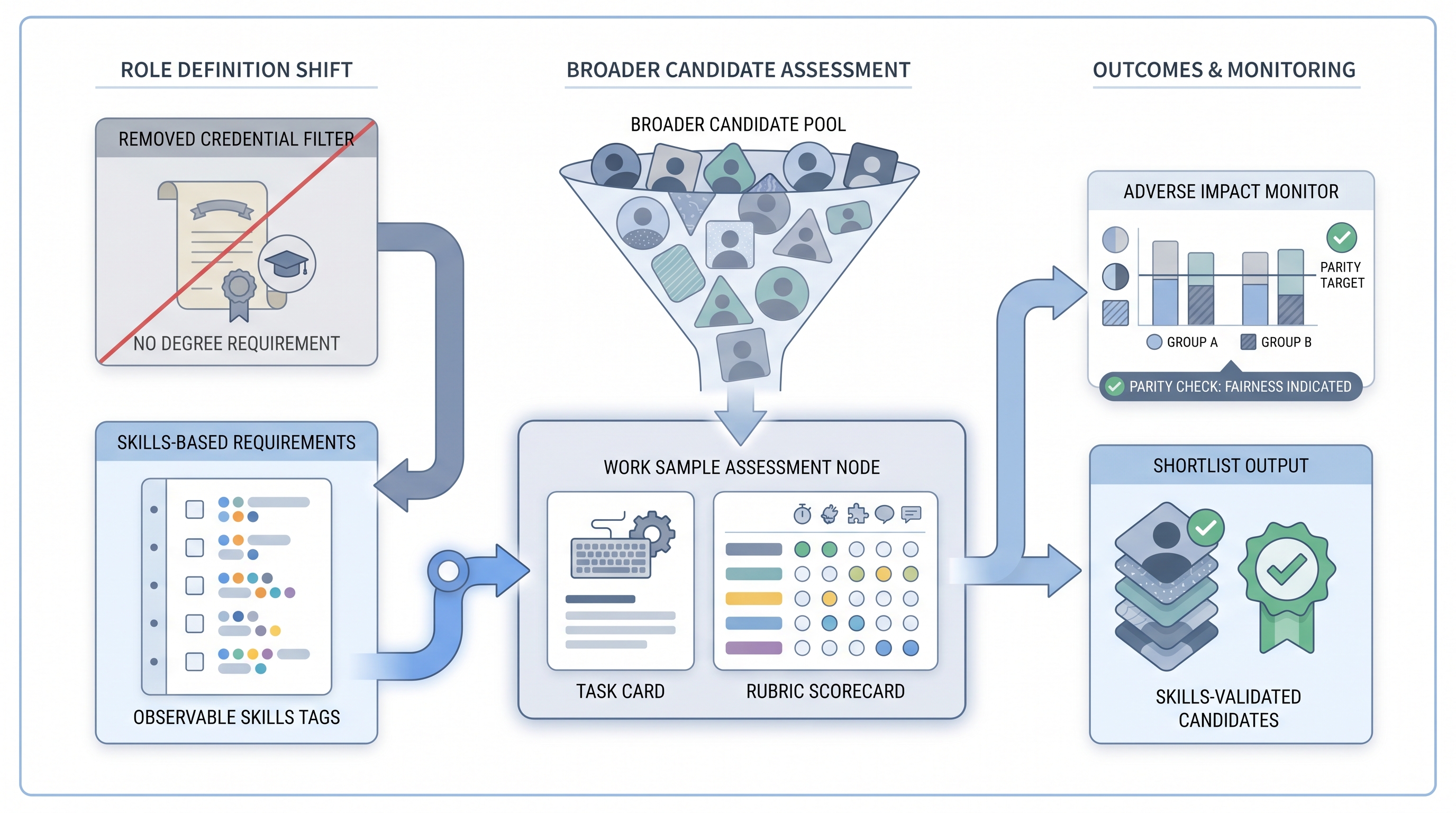
Skills-based hiring evaluates candidates on what they can demonstrably do rather than on credentials, titles, or years of experience used as proxies for capability. The recruiter and hiring manager define the specific skills the role requires, build assessments that measure those skills directly, and use that evidence to make the hiring decision.
In practice
- A software company removes the degree requirement from all engineering roles and replaces it with a two-stage technical screen: a take-home exercise followed by a live code review. Pass rates improve for candidates without traditional CS backgrounds.
- A high-volume contact centre operation moves from resume screening to a 15-minute async skills assessment. Hire quality improves and average time-to-screen drops because the assessment measures the skills the role actually needs rather than qualifications that predict those skills indirectly.
- A TA leader who says "we are going skills-first" means the team is moving away from filtering resumes by degree or company name tier, shifting evaluation to demonstrated capability earlier in the process.
Quick read, then how hiring teams use it
This is for recruiters, TA leaders, and hiring managers who want to broaden candidate pools and improve hire quality by evaluating what candidates can do rather than what they have studied or where they worked. Skim the first section for a shared definition. Use the second when designing or auditing a skills-based screening process.
Plain-language summary
- What it means for you: You evaluate what the candidate can do, not what their resume says they have done. Assessments replace credential filters at the screening stage.
- How you would use it: Define the five most important skills for the role. Build a short assessment that measures them directly. Remove credential filters that are proxies for skills you can now measure.
- How to get started: Pick one role where inbound quality is low despite good applicant volume. List the actual skills the job requires. Ask the hiring manager if a candidate without a degree who demonstrated all those skills could do the job. If yes, trial a skills-based screen for that role.
- When it is a good time: Roles where the talent pool is too narrow because credential screens are excluding qualified candidates. High-volume roles where screening efficiency is a priority.
When you are running live reqs and tools
- What it means for you: Skills-based hiring requires structured assessment data, not just resume text. AI tools for semantic search and matching work better when skills are explicitly defined in the req brief and candidates have been evaluated against those skills in a structured format.
- When it is a good time: When your ATS can store structured skills assessment data per candidate. When you have defined evaluation rubrics for each skill. When hiring managers are trained to evaluate skills evidence rather than credentials.
- How to use it: Build skills definitions into the requisition intake process. Map assessment types to each skill. Use structured output from assessments to populate candidate records in the ATS so skills data is searchable and reusable. Run adverse impact analysis on pass rates by group before deploying at scale.
- How to get started: Pilot on one role type. Document the skills list, assessment design, and rubric before running any candidates through it. Run at least 30 candidates through the pilot before drawing conclusions about the assessment's validity.
- What to watch for: Skills definitions that drift across hiring managers. Work samples that advantage candidates with more preparation access. AI skills inference from resumes reproducing credential-based patterns. Pass rates that show demographic skew despite removing explicit credential screens.
Where we talk about this
On AI with Michal sessions, skills-based hiring comes up in the AI in recruiting track when discussing how structured output from assessments feeds ATS pipeline data, and how semantic search tools surface candidates who have relevant skills but non-standard titles. See AI Sourcing Lab for the next live session.
Around the web (opinions and rabbit holes)
Third-party creators move fast. Treat these as starting points, not endorsements.
YouTube
- Search "skills-based hiring" on YouTube for practitioner perspectives; LinkedIn Talent Solutions and assessment vendors publish content on the shift from credential-based to skills-based evaluation.
- Grads of Life and Lightcast (formerly Burning Glass) have conference recordings on skills-based hiring adoption across industries worth reviewing for practitioner data.
- r/recruiting includes honest threads on skills-based hiring implementation challenges and where the approach works versus fails.
- r/humanresources has discussion on assessment design and bias risks in skills-based screening that covers the practical compliance angle.
Quora
- What is skills-based hiring and does it work? collects practitioner perspectives worth reading alongside the research on assessment validity.
Credential-based versus skills-based screening
| Screen type | Proxy or direct | Bias risk | Candidate pool |
|---|---|---|---|
| Degree requirement | Proxy | High | Narrow |
| Job title tier | Proxy | High | Narrow |
| Work sample | Direct | Lower | Broader |
| Structured skills interview | Direct | Lower with rubric | Broader |
Related on this site
- Glossary: Scorecard, Adverse impact, Async screening, Semantic search, Structured output
- Blog: AI sourcing tools for recruiters
- Guides: Sourcers
- Live cohort: AI Recruiting Accelerator
- Membership: Become a member