Talent acquisition budget
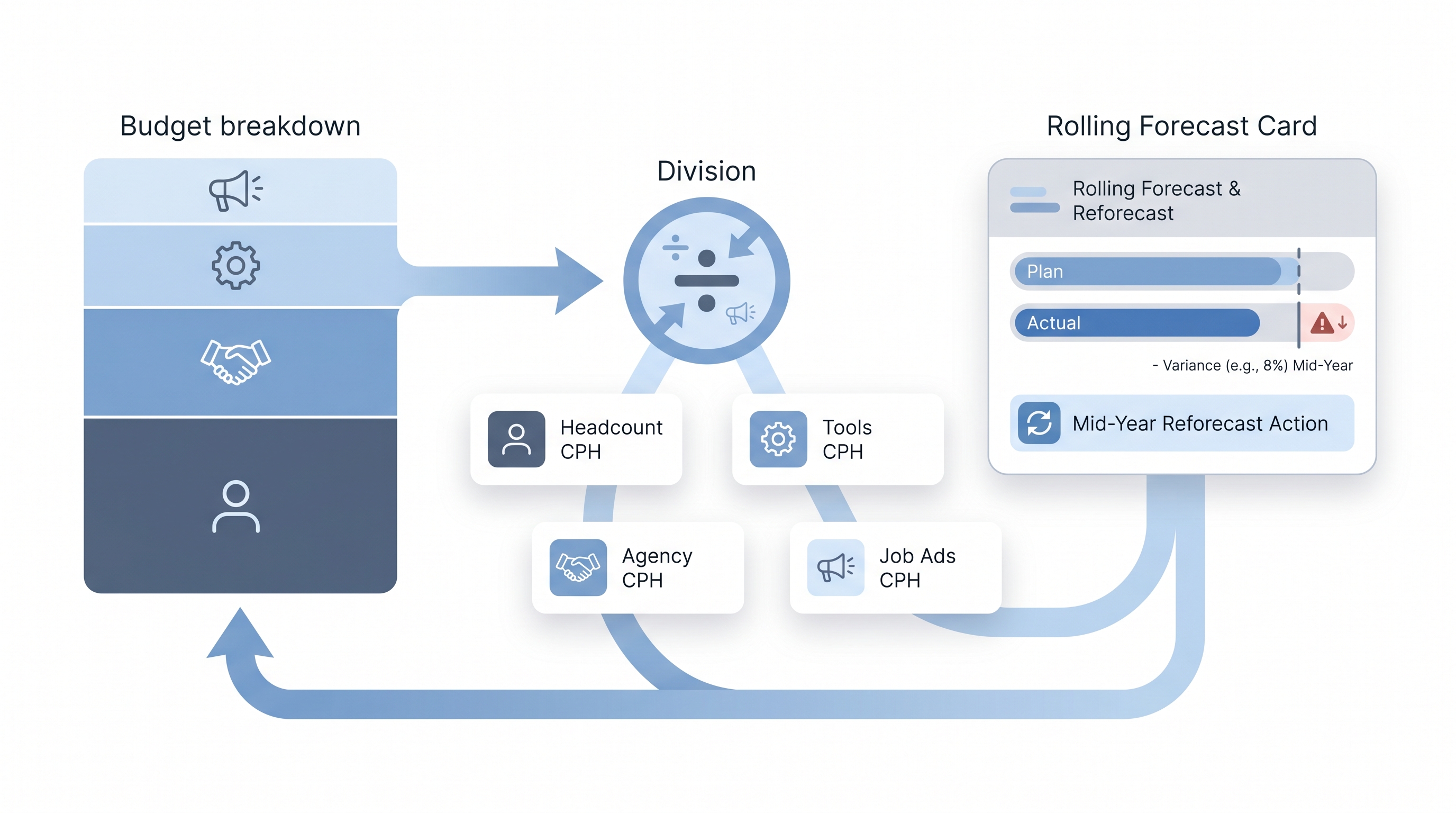
The annual allocation of spend across sourcing tools, job advertising, recruiter headcount, agency fees, assessment platforms, and recruiting operations that a TA function needs to hit its hiring plan. Well-built TA budgets connect every cost line to a per-hire outcome.
Michal Juhas · Last reviewed June 14, 2026
What is a talent acquisition budget?
A talent acquisition budget is the planned spend that enables a TA function to hire at the scale and speed the business needs. It covers everything from recruiter salaries to job board fees to agency costs to the software stack. The key difference between a good TA budget and a bad one is not the total number: it is whether every line ties to a per-hire outcome that leadership can interrogate and a TA leader can defend.
In practice
- A TA director presents the annual hiring plan to finance as two tables: hires by quarter and cost per hire by channel. The agency line is 30 percent of total spend in Q1 (new offices) and 12 percent in Q3 (lower-complexity backfills). Finance approves because the model is legible.
- A recruiting manager tracks TA spend monthly in a spreadsheet that pulls from the ATS (req status), the accounting system (invoices paid), and a manual log (tool subscriptions). When actual agency spend exceeds plan by 15 percent in February, he flags it immediately rather than discovering it at quarter end.
- A newly promoted head of talent realises she has no idea what a hire in her company actually costs. She spends two days pulling invoices, recruiter time logs, and ATS data. The blended number shocks her. She uses it as the baseline for her first budget presentation.
Quick read, then how hiring teams use it
This is for TA leaders, recruiting managers, and TA ops professionals who own or influence how recruiting spend is planned, tracked, and justified. Skim the first section for shared vocabulary. Use the second when you are building a budget model or preparing a mid-year reforecast.
Plain-language summary
- What it means for you: A TA budget that connects every cost to a per-hire outcome gives you the language to defend spend, reallocate toward what works, and ask for more when the hiring plan demands it.
- How you would use it: Start with a cost-per-hire calculation for each channel. Use that as the baseline for any investment or cut decision.
- How to get started: Pull the last 12 months of hiring data from your ATS. Assign costs to each hire from finance records. Calculate cost per hire by channel. You have a budget baseline.
- When it is a good time: Before the annual planning cycle, when a sourcing tool comes up for renewal, and immediately when agency spend deviates more than 15 percent from plan.
When you are running live reqs and tools
- What it means for you: At scale, TA budgets without automation become reconciliation nightmares. Wiring your ATS, finance system, and tool stack so spend data flows automatically is the difference between a live budget view and a quarterly fire drill.
- When it is a good time: During a technology stack review, when onboarding a new ATS or finance integration, and when headcount plans change mid-year and the budget needs to flex with them.
- How to use it: Connect requisition data from your ATS to a budget model that auto-calculates expected cost to close for each open req. Update actuals monthly from finance. Flag reqs above budget threshold for review. See workflow automation for the integration patterns.
- How to get started: Map your current TA spend categories to a standard taxonomy (headcount, tools, job ads, agency, assessments, background checks). Assign an owner for each category. Set up a monthly reconciliation meeting between TA and finance.
- What to watch for: Shadow TA spend in business unit budgets. Hiring managers who pay agency fees or LinkedIn licenses directly create blind spots in your budget model. Centralize visibility even if spend stays decentralized.
Where we talk about this
On AI with Michal sessions, TA budget planning comes up in the context of evaluating AI tools and proving ROI for sourcing investments. If you want to build a unit cost model for your own TA function and practice presenting it, start at the AI Sourcing Lab and bring your current hiring plan and spend data.
Around the web (opinions and rabbit holes)
Third-party creators move fast. Treat these as starting points, not endorsements, and double-check anything before wiring candidate data.
YouTube
- How to Build a Recruiting Budget (LinkedIn Talent Solutions) covers the foundational model for connecting headcount plans to TA spend.
- Cost Per Hire: How to Calculate and Benchmark It (SHRM) walks through the SHRM-defined methodology for the most widely used TA budget metric.
- How do you build a TA budget from scratch? in r/recruiting is a candid thread from practitioners who inherited no baseline and had to build one.
- Justifying TA headcount to leadership in r/humanresources covers the unit economics framing that works best with skeptical finance teams.
Quora
- What is a typical talent acquisition budget as a percentage of revenue? collects benchmarks and framing from TA leaders at companies of different sizes.
TA budget cost categories
| Category | Typical share of total budget | Notes |
|---|---|---|
| Recruiter and coordinator headcount | 40 to 60% | Fully loaded including benefits |
| Agency fees | 5 to 30% | Higher when direct sourcing is limited |
| Sourcing and ATS software | 5 to 15% | Scales with tech stack maturity |
| Job advertising and programmatic | 5 to 15% | Often first cut in downturns |
| Assessments and background checks | 2 to 8% | Per-hire cost; scales with volume |
| Referral bonuses and TA ops | 2 to 5% | Often undertracked |
Related on this site
- Glossary: Talent acquisition metrics, Sourcing ROI, Time to fill, Headcount planning, LLM spend management for recruiting
- Blog: AI sourcing tools for recruiters
- Live cohort: AI Recruiting Accelerator
- Course: Starting with AI: the foundations in recruiting
- Membership: Become a member