Time to hire
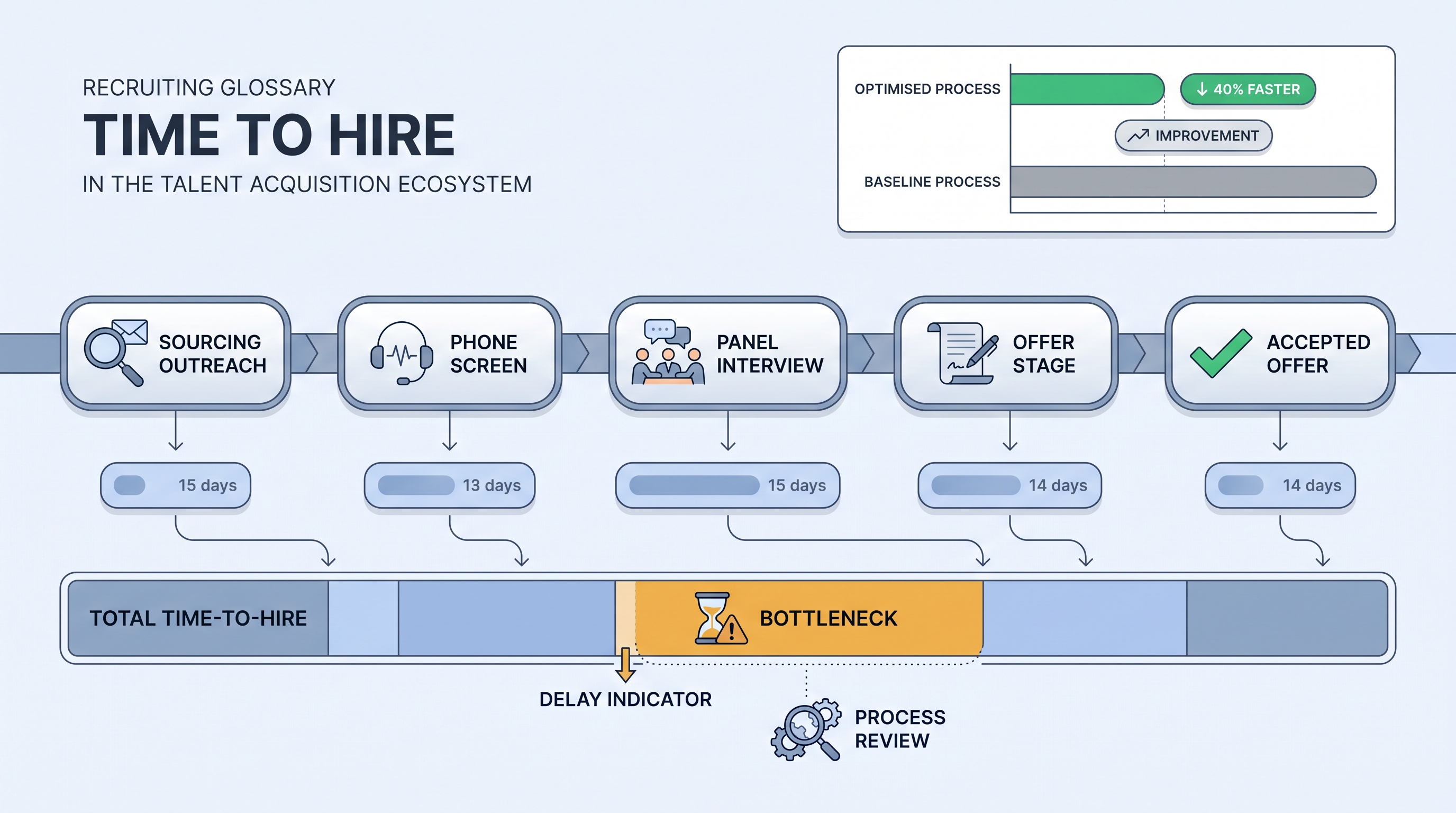
The number of calendar days between a candidate entering the active hiring process and accepting an offer, measuring the speed and efficiency of the candidate-facing pipeline from first engagement to close.
Michal Juhas · Last reviewed June 22, 2026
What is time to hire?
Time to hire is the number of calendar days from when a candidate enters your active hiring process to when they accept an offer. It measures how fast and efficiently you move a specific candidate through the pipeline once you have found them. This is distinct from time to fill, which measures from req open to offer acceptance and includes the sourcing phase. Time to hire is the candidate-facing speed of your process, and it is the metric that tells you whether your interview stages, scheduling, and offer approval chain are fast enough to avoid losing candidates to competing offers.
In practice
- A recruiter tracks her team's median time to hire for engineering roles at 23 days. After implementing an automated scheduling tool and removing a redundant interview round, she brings it to 16 days over one quarter. Offer decline rate drops from 18% to 11%.
- A TA lead presents time-to-hire data to a hiring manager who asks why a strong candidate accepted a competing offer. The pipeline report shows the candidate was held at the final-round feedback stage for nine days before the debrief call was scheduled.
- A sourcer says "our time to hire is fine, it's time to fill that's killing us" to distinguish between a sourcing problem (hard to find candidates) and a pipeline speed problem (slow to move them through once found).
Quick read, then how hiring teams use it
This is for recruiters, sourcers, TA, and HR partners who need the same vocabulary in debriefs, vendor calls, and policy reviews. Skim the first section when you need a fast shared picture. Use the second when you are deciding how it shows up in the ATS, sourcing tools, or candidate communications.
Plain-language summary
- What it means for you: Time to hire tells you how fast you move a candidate once you have them in your process. If you are losing people to other offers, this is the metric to look at first.
- How you would use it: Pull a monthly report from your ATS showing median calendar days from first contact to accepted offer, segmented by job family. Look for the stages where candidates sit the longest without a next action.
- How to get started: Define your start event (first outreach sent, or application date) and end event (offer acceptance signed) consistently in your ATS. Without a consistent definition, your data will be unreliable.
- When it is a good time: Review time to hire after every quarter and after any offer decline. Make it a standing item in TA ops reviews alongside pipeline coverage and offer acceptance rate.
When you are running live reqs and tools
- What it means for you: Time to hire is a process efficiency metric with direct cost implications: every extra day a role is open has a productivity cost, and every day a candidate waits increases the probability they accept elsewhere.
- When it is a good time: Report it continuously, not only when something goes wrong. Trends over time are more useful than point-in-time snapshots.
- How to use it: Set stage-level SLA targets in your ATS: for example, interviewer feedback submitted within 24 hours of a call, offer approval completed within 48 hours of verbal acceptance. Automate reminders at each SLA breach point. Use workflow automation to trigger the next step the moment a stage is marked complete.
- How to get started: Map your full process including every approval step from first contact to signed offer. Time each stage in your next three hires manually before relying on ATS timestamps, which are often set inconsistently.
- What to watch for: Offer approval delays are the most common hidden bottleneck. Map the approval chain before blaming the recruiter or hiring manager for slow time to hire. Also watch for the definition drift: if different recruiters start the clock at different events, your aggregate metric is meaningless.
Where we talk about this
On AI with Michal live sessions, time to hire and hiring funnel velocity come up in the AI in recruiting track when we map where automation reduces delay and where process redesign is needed. We look at stage-level SLA reporting, automated reminders, and how to present time-to-hire data to hiring managers constructively. Start at AI Recruiting Accelerator or join membership for TA ops office hours.
Around the web (opinions and rabbit holes)
Third-party creators move fast. Treat these as starting points, not endorsements, and double-check anything before you wire candidate data.
YouTube
- Search "time to hire recruiting metrics" on YouTube for practitioner explanations of how to set up ATS reporting and present the metric to business stakeholders.
- LinkedIn Talent Solutions publishes annual Talent Trends reports with time-to-hire benchmarks by industry that are useful for setting initial targets before you have your own baseline.
- r/recruiting has threads on hiring funnel metrics including candid discussions of what actually moves time to hire and what does not.
- r/humanresources covers time-to-hire from the HR operations side, including how it is reported to finance and business leaders.
Quora
- What is the difference between time to hire and time to fill? collects clear explanations from recruiters and HR professionals on the distinction between these two metrics.
Time to hire versus related metrics
| Metric | Start event | End event | What it measures |
|---|---|---|---|
| Time to hire | Candidate enters pipeline | Offer accepted | Pipeline speed (candidate-facing) |
| Time to fill | Req opens | Offer accepted | Full recruiting cycle including sourcing |
| Time to start | Req opens | First day of work | Complete lag including notice period |
Related on this site
- Glossary: talent acquisition metrics, time to fill, quality of hire
- Glossary: workflow automation, conversational scheduling, structured output
- Glossary: hiring funnel conversion rates, talent pipeline
- Live cohort: AI Sourcing Lab
- Membership: Become a member