AI for Recruiters
Built around the AI adoption ladder: where full-cycle recruiters sit today (Offline through AI-Native), example climbs, tactics, and links to the ladder page plus glossary.

If this is your job
You own reqs end to end: intake, sourcing support, hiring managers who change their minds, candidates who ghost, and the quiet expectation that you will move faster every quarter. Nobody handed you extra hours. AI did not fix that.
Your buyers are not "AI curious." They want less rework, clearer intake, respectful candidate experience, and process they can defend when Finance, Legal, or a candidate asks what happened. Every recruiter is somewhere on the AI adoption ladder already: ad-hoc chat at two in the morning is not the same as a shared pod playbook. This page starts from that ladder (see the cornerstone section below), then goes deep on tactics so you climb one rung at a time without breaking trust.
How to think about AI in full-cycle recruiting
These habits sit on top of your ladder rung: even at Chatting, separate drafting from deciding; at Systemizing, templates beat hero prompts. The cornerstone section names rungs; these bullets apply at every stage.
Separate drafting from deciding. Models are strong at turning messy inputs into structured drafts: intake briefs, outreach variants, debrief notes, hiring-manager summaries. They are weak at owning tradeoffs that affect careers. Keep pass or proceed with humans who can cite evidence and policy.
Prefer shared templates over hero prompts. The winning setup is rarely "the best model." It is one prompt library your pod can find, with owners who refresh it when intake patterns drift or tools change.
Measure recruiter-controlled outcomes before you claim hiring magic. Time-to-first-qualified screen, slate quality rated by hiring managers, reply quality on outbound. If volume spikes but conversion drops, you usually have an intake or relevance problem, not a model problem.
Treat candidate and employee data as classified by default. If your security team has not approved a tool for the data class you hold, do not paste it there. That single habit prevents more incidents than any policy PDF.
Where the pressure actually shows up
Intake that never stabilizes. You get a Slack thread, a borrowed JD from three years ago, and a panel that disagrees about seniority. You are expected to source while the definition of "good" is still moving.
Stakeholder asymmetry. Hiring managers scan slates between meetings. Finance or People asks for reporting you do not have at your fingertips. Candidates compare your process to the last company that moved in forty-eight hours. Concrete annoyances: your HM replies "looks fine" to eight profiles with no shared definition of fine; finance asks for time-to-offer by business unit and you are still tracking in a spreadsheet; a candidate emails "any update?" and you have no status field to point to.
Consistency under load. When everyone runs their own prompts in personal chat accounts, you get five versions of the intake brief, uneven outreach tone, and no audit trail when Legal or People asks what happened.
Fair process under scrutiny. Screening assist, notes in the ATS, and anything that smells like automated ranking draw questions. You need speed that still looks defensible on paper.
Agency overflow. You become the human router for every ambiguous answer: comp, location policy, level. AI can reduce repeat typing only after you know what you are allowed to say.
Where you are on the AI adoption ladder (cornerstone)
Start here. You are not "bad at AI" if you still draft in a blank chat window. You are on a rung of the ladder everyone climbs: Offline → Chatting → Systemizing → Automating → AI-Native. Recruiting just adds fair process and data rules on every step. Name where you are today, then plan the next rung, not the roof.
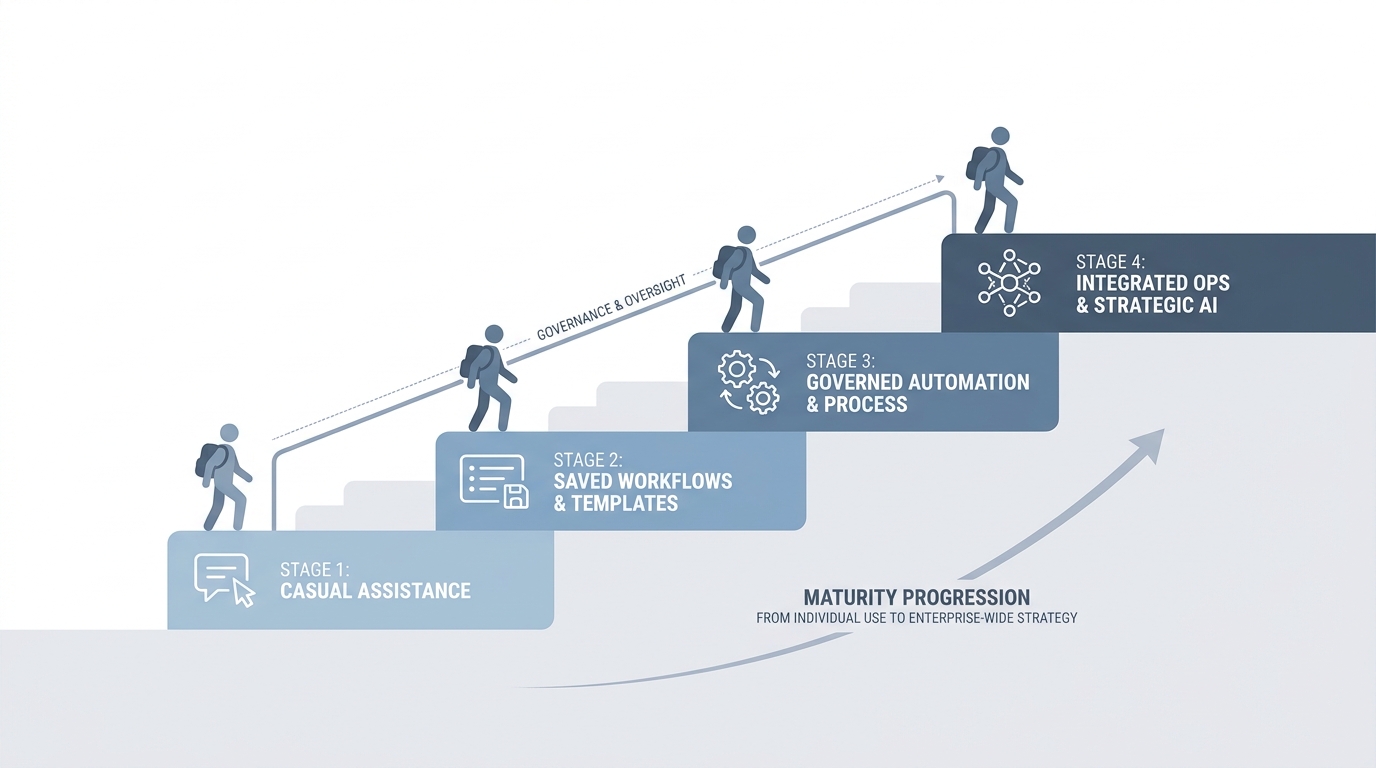
Explore the stages interactively on the AI adoption ladder page. For risks, FAQs, and how this ties to automation, read the AI adoption ladder glossary entry.
Signals recruiters often recognize
- Offline / early Chatting: New chat for every task; JD context retyped from memory; no shared brief.
- Chatting: You have hacks that work, but they live in private tabs and die when you are on PTO.
- Systemizing: Shared intake template, outreach shells, debrief prompts, owners, and refresh dates your pod can actually find.
- Automating: Repeatable handoffs only after prompts stopped changing weekly: Slack or ATS nudges, scheduled reminders, draft packets queued for human send (still no silent auto-advance without policy cover).
- AI-Native: Structured intake in your ATS or wiki is the single source of truth; HM packets and sourcing maps pull from the same fields; humans still own advance or pass.
Example climbs (pick what matches your week)
- Chatting → Systemizing (this sprint): Paste scorecard rows once into a Custom GPT or shared system prompt; stop re-explaining level every time you draft outreach. Success metric: time from "open tool" to "first usable outbound" drops on five tracked reqs.
- Systemizing → Automating (next quarter): One automation only: e.g. when stage hits onsite, post the panel brief checklist to Slack from a template. No candidate-facing auto-decisions until Legal signs off.
- Toward AI-Native (multi-quarter): One role family where intake fields must be filled before sourcing spends credits; HM brief exports from those fields so nobody maintains three truths.
If you are unsure which rung fits, walk the visuals on AI adoption ladder and compare the "You are here if" lines to how you worked yesterday.
High-leverage use cases (with examples)
Turning noise into a working brief. Paste stakeholder bullets, old JD text, and call notes into a structured template: outcomes for the first ninety days, real constraints, anti-patterns, and what is negotiable. You still run the meeting that locks the brief; AI shortens the path to a shared artifact.
Example: You inherit "senior backend engineer, Kubernetes, nice culture." Ask the model to output a one-page brief with must-have outcomes, explicit non-goals, level calibration anchors, and five screening signals sourced from your scorecard. Take that doc into a fifteen-minute sync with the hiring manager. The win is not the PDF. It is one shared definition before sourcing burns a week.
Outbound and nurture shells. First-pass outreach, follow-ups after events, and polite pass messages that stay respectful. Models are fine at variants when you inject one verified proof point (product, talk, paper) per candidate.
Example: After a conference, you have forty leads and three tone guidelines from brand. Generate three subject-line families and two body templates, then manually insert one real detail per person from your notes. The model saves structure; you prevent mail-merge smell.
Candidate packets for hiring managers. Summaries tied to your scorecard rubric, not generic superlatives. Strong teams ask the model to organize evidence from notes and structured ATS fields, then recruiters edit tone and remove anything that overclaims.
Example: For each shortlisted profile, a tight section on "why advance," "what to verify in screen," and "risks," each bullet tied to a field or note. Hiring managers stop confusing "strong resume" with "solves our problem."
Debrief discipline. After every screen, paste the same three questions into your notes (or your pod's template) and answer in two lines each. Use this exact triad with the model as a blank form, not as a judge:
- Signal: what evidence did we get that maps to the scorecard row (quote or paraphrase the candidate, not vibes)?
- Risk: what are we still uncertain about, and which interview round would clear it?
- Next experiment: one specific follow-up (e.g. "deep dive on their last migration" or "reference from prior manager on conflict").
Tomorrow: add those three headings to your ATS note template for one active req and force yourself to fill them before you mark the stage complete.
Internal translation. You paste the same three facts: band min and max, how many submittals this week, one market note. Then ask for three versions: (a) exec: five bullets, no names, focus on risk to roadmap; (b) hiring manager: one paragraph, names OK, focus on "here is who to interview next and why"; (c) finance or People: table-friendly, focus on stage counts and blockers. You still send from your email; the model only cuts rewrite time.
Offer and process communications. Draft the candidate email that says who signs the offer, when background checks run, and what happens if they need visa support. Example skeleton you can paste into your assistant: role title, start date target, office or remote rule, who is their main contact for logistics, link to your FAQ. Strip anything your Legal team has not approved; never invent benefits.
Employer brand snippets. Take one true fact (e.g. "we shipped feature Z last quarter" or "team is twelve engineers in two cities") and ask for three lengths: LinkedIn post (~150 words), careers page blurb (~50 words), outreach sentence (~25 words). Run a quick check: every number matches your press kit or careers site.
What we often see high-performing teams do
They run weekly thirty-minute prompt hygiene: one person shares a redacted before and after from last week, the pod agrees what becomes the new default, and the old draft gets archived. Example agenda minute one to ten: "Here is our old intake prompt; here is the slate quality before. Here is one changed paragraph in the prompt; here is the slate after." Minute ten to twenty: vote on whether the new block becomes v3 in the shared library. Momentum beats sophistication.
They pair recruiters on intake for painful reqs so one person interviews the hiring manager while another drafts the brief in parallel from the same notes. You cut calendar thrash. Try it tomorrow on one messy req: Zoom with HM on speakerphone, shared doc open, one person asks questions while the other types the brief live; AI cleans up bullets after the call.
They ban mystery screening. If a tool scores or ranks, they can explain what signal it uses and where humans override. If they cannot explain it, they do not ship it. Litmus test: "If Legal asks why candidate A advanced and B did not, what sentence do we write?" No sentence, no tool.
They A/B test outreach in small batches: same pool, two subject lines, measure replies that turn into qualified conversations, not raw opens. Concrete split: twenty prospects, subject A "your talk at DevConf," subject B "your post on event sourcing," same body after line two. Track how many enter phone screens, not how many open the InMail.
What tends not to work
Ranking candidates purely on AI summaries of resumes without structured criteria and human review where your policy or law expects it. You may save hours and buy an audit you cannot answer.
Letting hiring managers treat chat output as fact. If the packet says "likely led migration," the hiring manager still verifies in interview. Models inflate verbs when the ATS row was thin.
Tool shopping without a workflow owner. A new license every quarter, zero prompt library, zero metrics. The team feels busy and stays fragmented.
Unbounded paste culture. Resumes and investigation-grade notes in consumer chat. Even when nothing leaks externally, you may violate retention and vendor rules.
A simple rollout shape (no hype)
Week one: pick one recurring pain (intake, outbound, or packets) and ship one shared template in an approved workspace. Name the file with version v1 and link it from your team wiki so nobody asks "which prompt is current?"
Weeks two to three: measure time saved on that task and quality (HM rating or error rate). Example metrics card: before median twenty minutes per intake brief, after nine minutes; hiring manager "brief usefulness" score one to five from three random reqs.
Adjust the template. Do not add a second workflow until the first is actually used (at least five people ran it without you nagging).
Week four: teach one teardown in a live meeting using redacted examples. Script: "Here is anonymized brief A that produced bad slates; here is one paragraph we changed; here is brief B outcomes." Adoption follows demonstration.
You can go faster with leadership air cover; you cannot skip the habit layer.
Where teams get hurt
Models invent employers, dates, and credentials when your paste is thin. Compensation, visa status, and assessment scores belong in verified fields from your ATS and policy owners, not in a chat summary you forward as truth.
When automated ranking or keyword scoring touches pass or proceed decisions in your jurisdiction, keep structured human review and documentation. That is how you stay fair and explainable.
Speed without structure creates fragile trust: hiring managers skim AI summaries as if they were facts, candidates get outreach that sounds mail-merged, and your team redoes the same drafts because nobody shares the winning prompt pack.
Vocabulary and deeper reading
Revisit the cornerstone AI adoption ladder section if you are deciding what to read first: it lines up with the terms below.
For serious TA conversations, see human in the loop and hallucination. Start with how to use AI in recruiting and ChatGPT prompts for recruiters.
Deep dives live on the blog. Stack-specific notes sit in the tools directory: ChatGPT, LinkedIn Recruiter, and Greenhouse. Boolean search and semantic search help when you explain sourcing tradeoffs.
Free PDFs on the resources page include the recruiting prompts guide and a prompting mastery guide you can hand to new hires without another slide deck.
Courses, live sessions, and consulting on AI with Michal
Courses (async foundations). If you need a structured baseline before you change team habits, Starting with AI builds practical workflows and judgment around everyday tools. If recruiting-specific muscle is the gap, First Principles Sourcing treats sourcing discipline as the multiplier behind any model. Claude for Recruiters and Better Prompts for Recruiters help when your stack tilts toward those workflows.
Live public sessions. When you want accountability and live Q&A, see upcoming sessions on Sourcing Lab. Good fit if you are ready to implement in real reqs within days, not months.
Team and company formats. If your whole pod or TA org needs the same language and shared templates, AI sessions for teams is the starting point for private delivery.
1-on-1 consulting and mentoring. For rolling out AI across recruiting without governance theater, read Recruiting AI Workflow Advisory. For ongoing individual guidance as you implement, see Individual AI Implementation Mentoring. Broader leadership framing lives under Using AI in Your Business. The full menu is on consulting.
If you are unsure which path fits, contact with context on team size, stack, and constraints is usually the fastest way to route.
Membership. For ongoing material and community after you finish a course or session, membership keeps you in the loop as playbooks update.
FAQ
- What is the smallest first step to implement AI in my recruiting week?
Pick one repeatable task only: intake brief, outbound shell, or candidate packet notes. Run your next ten reps through one saved prompt or Custom GPT with scorecard context pasted once. Measure minutes saved before you add a second workflow. That maps directly to moving from Chatting to Systemizing on the AI adoption ladder.
- Which tools should recruiters use first?
Start with whatever your employer already approves for candidate data (often enterprise ChatGPT or similar), plus your ATS notes fields. Add LinkedIn or sourcing stack tools you already pay for before buying net-new bots. The tooling matters less than shared templates your pod can find.
- Should recruiters let AI score or rank candidates automatically?
Use AI to summarize and structure evidence you already have, not to replace structured human review when pass or proceed decisions must be fair and explainable. Many teams start with AI-assisted packets and keep decisions with recruiters and hiring managers who can cite specific evidence.
- What should we avoid in the first ninety days?
Avoid silent ranking, mystery scoring vendors without Legal review, pasting full resumes into consumer chat, and rolling out three disconnected pilots at once. Avoid promising hiring lift before intake and prompts stabilize.
- How do I spot nonsense or hallucinations before candidates see it?
Every bullet needs a source: ATS field, resume quote, or verified URL. If the model fills gaps when data is thin, you get confident fiction. Read drafts out loud and ask: could I defend this line in front of Legal or the candidate?
- What is the fastest way to get value without chaos?
Ship one shared intake and scorecard prompt for your pod, measure time-to-first-qualified-screen for two sprints, then iterate. Tool shopping without templates usually wastes more time than it saves.
- When does it make sense to hire an external consultant?
Bring someone in when shadow AI is widespread but no approved path beats it, when Legal needs a sequenced pilot narrative, or when your pod cannot agree on one workflow to standardize. At AI with Michal, recruiting-focused advisory includes roadmap work and hands-on workshops; Email hello@aiwithmichal.com with team size, stack, and constraints, or explore the consulting overview and recruiting AI workflow advisory.
- Where can I learn the foundations alongside the job?
Public workshops are listed on live workshops. Async courses include Starting with AI and First Principles Sourcing. Teams often pair reading this guide with those formats before expanding automation.
Skill bundles that pair with this role
Packaged skills and integration paths in the store help you move from one-off prompts to repeatable workflows. Browse bundles below or explore the full skill bundles catalog.
No matching bundles in the catalog from this device. Open the store or skill bundles to see what is available.
For teams
Private workshops and implementation support for rolling out AI responsibly across TA and HR.
AI workshops for teamsTeaching notes based on workshop delivery and recruiting practice. Tools and regulations change; verify current employer policies and vendor terms before production use.