AI-enabled recruitment
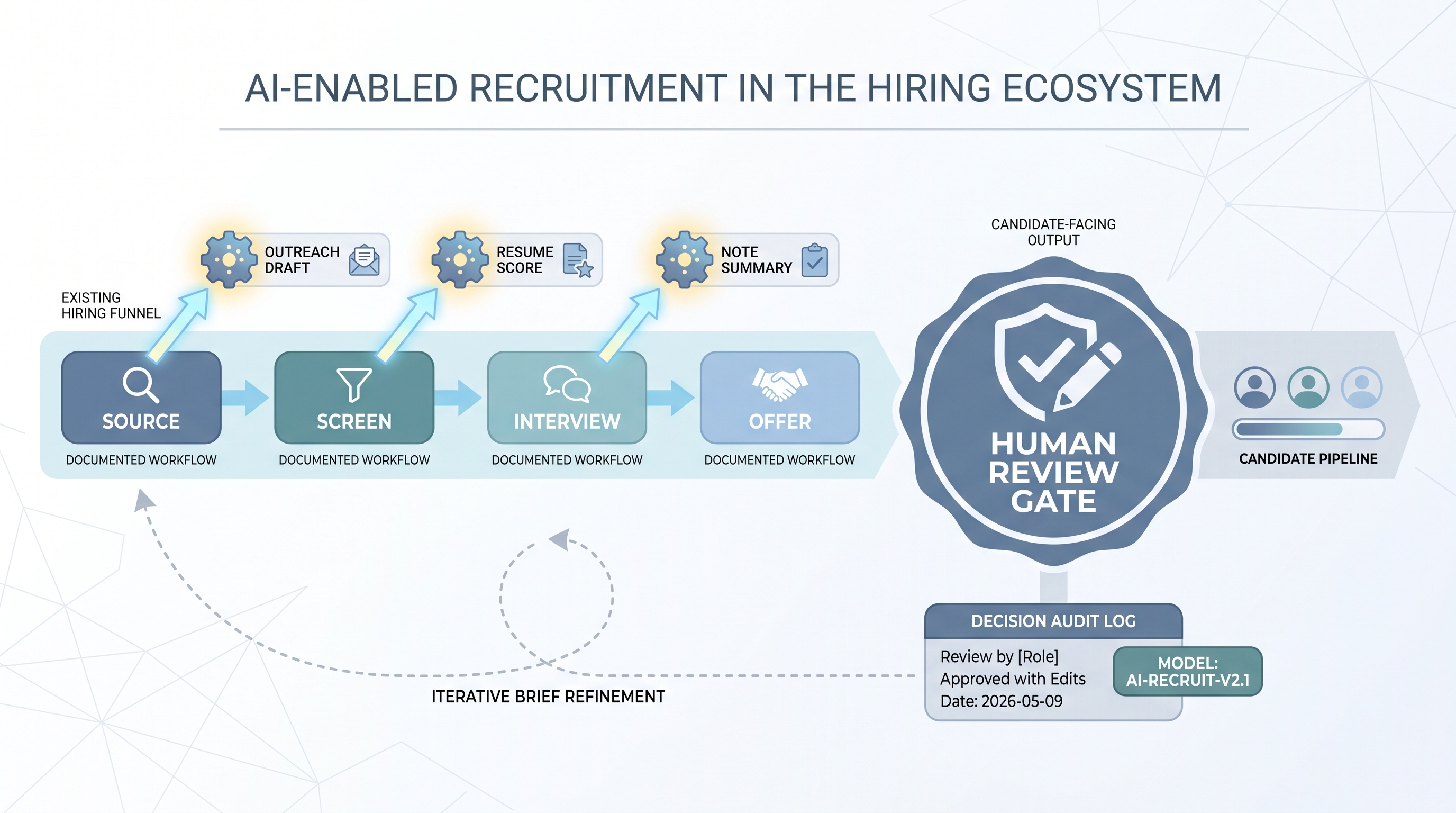
Augmenting an existing recruitment process with AI tools at specific steps (outreach drafting, resume triage, interview summarisation) without redesigning the whole workflow from scratch.
Michal Juhas · Last reviewed May 9, 2026
What is AI-enabled recruitment?
AI-enabled recruitment is what most teams are actually doing when they say they are "using AI in hiring": they have added AI tools to specific steps of an existing process without rebuilding everything from the ground up. A sourcer uses a model to draft outreach from a candidate brief. A recruiter runs a resume batch through a scoring prompt before the human review pass. An interviewer pastes a transcript into an AI tool to get a draft of structured notes. Each step is faster and the output is higher-quality when the brief is clear. The process itself stays recognisable.
The difference from AI-native recruiting is intent and architecture. AI-native teams design their process around AI from the start: prompt libraries, shared system instructions, automation chains, and governance before a single workflow goes live. AI-enabled teams start where they are and add leverage at the bottlenecks. Neither is better in every situation. The right approach depends on team maturity, risk appetite, and how clearly the workflow was documented before AI entered it. If the workflow was not documented, the AI layer tends to surface that gap quickly.
The compliance obligation is the same in both cases. Documenting which tool ran, what version, on whose data, and who reviewed the output matters from the first use, not after scaling.
In practice
- A recruiter who says "I use ChatGPT to draft my outreach, but I always edit it before sending" is running AI-enabled recruitment: AI at the draft step, human at the send gate.
- A TA leader asking "how do we make sure the AI screener is not filtering out candidates we should have seen?" is hitting the adverse impact risk that comes up in every AI-enabled screening workflow audit.
- A team that bought an AI recruitment tool and six months later still uses it only for job description first drafts has not enabled AI across their process. They have used a single feature, which is still a win, but it is not the same as structured enablement across the funnel.
Quick read, then how hiring teams use it
This is for recruiters, sourcers, TA leads, and HR partners who need shared vocabulary when talking to hiring managers, compliance teams, or vendors about what "AI in our process" actually means. Skim the first section for a fast shared picture. Use the second when you are running live reqs.
Plain-language summary
- What it means for you: AI-enabled recruitment means specific steps in your existing hiring process are now handled faster or at higher quality by an AI tool, not that the whole process has been replaced.
- How you would use it: Pick a high-volume, low-stakes step (outreach drafts, resume triage, note summarisation) and run it in parallel with your current method for four weeks before switching over.
- How to get started: Document the current step on one page: what comes in, what a good output looks like, and who checks it. That document becomes your AI brief.
- When it is a good time: When you have enough volume that one step is taking disproportionate time, and when you can define "good output" clearly enough to review AI results consistently.
When you are running live reqs and tools
- What it means for you: Every AI-assisted decision in a live req needs a documented audit trail: which tool, which version, what brief it received, and who reviewed the output. That trail is what compliance and legal need if a candidate challenges a decision.
- When it is a good time: After you have baselined performance on the current process, validated that AI output quality holds on a sample set, and confirmed your data processing agreement with the tool vendor covers the candidate data you are running through it.
- How to use it: Pair AI drafting steps with a human-in-the-loop review gate before any candidate-facing action. Use prompt chains to separate the generation step from the review step so reviewers see the full context, not just the output. Keep workflow automation separate from AI generation until both are individually stable.
- How to get started: Run an AI bias audit after the first 200 AI-assisted decisions on any screening step to check for demographic skew before scaling volume.
- What to watch for: Prompt drift (the brief that worked in week one needs updating by week four as the req evolves), tool version changes that affect output quality without notice, and candidate data landing in AI tools outside your approved vendor list.
Where we talk about this
On AI with Michal live sessions AI-enabled recruitment is the starting frame for both tracks: AI in recruiting covers how to introduce AI at sourcing, screening, and outreach with the governance habits that let teams scale safely; sourcing automation covers the workflow wiring and monitoring that keeps AI-enabled steps running reliably after the first pilot. Bring your current process steps and the specific bottleneck you want to address. Start at Sourcing Lab.
Around the web (opinions and rabbit holes)
Third-party creators move fast on this topic. Treat these as starting points, not endorsements. Verify compliance postures and integration claims directly with vendors before deployment.
YouTube
- AI in recruiting: how to actually use it covers practitioner walkthroughs of live AI-enabled hiring setups, prompt design, and output review habits.
- AI tools for recruiters 2025 shows real-world test results for tools used in outreach, resume screening, and interview summarisation.
- Recruiting automation step by step demonstrates how to layer AI into existing recruiting workflows without rebuilding from scratch.
- What AI are you actually using in your recruiting workflow? in r/recruiting collects candid in-production reports from recruiters with real volume.
- Has anyone run into legal issues with AI screening? in r/recruiting surfaces honest risk stories and compliance questions from practitioners.
- AI recruitment tools honest review in r/recruiting separates tools that held up in production from those that looked good only in demos.
Quora
- How do companies implement AI in their recruitment process? collects practitioner explanations of what AI-enabled recruitment looks like across different team sizes and sectors.
AI-enabled vs related approaches
| Approach | What it changes | Who drives it | Governance baseline needed |
|---|---|---|---|
| AI-enabled recruitment | Specific steps in existing workflow | TA team, recruiter level | Process documentation, DPA, human review gate |
| AI-powered recruiting | Platform built with AI at core | Product and procurement | Vendor audit, ATS data agreement |
| AI-native recruiting | Process redesigned around AI | TA leader, with IT and legal | Prompt library, bias review cadence, change management |
| No AI | Status quo | Hiring manager | None specific |
Related on this site
- Glossary: AI-native, AI adoption ladder, Human-in-the-loop, Workflow automation, Prompt chain, AI bias audit, Adverse impact, AI for recruiters, AI in recruiting, AI-powered recruiting, Explainable AI hiring
- Blog: AI sourcing tools for recruiters
- Guides: Sourcers
- Live cohort: Sourcing Lab
- Courses: Starting with AI: the foundations in recruiting
- Membership: Become a member