AI resume ranker
A tool that parses incoming resumes, compares them to a role, and returns a ranked list or match score so recruiters can decide what to review first. It is the product form of AI candidate ranking, usually sold inside or bolted onto an applicant tracking system.
Michal Juhas · Last reviewed June 27, 2026
What is an AI resume ranker?
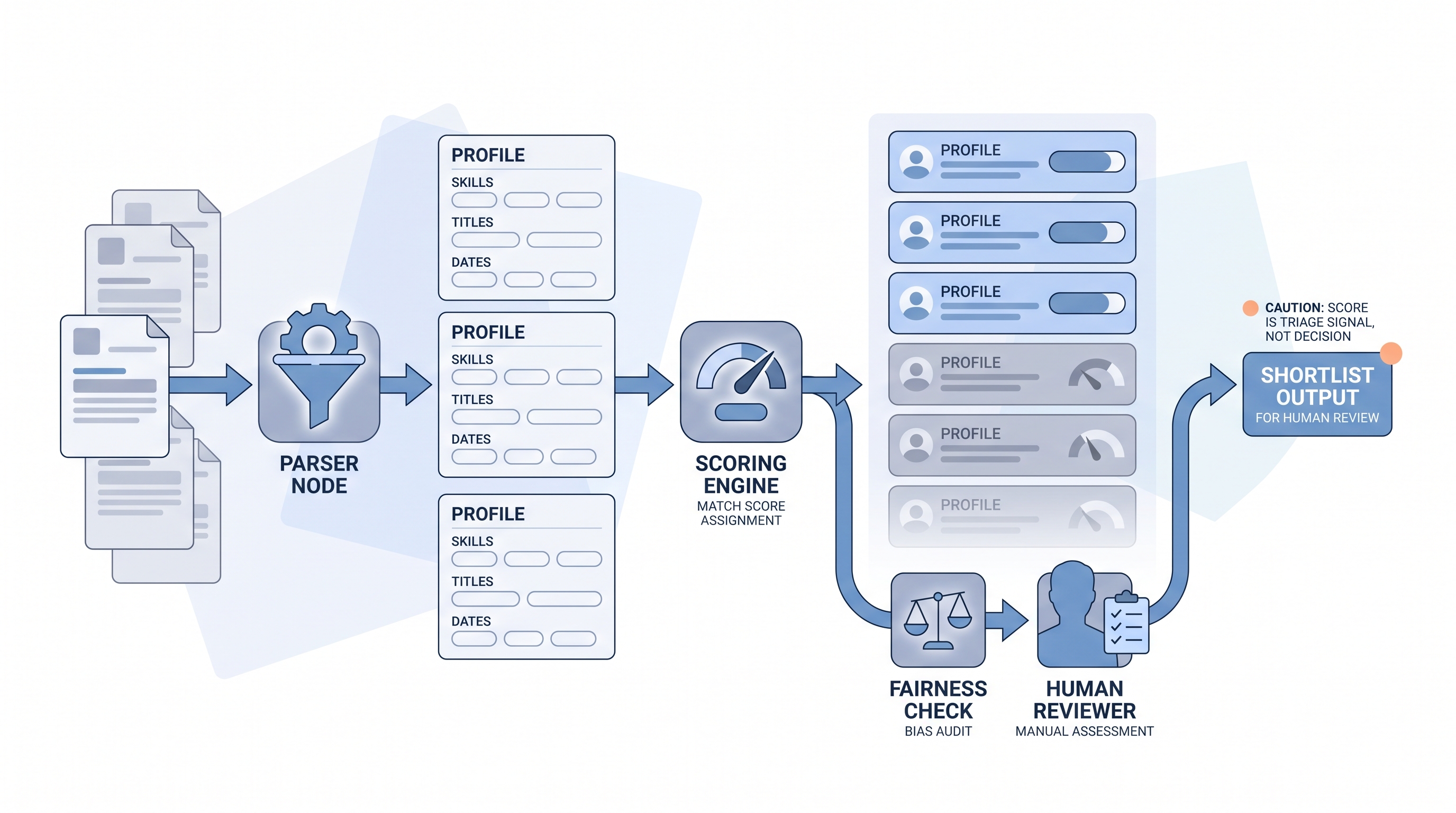
An AI resume ranker is a tool that parses incoming resumes, compares each one to a role, and returns a ranked list or a match score so recruiters can decide what to review first. It is the product form of AI candidate ranking, usually sold inside an applicant tracking system or as an add-on. It is built for high-volume hiring, where reading every application by hand is impossible. The score is a triage aid that reflects similarity to a target profile, not a verdict on who is qualified, and the quality of both the parsing and the job profile decides whether the ranking is useful or noise.
In practice
- A recruiter with 600 applicants opens the ranker's sorted view, reads the top 40 closely, samples lower-ranked profiles, and does not auto-reject anyone on score alone.
- In procurement, a TA leader asks a vendor not "how accurate is it" but "show me your parsing accuracy on image PDFs and your adverse-impact audit for roles like ours."
- During rollout, the team back-tests the ranker on a past req where they already know the finalists, then adjusts before trusting it on live pipelines.
Quick read, then how hiring teams use it
This is for recruiters, sourcers, TA, and HR partners who need the same vocabulary in vendor calls, procurement, and hiring manager debriefs. Skim the first section for a fast shared picture. Use the second when you are deciding how the tool fits your stack and compliance posture.
Plain-language summary
- What it means for you: An AI resume ranker scores and orders your applicant pool. It can save hours, but it depends entirely on clean parsing and a sharp job profile, and it inherits any bias in its training data.
- How you would use it: As a review-order aid inside your ATS. Read the top first, sample the bottom, and never auto-reject on score alone.
- How to get started: Back-test on 30 to 50 past applicants for a real role where you know the outcome. If the order disagrees with your judgment on known cases, do not trust it on new ones.
- When it is a good time: Genuinely high-volume roles. For low-volume or specialist hiring, careful human review usually beats a noisy score.
When you are running live reqs and tools
- What it means for you: The biggest risk is invisible: a ranker can systematically down-rank a protected group while looking efficient, which creates adverse impact liability the employer owns, not the vendor.
- When it is a good time: After you have the vendor's bias audit, your own threshold testing, a written no-auto-reject policy, and a human-in-the-loop review with a named owner.
- How to use it: Fix the inputs first. Confirm resume parsing accuracy on your messy real resumes, standardize job descriptions, and add a candidate data enrichment step so profiles are complete before scoring.
- How to get started: Set a threshold policy, log how scores shaped real decisions, and have recruiters spot-check rejected applicants weekly. Pair the ranker with structured interviews downstream for a consistent funnel.
- What to watch for: Hallucinated skills, parsing failures on non-standard formats, score drift after model updates, and the comfort of a clean dashboard that makes you stop questioning the number.
Where we talk about this
On AI with Michal live sessions, AI resume rankers come up in AI in recruiting tracks and vendor-evaluation discussions. We walk through how to back-test a tool on your own data, how to read a bias audit, and how to design a human review step that holds up with both hiring managers and compliance. Start with the main AI Sourcing Lab for the screening and procurement context, or join Sourcing Lab for the upstream sourcing side of the same pipeline.
Around the web (opinions and rabbit holes)
Third-party creators move fast. Treat these as starting points, not endorsements, and verify any process before you wire candidate data across tools.
YouTube
- Search "AI resume screening tools review" and "resume ranker bias" for recent walkthroughs. Favor uploads from the last year, since the compliance picture (NYC Local Law 144, EU AI Act) keeps shifting.
- Analyst and recruiter channels sometimes test rankers against deliberately tricky resumes; those teardowns are more useful than vendor demos on clean data.
- r/recruiting threads on resume rankers are honest about where the tools help and where recruiters override them. Search "resume ranker" or "AI screening" in the subreddit.
- r/jobs shows the candidate side, including how applicants try to game rankers, which is useful context for setting realistic expectations.
Quora
- Search "are AI resume rankers accurate" on Quora for answers from recruiters, candidates, and vendors, surfacing all three views on whether the score deserves trust.
AI resume ranker vs. ATS keyword search
| Dimension | ATS keyword search | AI resume ranker |
|---|---|---|
| Matching | Exact terms you type | Semantic similarity, many signals |
| Transparency | High | Lower, harder to explain |
| Output | Filtered list | Match score or ranked order |
| Main risk | Misses different phrasing | Hidden bias, over-trust |
| Best use | Hard non-negotiables | Ordering a pool for review |
Related on this site
- Glossary: AI candidate ranking, Resume parsing, Applicant tracking system (ATS), Adverse impact, Human-in-the-loop (HITL), Hallucination, Candidate data enrichment, Structured interview
- Blog: AI sourcing tools for recruiters
- Guides: Sourcers
- Live cohort: Sourcing Lab
- Course: Starting with AI: foundations in recruiting
- Membership: Become a member