AI candidate ranking
The use of machine learning or large language models to score and order applicants against a role, producing a ranked shortlist or a match score. It speeds triage of high-volume pipelines but carries real bias, validity, and compliance risk that a human must own.
Michal Juhas · Last reviewed June 27, 2026
What is AI candidate ranking?
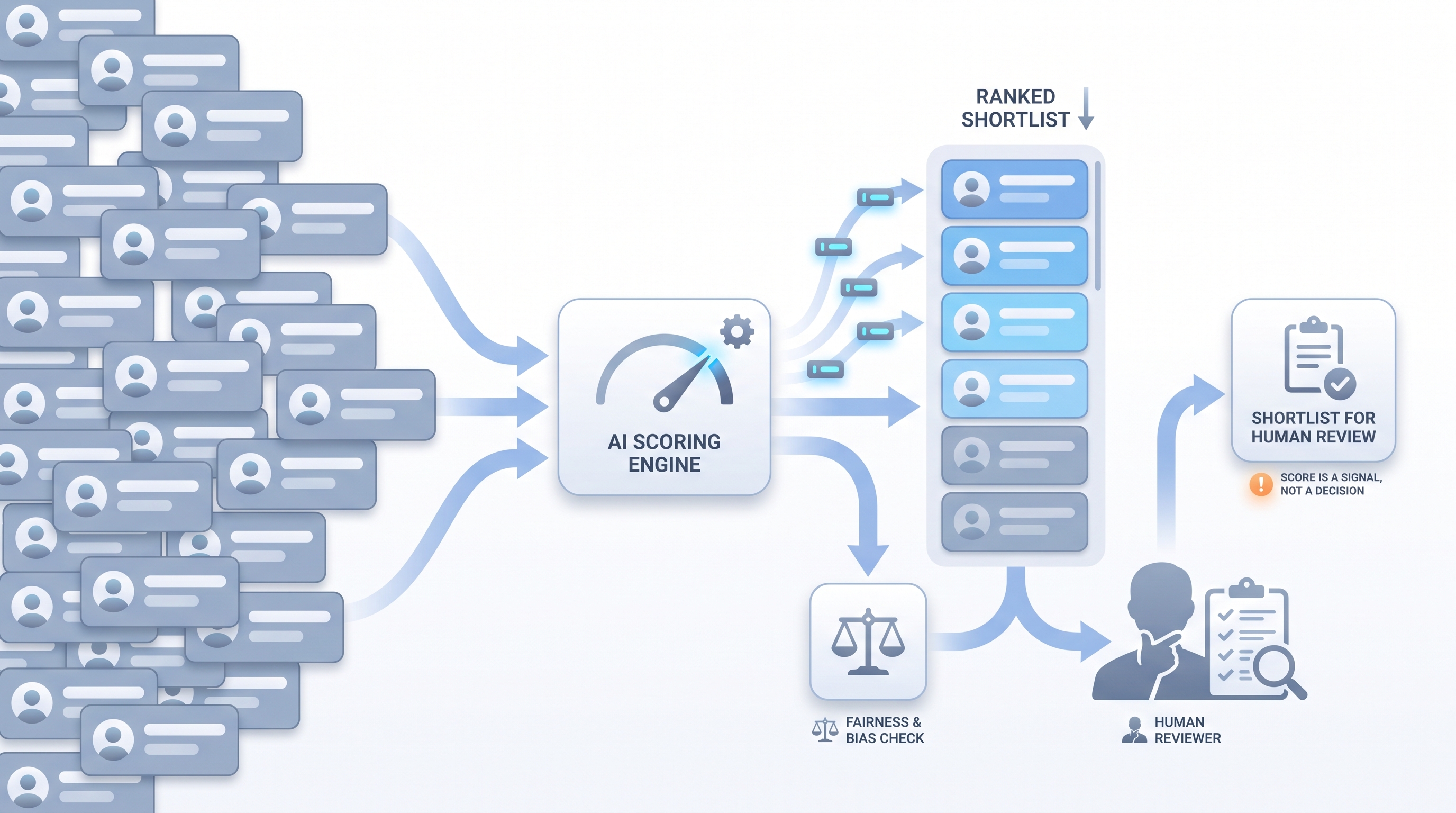
AI candidate ranking is the use of machine learning or large language models to score and order applicants against a role, producing a ranked shortlist or a numeric match score. It is most common in high-volume hiring, where a recruiter cannot read every application and needs a way to decide what to review first. The score usually reflects how similar a candidate looks to a target profile built from the job description, past hires, or recruiter input. It is a triage aid, not a hiring decision, and treating it as the latter is where most teams get into trouble.
In practice
- A recruiter facing 800 applicants for one role uses the ATS ranking view to sort by match score, reads the top 50 carefully, and samples the rest, rather than rejecting anything automatically.
- In a vendor demo, a sales engineer shows a "94% match" badge next to a candidate. The useful follow-up is not "how is it calculated" in the abstract, but "show me your adverse-impact audit and your false-negative rate on roles like mine."
- At a hiring debrief, someone says "the AI ranked her low" as if that settles it. A mature team treats that as a prompt to look closer, not a reason to move on.
Quick read, then how hiring teams use it
This is for recruiters, sourcers, TA, and HR partners who need the same vocabulary in req intake, vendor calls, and hiring manager debriefs. Skim the first section when you need a fast shared picture. Use the second when you are deciding how it shows up in your screening stack and compliance posture.
Plain-language summary
- What it means for you: AI candidate ranking orders your pipeline by a learned score. It can save hours of triage, but the score reflects patterns in its training data, including any bias in who you hired before.
- How you would use it: As a review-order aid. Read the top of the list first, but never auto-reject on score alone, and sample the bottom of the list to catch good candidates the model missed.
- How to get started: Test the tool on a set of past finalists and rejects you already understand. If its order disagrees with your judgment on known cases, do not trust it on new ones.
- When it is a good time: High applicant volume where manual triage is genuinely impossible. For low-volume specialist roles, careful human review usually beats a noisy score.
When you are running live reqs and tools
- What it means for you: The risk is not just bad ranking, it is invisible bad ranking. A model can systematically down-rank a protected group while looking efficient, which creates adverse impact liability under EEOC guidance and the EU AI Act's high-risk rules.
- When it is a good time: After you have a documented bias audit, a written policy that score never triggers auto-rejection, and a human-in-the-loop review step with a named owner.
- How to use it: Feed it clean, standardized inputs. Use a candidate data enrichment step so profiles are complete, and pair ranking with structured interviews downstream so the rest of the funnel is consistent too.
- How to get started: Set a threshold policy, then have recruiters spot-check rejected candidates near and below it every week. Log how scores influenced real decisions so you can answer a candidate or a regulator.
- What to watch for: Hallucinated skills when an LLM infers experience that is not on the resume, score drift as your pipeline changes, and over-trust: the more polished the dashboard, the easier it is to stop questioning the number.
Where we talk about this
On AI with Michal live sessions, AI candidate ranking comes up in AI in recruiting tracks and in vendor-evaluation discussions. We walk through what to ask before you buy, how to read a bias audit, and how to design a human review step that holds up with both hiring managers and compliance. Start with the main AI Sourcing Lab for the screening and compliance context, or join Sourcing Lab for the upstream sourcing side of the same pipeline.
Around the web (opinions and rabbit holes)
Third-party creators move fast. Treat these as starting points, not endorsements, and verify any process before you wire candidate data across tools.
YouTube
- Search "AI resume screening bias" and "hiring algorithm audit" for recent talks. Look for uploads from the last year, since the regulatory picture (NYC Local Law 144, EU AI Act) has shifted fast.
- HR-tech analyst channels post breakdowns of how match scores are calculated and where they fail; favor ones that show real adverse-impact numbers, not just product demos.
- r/recruiting threads on AI ranking and resume screening are an honest source of where these tools help and where recruiters quietly override them.
- r/humanresources discussions cover the compliance and policy side, including how teams document automated screening decisions.
Quora
- Search "are AI resume rankers accurate" on Quora for answers from recruiters, candidates, and vendors, which surfaces all three perspectives on whether the score deserves trust.
AI candidate ranking vs. ATS knockout rules
| Dimension | ATS knockout rules | AI candidate ranking |
|---|---|---|
| Logic | Explicit rules you write | Learned, continuous score |
| Transparency | High, easy to explain | Low, hard to explain |
| Output | Pass or fail | Match score or ranked order |
| Main risk | Too blunt, screens out good people | Hidden bias, false confidence |
| Best use | Genuine non-negotiables | Ordering a pool for human review |
Related on this site
- Glossary: Adverse impact, Human-in-the-loop (HITL), Hallucination, Candidate data enrichment, Structured interview, Work sample assessment, Semantic search, AI candidate sourcing
- Blog: AI sourcing tools for recruiters
- Guides: Sourcers
- Live cohort: Sourcing Lab
- Course: Starting with AI: foundations in recruiting
- Membership: Become a member