Recruitment marketing
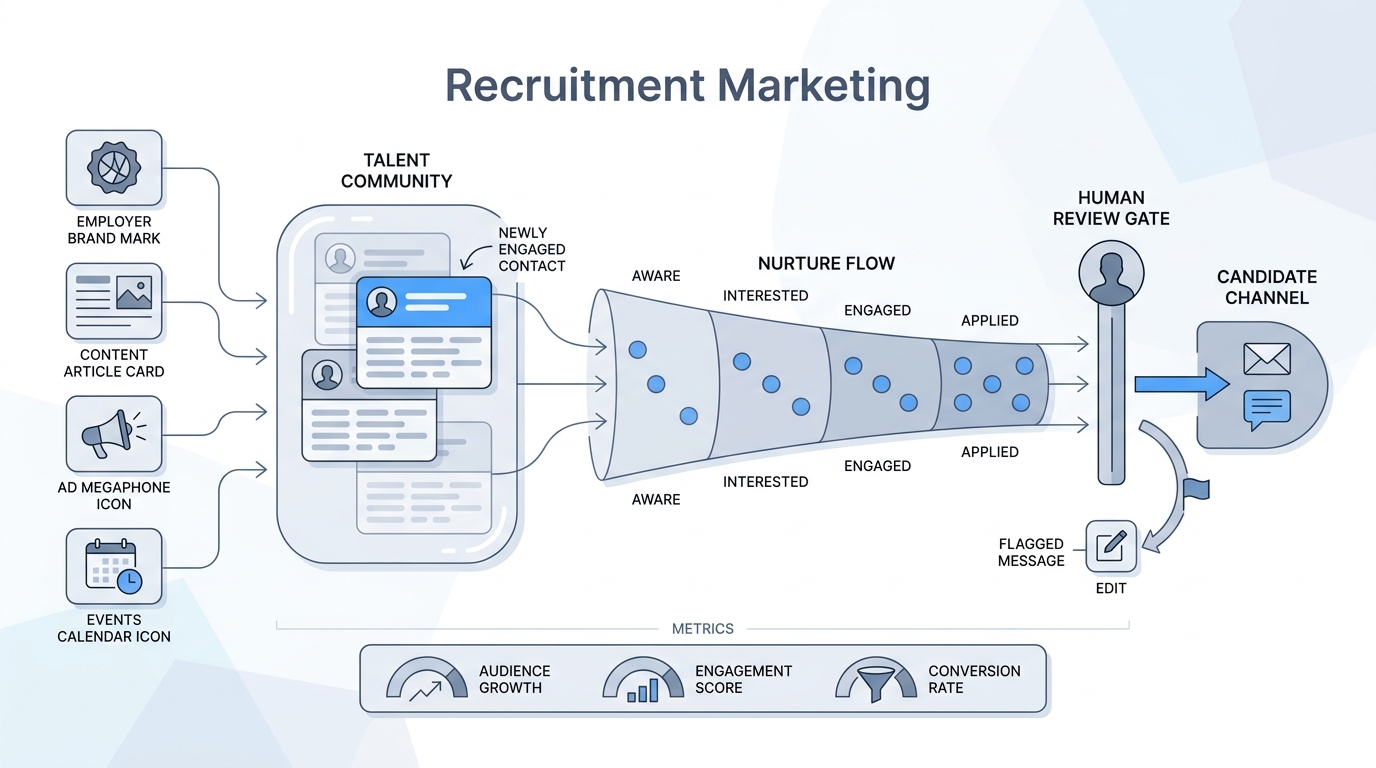
Applying marketing tactics (employer brand, content, nurture, ads, SEO) to attract, engage, and warm up candidates before they ever apply, so your pipeline is full of people who already know and trust the team.
Michal Juhas · Last reviewed June 8, 2026
What is recruitment marketing?
Recruitment marketing is the practice of using marketing tactics, employer brand, content, ads, SEO, events, and email nurture, to attract and warm up candidates before a role even opens. Instead of starting from zero every time a req lands, you build an audience of people who already know the team, so applications and outreach replies cost less and arrive warmer.
In practice
- When a TA team runs a careers blog, posts a steady drip of "day in the life" content, and emails a talent community when a role opens, that is recruitment marketing, even if nobody on the team uses the phrase.
- Vendors sell it as "candidate attraction" or "talent CRM"; podcasts call it "building a pipeline before you need it." It is the same idea: demand generation aimed at future hires, not buyers.
- A recruiter might say "our brand does the warming so my outreach lands," which is the whole point: marketing softens the ground so outbound talent sourcing gets more replies for less effort.
Quick read, then how hiring teams use it
This is for recruiters, sourcers, TA, and HR partners who need the same vocabulary in pipeline reviews, vendor calls, and budget conversations. Skim the first section for a fast shared picture. Use the second when you are deciding how recruitment marketing shows up in your ATS, your content calendar, and your candidate communications.
Plain-language summary
- What it means for you: Instead of cold-starting every search, you keep a steady drumbeat of useful content and friendly emails so people already like the team before you message them. Warm beats cold, every time.
- How you would use it: You pick one channel (a careers blog, a LinkedIn cadence, or a short nurture email series), you make it consistent, and you keep a tagged list of people who raised their hand.
- How to get started: Write down the three things candidates always ask about your roles. Turn each into one honest post. Collect interested names in one tidy list with a clear opt-out, not five scattered spreadsheets.
- When it is a good time: Before you are desperate. Recruitment marketing pays off on a delay, so the best time to start a pipeline is the quarter before you need it.
When you are running live reqs and tools
- What it means for you: Recruitment marketing moves people through a funnel (aware, interested, engaged, applied) rather than chasing one req at a time. You manage an audience and a talent community, not just an open requisition.
- When it is a good time: When the same roles recur, when employer brand is strong enough to distribute, and when you have an owner for content, the nurture list, and the compliance side of holding candidate data.
- How to use it: Pair a content engine with a tagged candidate database and AI-assisted drafting. Keep every candidate-facing send behind a human review gate. Use AI in recruiting to repurpose one piece into many and to summarise which touches actually drove replies.
- How to get started: Ship one reliable channel before adding a second. Wire it to your ATS and sourcing funnel metrics so marketing-touched candidates are visible next to cold ones. Add AI drafting only after your voice and review habits are stable.
- What to watch for: Reach numbers that look great but never convert, nurture lists with no lawful basis, hallucinated benefits or salary bands in AI-written ads, and a content calendar that quietly dies when one person gets busy. Plan for consistency the way you plan a launch.
Where we talk about this
On AI with Michal live sessions we treat recruitment marketing as a build, not a theory deck. The sourcing automation track wires a repeatable content and nurture engine to a real talent pool, and the AI in recruiting track connects the same work back to hiring manager trust, candidate experience, and GDPR. If you want the full room conversation, start at the AI Sourcing Lab and bring your real channels, numbers, and policy constraints.
Around the web (opinions and rabbit holes)
Third-party creators move fast and pitch hard. Treat these as starting points, not endorsements, and never copy a stranger's flow that moves candidate data before you check consent and storage.
YouTube
- What is Recruitment Marketing? searches surface short explainers that are good for shared vocabulary before you pick tactics.
- How to build a talent pipeline walkthroughs show the nurture-and-community idea in public, with varying quality.
- r/recruiting threads on employer brand and pipeline-building are full of frank takes from people in the chair.
- r/talentacquisition discussions on candidate nurture and CRM tools surface what actually survives in real teams.
Quora
- What is recruitment marketing? collects a wide range of practitioner answers (quality varies, so read critically).
Recruitment marketing versus sourcing
| Dimension | Recruitment marketing | Outbound sourcing |
|---|---|---|
| Audience | One-to-many (a future-hire audience) | One-to-one (a named candidate) |
| Timing | Before the req, ongoing | After the req opens |
| Main lever | Brand, content, nurture | Personalised outreach |
| Pays off | On a delay, compounding | Immediately, per search |
Related on this site
- Glossary: Outbound talent sourcing, Talent community sourcing, Proprietary talent pool, Talent acquisition
- Blog: How to use AI in recruiting
- Tools: LinkedIn Recruiter for distribution and follow-up
- Live cohort: AI Sourcing Lab
- Membership: Become a member