Interview kit
A structured packet distributed to every interviewer before the first conversation with a candidate, containing assigned competencies, behavioural questions, and a shared rating rubric so the panel evaluates consistently.
Michal Juhas · Last reviewed June 16, 2026
What is an interview kit?
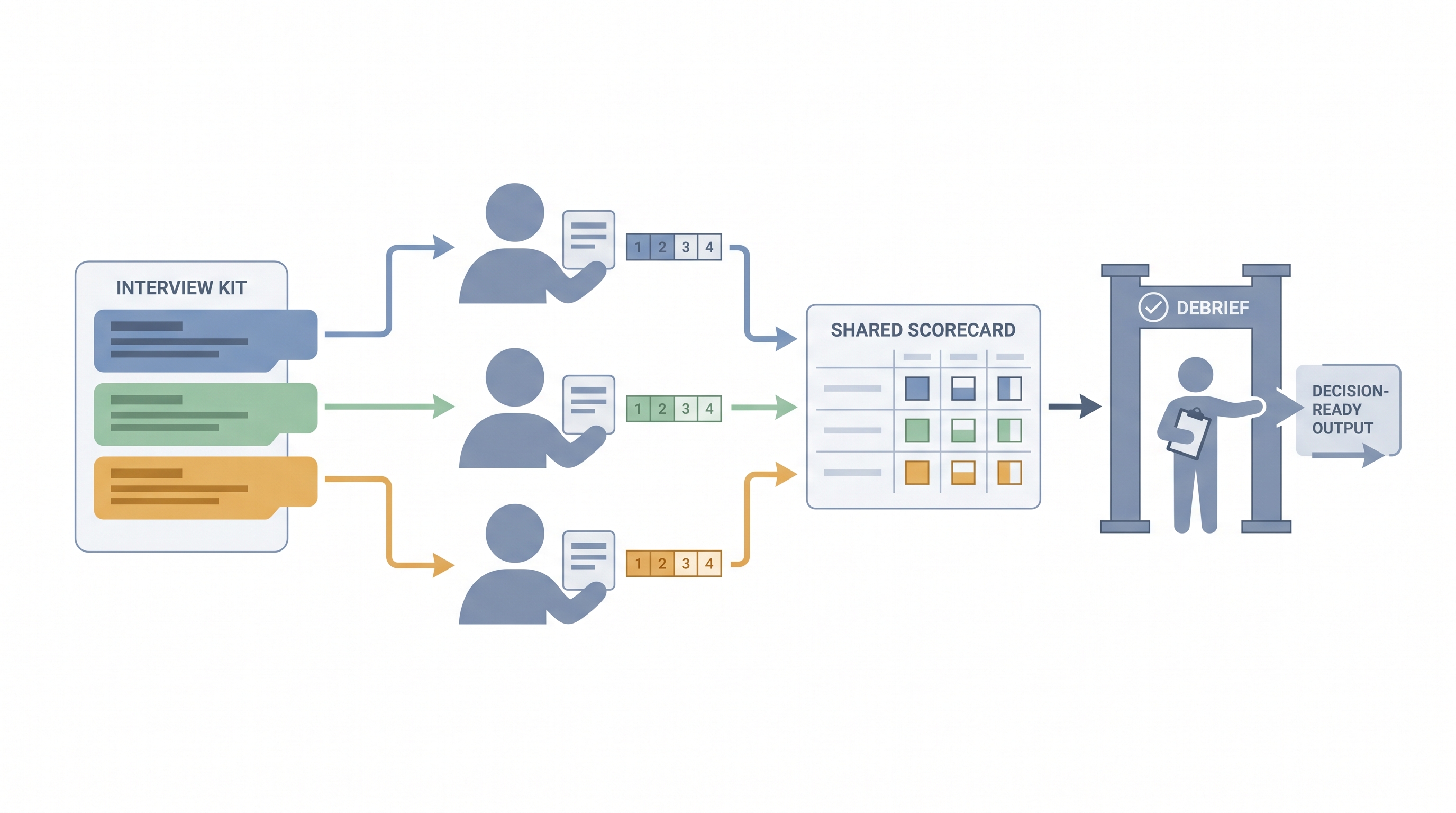
An interview kit is the structured guide a recruiter distributes to every member of the interview panel before the first candidate conversation. It assigns competencies, questions, and rating scales to each interviewer so the panel covers the full requirements without duplicating effort or accidentally skipping what matters most.
Without one, every interviewer decides independently what to probe. Debriefs become a comparison of personal impressions rather than a shared evaluation against the same criteria. With one, the conversation in the debrief starts from a scorecard instead of from feelings.
Interview kits connect directly to the scorecard and are usually stored inside the ATS, in a shared doc, or in a dedicated interview intelligence tool. They are most valuable when paired with a calibration session at the start of a search so the panel agrees on what "good" looks like before anyone meets a candidate.
In practice
- A recruiter builds a five-competency kit for a senior product manager role, assigns two competencies to the engineering lead and three to the CPO, and sends a pre-brief ten minutes before the panel call to confirm the split.
- During a debrief, the hiring manager says "she seemed sharp" and the recruiter pulls up the kit: the sharp impression was not backed by a rating on the problem-solving rubric because the hiring manager ran out of time for that section.
- An HR team discovers that one hiring manager who conducts 20 interviews a year has never received a kit, explaining why their offer acceptance rate is 20 points below the company average.
Quick read, then how hiring teams use it
This is for recruiters, HR partners, and anyone who coordinates interview panels. Skim the first section for the shared definition. Use the second when you are setting up kits in your ATS or coaching a panel for the first time.
Plain-language summary
- What it means for you: A kit is a packet that tells each interviewer exactly which questions to ask and what a good answer looks like, so the debrief is evidence-based rather than a gut-check.
- How you would use it: Build a kit for each role family, not each individual role. Customise the competency weights for seniority, but reuse the question bank and rubric structure.
- How to get started: Start with your three most common role types. Write two behavioural questions per competency, define two observable anchors (meets bar, does not meet bar), and pilot with one panel before refining.
- When it is a good time: Every search, without exception. The return is highest for roles where the panel includes hiring managers who are not trained interviewers.
When you are running live reqs and tools
- What it means for you: A well-designed kit reduces time in debrief, cuts score variance across the panel, and gives you defensible documentation if a hiring decision is challenged.
- When it is a good time: Start building kits before sourcing opens so the panel can calibrate on what they are screening for, not after first interviews expose disagreements.
- How to use it: Use your ATS kit builder (or a shared Notion template) to lock the question set and rubric. Send automatically when an interviewer is added to a stage. Pull completion rates in your ATS to see which interviewers are skipping kit review.
- How to get started: Audit your last ten hiring decisions. For how many did the panel submit scores before the debrief rather than after? If fewer than half, the kit is not being used as designed.
- What to watch for: Kits that are built but never reviewed, rating scales with anchors so vague they produce no calibration, and AI-generated question banks that include legally risky questions about employment gaps or family circumstances.
Where we talk about this
On AI with Michal live sessions, interview kits come up in AI in recruiting blocks when participants are designing structured evaluation processes and connecting them to scorecard templates and ATS workflows. The membership community is a good place to share and compare kit templates across industries.
Around the web (opinions and rabbit holes)
Third-party creators move fast. Treat these as starting points, not endorsements, and double-check anything before you embed it in a live hiring process.
YouTube
- Searches for "structured interview guide" and "interview scorecard design" on YouTube surface practitioner walkthroughs on building question banks and rubrics for consistent hiring.
- r/recruiting has threads on how to introduce structured interviews to hiring managers who resist the process and on which ATS platforms have the best kit builders.
- r/humanresources includes discussion on legal requirements for interview documentation and how kits factor into adverse impact analysis.
Quora
- Searches for "how to build an interview guide for hiring" on Quora collect a range of practitioner answers on question design, rubric calibration, and panel coordination.
Related on this site
- Glossary: Scorecard, Calibration session (hiring), Panel debrief alignment, Competency framework, Behavioral interview, Human-in-the-loop
- Guides: Sourcers
- Lab: AI Sourcing Lab
- Membership: Become a member