Recruitment software for startups
Hiring software sized for early-stage teams: lightweight ATS, AI-assisted outreach, and sourcing tools that go live in days, stay within a lean budget, and scale with headcount without requiring a dedicated TA ops team.
Michal Juhas · Last reviewed May 15, 2026
What is recruitment software for startups?
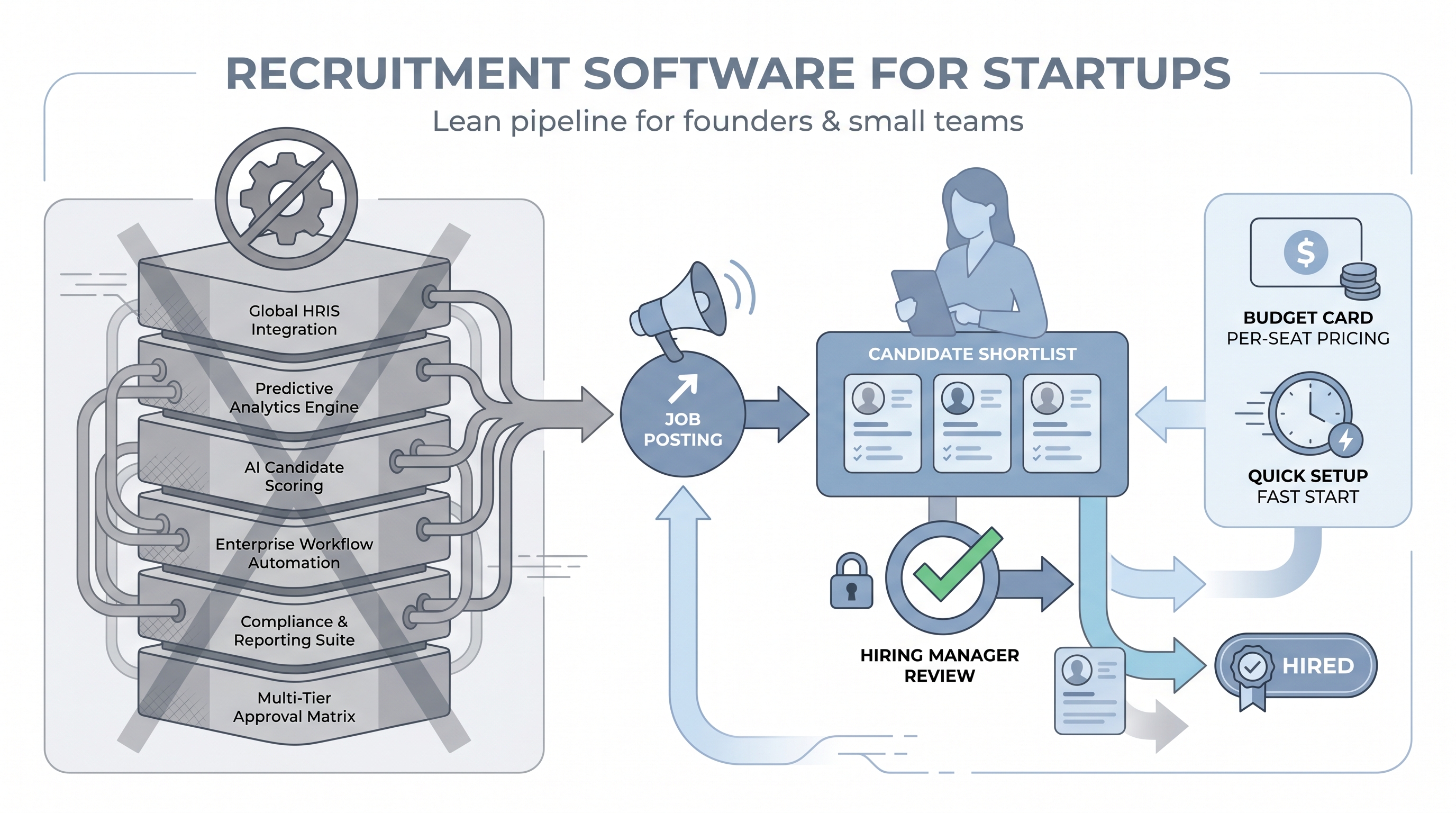
Recruitment software for startups is hiring tooling scaled to lean teams: a lightweight applicant tracking system for pipeline visibility, AI-assisted drafting for job descriptions and outreach, and simple sourcing tools that do not require a dedicated recruiter or IT admin to configure. The distinction from enterprise software is scope and setup time. A startup adding three to eight people per quarter needs something live in a day, not a six-week implementation. The risk of under-tooling is real (spreadsheets break at volume, notes live in personal inboxes) but the risk of over-buying is just as common: paying for compliance modules, advanced analytics, or multi-entity support before the team has a single dedicated recruiter.
In practice
- A five-person engineering startup with a first recruiter hire will often already have LinkedIn Recruiter Lite and a spreadsheet pipeline. The question at that point is whether to graduate to an ATS before the next hiring sprint or wait until the spreadsheet breaks visibly.
- A founder running recruiting alongside their other responsibilities will often buy the cheapest tool that posts to major job boards automatically and sends the first nudge email, because the alternative is manual follow-up that slips when other priorities spike.
- A TA ops person hearing "we use Ashby" versus "we use Greenhouse" at a startup can usually infer the company's current recruiting maturity and whether they have invested in CRM and outreach tooling or only pipeline tracking.
Quick read, then how hiring teams use it
This is for recruiters, sourcers, TA, and HR partners who need the same vocabulary in debriefs, vendor calls, and policy reviews. Skim the first section when you need a fast shared picture. Use the second when you are deciding how it shows up in the ATS, sourcing tools, or candidate communications.
Plain-language summary
- What it means for you: A short list of tools that cover posting jobs, tracking candidates, and communicating without requiring a full-time ops person to maintain.
- How you would use it: Pick the tool that handles your worst bottleneck this quarter. Post one real job through it before you sign a contract.
- How to get started: List every step in your last hire that required copy-paste or a reminder to yourself. Software fixes those steps; it does not fix unclear requirements or slow hiring managers.
- When it is a good time: Before your next hiring sprint, not during it. Switching tools mid-campaign is expensive on focus if not on budget.
When you are running live reqs and tools
- What it means for you: At the moment your pipeline is split across a spreadsheet and a recruiter's inbox, data integrity starts to drift. An ATS creates a single source of truth that hiring managers can query without asking you.
- When it is a good time: When two or more people touch the same candidate and sync becomes a manual task, when the pipeline volume exceeds fifteen active candidates, or when a compliance question reveals you cannot answer where interview notes are stored.
- How to use it: Wire the ATS to your primary job board and calendar first. Track every stage in one place before you add AI layers or enrichment integrations. Measure time to fill from week one so you have a baseline before any new tool changes your process.
- How to get started: Export your last six months of placements or rejections from wherever they live now. Import them as a test batch into the trial ATS. If the import breaks, the vendor's migration support matters more than any feature.
- What to watch for: ATS tools that lock export behind a support ticket, pricing that jumps dramatically at the fifth user, AI features that write to the candidate record without a review gate, and GDPR deletion flows that require a help desk ticket instead of a self-serve button.
Where we talk about this
On AI with Michal live sessions, the AI in Recruiting track includes tool evaluation exercises where participants bring real requirements and test stacks together. Startup recruiters often raise questions about budget-to-feature trade-offs and what breaks at scale, which makes the group discussion more grounded than any vendor comparison page. If you want to hear how teams at similar headcount made these decisions, start at Sourcing Lab and bring your current tool shortlist.
Around the web (opinions and rabbit holes)
Third-party creators move fast. Treat these as starting points, not endorsements, and double-check anything before you wire candidate data.
YouTube
- Best ATS for startups 2025 for walkthrough reviews that show actual admin panels rather than marketing slides.
- Ashby vs Lever vs Greenhouse for direct comparisons from practitioners who have used more than one of these tools.
- How to hire as a startup founder for context on recruiting without a TA team, which shapes which tools are practical.
- r/recruiting has recurring "first ATS" threads where startup recruiters share what worked at low volume; verify post dates before trusting any recommendation.
- r/startups surfaces founder perspectives on their first hires and what tooling they wished they had earlier.
Quora
- Quora: what recruitment software do startups use for practitioner answers across different funding stages; treat as conversation starters before building your own shortlist.
Startup versus enterprise: key differences
| Factor | Startup | Enterprise |
|---|---|---|
| Setup time | Hours to days | Weeks to months |
| Admin requirement | Founder or one recruiter | Dedicated TA ops |
| Data volume | Tens to hundreds of candidates | Thousands and above |
| Compliance depth | GDPR basics, no audit function | Dedicated legal sign-off, adverse impact audits |
| AI risk tolerance | Higher (speed matters more than scale errors) | Lower (errors affect more people) |
Related on this site
- Glossary: Applicant tracking software, Recruitment software comparison, Recruitment software for small business, Time to fill, AI in recruiting, GDPR first-touch outreach
- Blog: AI sourcing tools for recruiters
- Course: Starting with AI: the foundations in recruiting
- Live cohort: Sourcing Lab
- Membership: Become a member