Time and materials vs fixed fee recruiting engagements
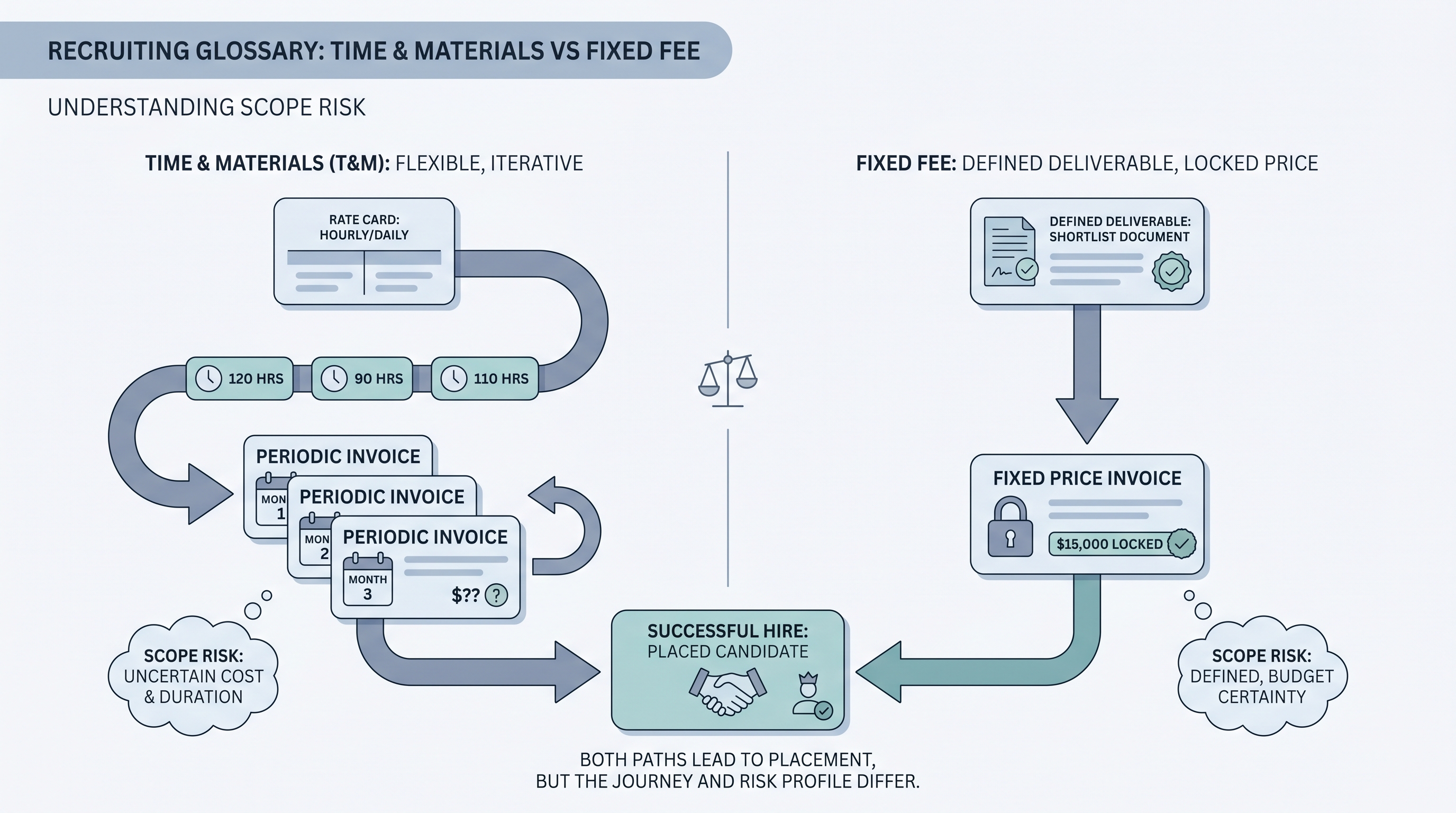
A recruiting engagement billing model choice: time and materials charges the client for actual hours and resources consumed as the search progresses, while a fixed fee commits both sides to one price for a defined deliverable. The right structure depends on scope clarity, search complexity, and which party carries the risk when a hire turns out to be harder than expected.
Michal Juhas · Last reviewed May 8, 2026
What is a time and materials vs fixed fee recruiting engagement?
The billing model for a recruiting engagement sets which side carries the commercial risk when a search turns out to be harder than expected. In a time and materials (T&M) engagement, the client pays for actual hours spent and resources consumed: sourcing tool access, researcher time, assessment costs, and occasionally travel. Invoices arrive as work happens. In a fixed fee engagement, the agency commits to a total price for a defined deliverable, whether that is a shortlist of five pre-screened candidates, one placed hire, or a market-mapping report delivered by a specific date.
The distinction matters because recruiting effort is hard to predict. A CFO search that the agency expected to complete in six weeks can stretch to five months if the client changes the compensation band twice, pauses for a board approval cycle, or expands the geography after the brief was set. In a fixed fee engagement, that extra work sits with the agency. In a T&M engagement, the client shares it.
Neither model is inherently better. Fixed fee works well for well-scoped roles with stable briefs and known candidate pools. T&M works better when the scope is genuinely uncertain, the role is novel, or the engagement combines hiring with talent market research that the client values independently of a hire. Most experienced agency operators match the model to the scope risk rather than defaulting to one format across all mandates.
In practice
- A boutique executive search firm quotes T&M with a monthly ceiling for a Chief Revenue Officer search after a previous fixed-fee engagement on a similar role ran 60 percent over estimated hours when the client changed the compensation structure mid-search and added a board presentation round not in the original brief.
- A contingency desk introduces a fixed-fee option for volume hiring programmes at scale-ups: three screened candidates per role at a set price, with a change-order clause that triggers T&M billing if the hiring manager revises the brief or rejects a compliant shortlist without documented cause.
- A client procurement team requests T&M breakdowns with activity codes before renewing the agency panel agreement, wanting to understand the split between sourcing hours, coordination overhead, and direct candidate contact before setting the next year's billing model for retained mandates.
Quick read, then how hiring teams use it
This page is for agency principals, in-house TA leaders, procurement teams, and operations managers who set the commercial terms for recruiting engagements. Skim the first section for the model definitions. Use the second when you are deciding how to structure the fee for a specific search or programme.
Plain-language summary
- What it means for you: The billing model decides who absorbs extra effort when a search takes longer than expected. Fixed fee protects the client budget; T&M protects the agency when scope is uncertain.
- How you would use it: Choose T&M when the brief is likely to change or the role is genuinely novel. Choose fixed fee when the role definition is stable and the candidate pool is predictable enough to price reliably.
- How to get started: For each open mandate, ask one question before quoting: if this search takes twice the estimated hours, can the agency absorb that cost without reducing effort? If the answer is no, T&M or a hybrid is the honest model.
- When it is a good time: Agree the billing model before work starts, not when the first invoice arrives. Document the model and its scope assumptions in the statement of work.
When you are running live reqs and tools
- What it means for you: The billing model determines what happens to your margin when a hard search runs long. Fixed fee on a brief that changes twice mid-search means the agency is effectively working for less per hour than it quoted. T&M requires a time-tracking discipline the agency may not have.
- When it is a good time: Use fixed fee for volume roles, standard profiles, and searches with stable briefs. Use T&M for executive, niche, or market-mapping engagements where scope is likely to evolve during the search.
- How to use it: Track hours per mandate even on fixed-fee engagements. This data tells you whether your fixed-fee pricing is calibrated correctly and gives you evidence when a client-side change triggers a scope amendment conversation.
- How to get started: Pull the last five fixed-fee searches that ran over estimated effort. For each one, identify whether the overrun was agency-side (underestimated difficulty) or client-side (changed brief, added interviews, delayed feedback). Use that analysis to decide whether to reprice, add scope-change clauses, or shift certain mandate types to T&M.
- What to watch for: Fixed-fee searches where the agency reduces sourcing effort to protect margin rather than raising the overrun with the client. T&M searches where clients approve hours without reviewing activity detail. Both erode the trust that makes long-term panel agreements viable.
Where we talk about this
On AI with Michal live sessions, agency commercial structure, including billing models, SOW drafting, and fee risk management, comes up in the AI in recruiting track when agency owners discuss how to run scalable, commercially predictable operations. The Sourcing Lab cohort covers how billing model choice interacts with ATS data, pipeline reporting, and the AI tools agencies are adopting for effort tracking and invoice automation.
Around the web (opinions and rabbit holes)
Third-party content on T&M versus fixed fee in recruiting spans agency owner forums, legal commentary, and professional services billing guides. These are starting points, not endorsements. Verify any legal or commercial position with qualified counsel before applying it to a live engagement.
YouTube
- Time and materials vs fixed price contracts explained covers the fundamental risk allocation difference that applies directly to recruiting project billing.
- How to price a retained search engagement walks through milestone fee structure and the assumptions behind fixed-fee retained search pricing.
- Scope creep in professional services and how to prevent it addresses the fixed-fee overrun problem with change-order approaches that recruiting agencies can adopt.
- Billing models for recruiting agencies in r/RecruitmentAgencies includes agency owner perspectives on when each model works and how overruns get handled in practice.
- How do you price hard-to-fill roles in r/recruiting covers the practical question of how agencies quote when the candidate pool is genuinely thin.
- SOW and billing disputes in staffing in r/smallbusiness captures small agency owner accounts of how billing model ambiguity turns into cash flow problems.
Quora
- When should a staffing agency use time and materials vs fixed fee? collects practitioner perspectives on how scope certainty drives model choice in live agency contexts.
T&M vs fixed fee at a glance
| Factor | Time and materials | Fixed fee |
|---|---|---|
| Fee trigger | Hours and resources consumed | Defined deliverable or milestone |
| Who carries scope risk | Client | Agency |
| Budget predictability | Variable (estimate provided upfront) | Certain |
| Scope change handling | Billed as incurred | Requires signed change order |
| Best fit | Novel roles, uncertain briefs, market mapping | Well-scoped roles, volume hiring, stable briefs |
| Billing cycle | Fortnightly or monthly | On milestone completion |
| Cash flow for agency | Steadier | Lumpy unless milestone-structured |
Related on this site
- Glossary: Statement of work (SOW) for recruiting projects, Retained search vs contingency recruiting
- Glossary: Master services agreement (MSA) for agency services, Agency invoice and payment terms
- Glossary: Recruitment factoring and agency cash flow, Agency escrow and retainer payments
- Glossary: Backfill periods and replacement guarantees, Time in stage reporting
- Glossary: Workflow automation, Claude in recruiting
- Workshops: Sourcing Lab
- Course: Starting with AI: the foundations in recruiting
- Membership: Become a member