AI engineer sourcing
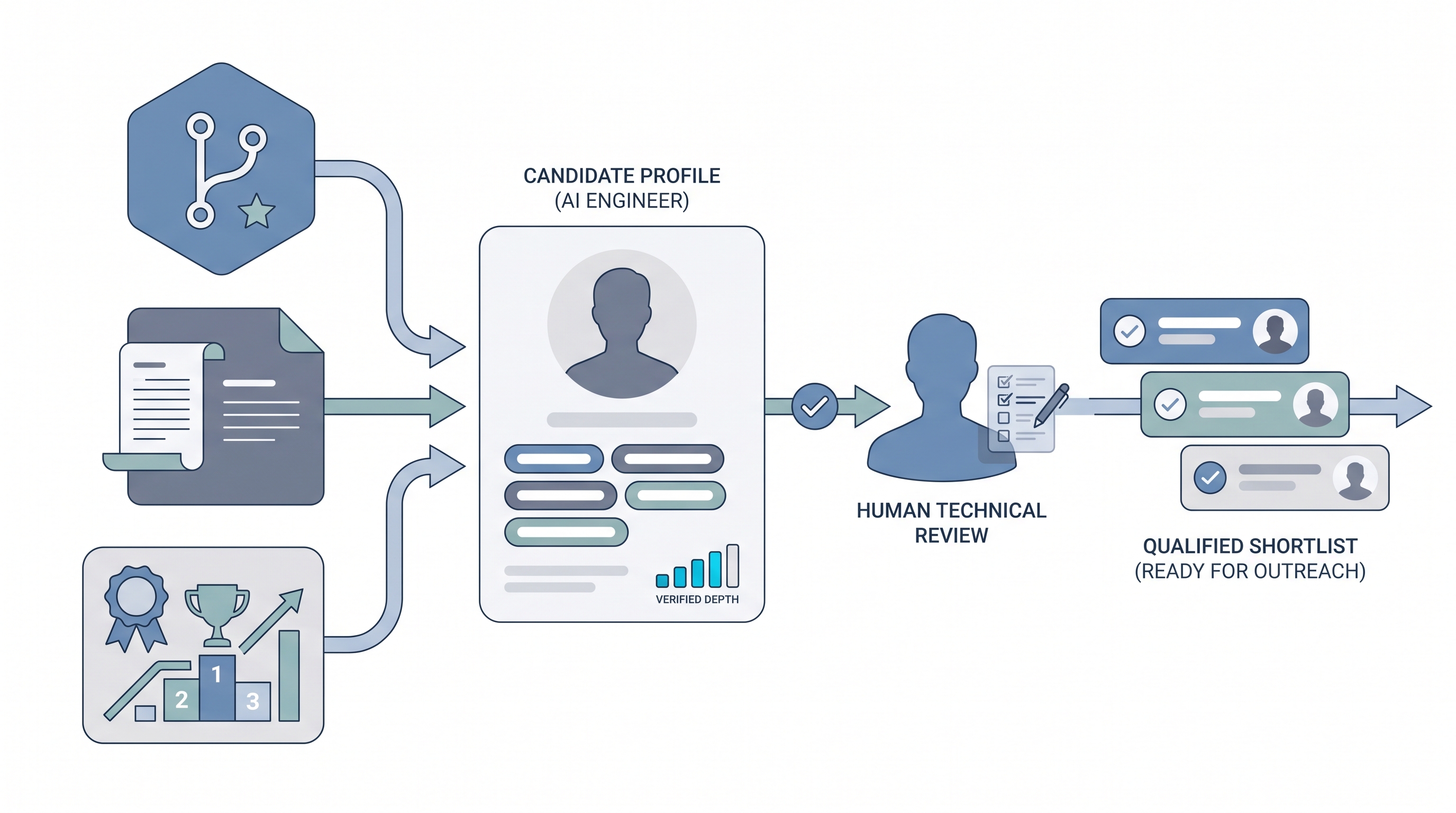
The disciplined process of finding, profiling, and engaging engineers who specialize in machine learning, deep learning, NLP, computer vision, or MLOps: a talent pool whose strongest signals live in open-source repositories, research pre-prints, and competition leaderboards as much as on job boards.
Michal Juhas · Last reviewed June 27, 2026
What is AI engineer sourcing?
AI engineer sourcing is the targeted process of finding and engaging engineers who specialize in machine learning, deep learning, NLP, computer vision, or MLOps. Unlike sourcing for most tech roles, the candidate pool is small, globally distributed, and leaves strong technical signals in places outside LinkedIn: open-source repositories, academic pre-prints, and competition leaderboards.
In practice
- A sourcer running a search for a senior ML engineer might start on GitHub, filtering by starred PyTorch repositories and recent commit activity, rather than keyword-searching LinkedIn Recruiter.
- At a recruiting team standup, someone might say "we need to source for AI engineers" and mean anything from a prompt engineer at a startup to a computer vision researcher at a lab. Clarifying the specialization (LLM fine-tuning, recommendation systems, real-time inference) before sourcing saves weeks of misaligned outreach.
- Tools like LinkedIn Recruiter AI-assisted search, Kaggle profile exports, and GitHub Talent Solutions are the platforms most sourcing teams evaluate first for this role family.
Quick read, then how hiring teams use it
This is for recruiters, sourcers, TA, and HR partners who need the same vocabulary in req intake, vendor calls, and hiring manager debriefs. Skim the first section when you need a fast shared picture. Use the second when you are deciding how it shows up in your sourcing stack and outreach cadences.
Plain-language summary
- What it means for you: AI engineer sourcing is not standard tech sourcing with AI keywords added. The talent pool is thinner, the technical signals are unfamiliar (papers, commits, competition rankings), and the candidates have high inbound interest from well-funded teams.
- How you would use it: Start with a req intake meeting that pins down the exact sub-specialty (NLP, computer vision, MLOps, reinforcement learning). Then build sourcing channels around where that sub-specialty is visible: GitHub, arXiv, Kaggle, or specific conference communities.
- How to get started: Ask your hiring manager to name three practitioners they admire and where they found them. Those answers reveal the actual signal sources for that specialization before you open a single tool.
- When it is a good time: When the req calls for direct ML model work, not just calling AI APIs. If the role mostly uses an OpenAI or Anthropic endpoint without training or fine-tuning, it is a product engineering req, not an AI engineer req.
When you are running live reqs and tools
- What it means for you: The sourcing funnel for AI engineers is inverted compared to most tech roles: the top is narrow (few qualified profiles), but the yield from a well-targeted shortlist is high if the outreach is personalized and the technical framing is accurate.
- When it is a good time: After the hiring manager has confirmed the exact model type, framework preference, and whether research publication history matters. Sourcing before this produces misaligned pipelines that waste candidate time and damage your brand with a small, communicative community.
- How to use it: Pair semantic search tools with Boolean search strings that target framework-specific terminology. Run outreach through a candidate data enrichment step to verify that contact details are current before personalizing at scale.
- How to get started: Build one search string per sub-specialty, test it against five known profiles your hiring manager respects, and calibrate the signal before scaling. Add a human-in-the-loop review step for any shortlist above 20 profiles before outreach goes out.
- What to watch for: Confusing AI adjacent (works at an AI company) with AI native (builds models). Over-indexing on publication count for applied engineering roles where shipping speed matters more than research depth. And ignoring compensation alignment before outreach: misaligned offers close pipelines faster than any sourcing mistake.
Where we talk about this
On AI with Michal live sessions, AI engineer sourcing comes up in sourcing automation blocks and AI in recruiting tracks. We walk through what works in practice: building Boolean strings for GitHub and arXiv, reading commit history as a proxy for model depth, and structuring outreach that respects how this candidate pool evaluates companies. Start at Sourcing Lab for the hands-on technical track, or join the main AI Sourcing Lab for the broader sourcing and hiring context.
Around the web (opinions and rabbit holes)
Third-party creators move fast. Treat these as starting points, not endorsements, and verify any process before you wire candidate data across tools.
YouTube
- Search "sourcing AI engineers GitHub" and "ML recruiter sourcing" for recent walkthroughs. Practitioners share live sourcing sessions for this role family regularly; look for uploads from the last six months to avoid outdated tool advice.
- Technical recruiter channels often post step-by-step GitHub and Kaggle profile analysis alongside sourcing sequences for ML roles.
- r/recruiting posts on ML and AI engineer sourcing are the most honest source of practitioner frustration and workarounds when generic tools fail. Search for "ML engineer sourcing" within the subreddit.
- r/MachineLearning occasionally surfaces posts about what engineers hate in recruiter outreach, which is valuable for writing better first messages.
Quora
- Search "how to recruit machine learning engineers" on Quora for answers from both recruiters and engineers, giving both sides of the outreach dynamic.
AI engineer sourcing vs. general tech sourcing
| Dimension | General tech sourcing | AI engineer sourcing |
|---|---|---|
| Primary signal | LinkedIn title, years of experience | GitHub commits, papers, competition rankings |
| Candidate pool | Wide | Narrow and globally distributed |
| Outreach trigger | Role and compensation | Specific technical problem or dataset |
| Research needed before outreach | Low | High (read one project or paper) |
| Comp alignment needed before sourcing | Optional | Required |
Related on this site
- Glossary: AI candidate sourcing, Boolean search, Semantic search, Candidate data enrichment, AI outreach drafting, GDPR and first-touch outreach, Human-in-the-loop (HITL), Hallucination
- Blog: AI sourcing tools for recruiters
- Guides: Sourcers
- Live cohort: Sourcing Lab
- Course: Starting with AI: foundations in recruiting
- Membership: Become a member