AI recruitment technologies
The category of software tools and AI systems that recruiting teams use across the hiring lifecycle, from job posting and candidate sourcing through screening, scheduling, and analytics.
Michal Juhas · Last reviewed May 10, 2026
What are AI recruitment technologies?
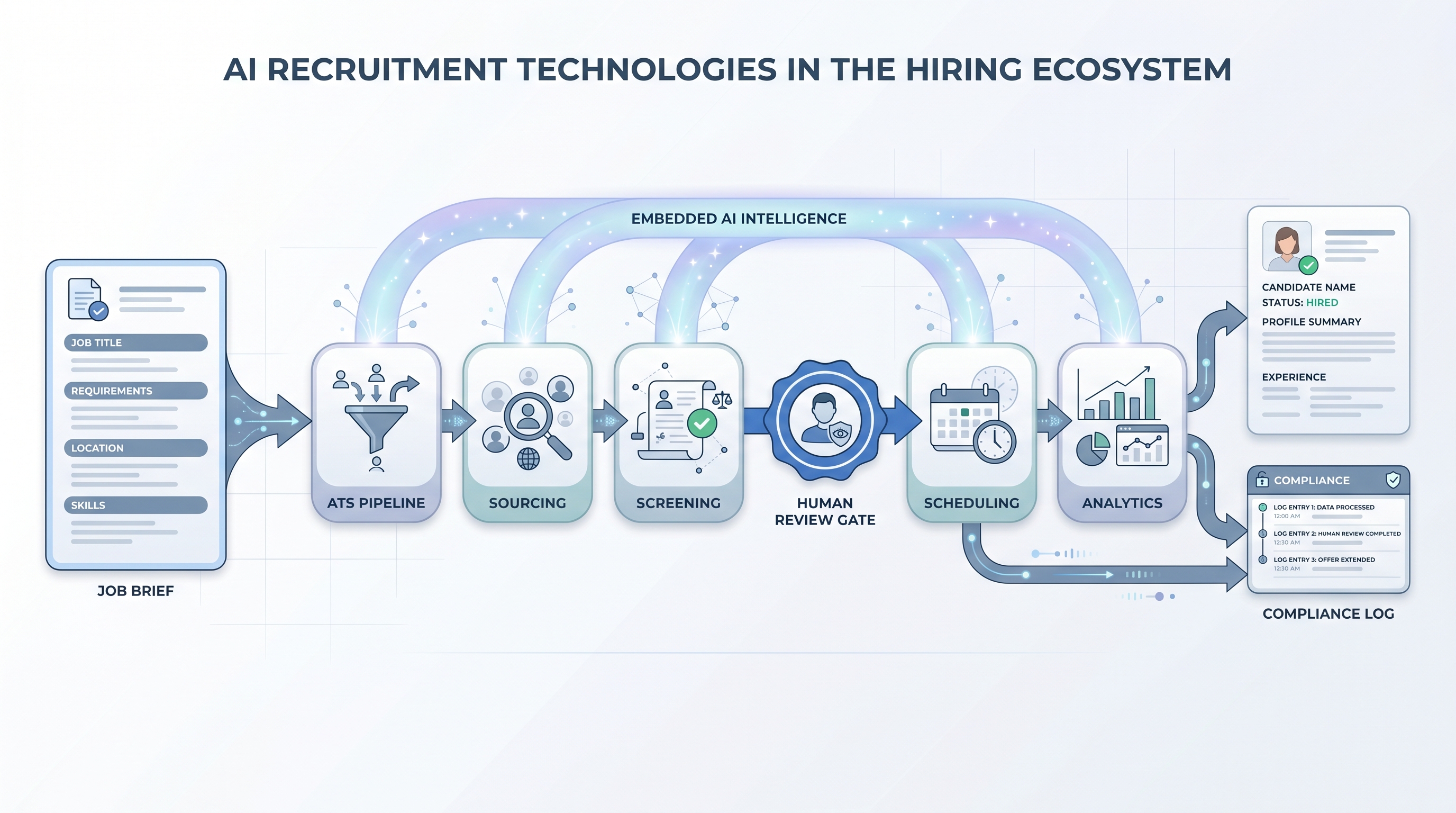
AI recruitment technologies is the umbrella term for the software, platforms, and AI systems recruiting teams use to take a candidate from job posting to hired. The category spans applicant tracking systems (ATS), AI-powered sourcing and semantic search tools, resume screening models, interview scheduling automation, video interviewing platforms, and pipeline analytics dashboards.
Some are dedicated AI products built for machine inference. Others are traditional tools, like ATS platforms, with AI features layered in. Both count. What matters operationally is whether the tool produces AI output that affects a candidate's progress in a hiring funnel, because that is the threshold where EU AI Act obligations, GDPR data processing agreements, and adverse impact monitoring requirements start.
In practice
- When a TA leader says "we're building our AI tech stack," they usually mean three to seven tools: an ATS as the pipeline of record, one or two sourcing tools, a screening or scoring model, and a scheduling or communication assist. That combination is what "AI recruitment technologies" means in practice.
- A recruiter at a high-volume operation might use semantic search to find passive candidates, an AI scoring model to rank inbound applications, and a scheduling tool to book phone screens, all without custom code. That is AI recruitment technology at point-solution depth.
- Compliance teams ask "does this tool process candidate data" before any trial because the answer determines whether a DPA is required and whether the tool falls under the EU AI Act high-risk category, regardless of price or feature set.
Quick read, then how hiring teams use it
This is for recruiters, sourcers, TA, and HR partners who need the same vocabulary in vendor calls, debrief reviews, and tool evaluations. Skim the first section for a shared picture. Use the second section when deciding how tools show up in the ATS, sourcing workflows, or candidate communications.
Plain-language summary
- What it means for you: AI recruitment technologies is the set of tools that automates or assists the repetitive parts of sourcing, sorting, and scheduling so you spend more time on judgment calls: calibrating with a hiring manager, reading a room in an interview, or building a relationship with a passive candidate.
- How you would use it: Identify your highest-friction, most-repetitive hiring stage. Add one AI tool there, stabilize it, then evaluate whether connecting it to the next stage is worth the integration and compliance work.
- How to get started: Map your current process in five stages (source, screen, schedule, interview, decide). Note which step has the clearest success criteria and the most repetition. Add one AI layer there before adding a second tool anywhere else.
- When it is a good time: When you have a named owner for each tool, a GDPR review complete for each vendor, and at least one real req to test on before scaling to high volume.
When you are running live reqs and tools
- What it means for you: AI recruitment technologies form a pipeline, not a product category. Each tool produces output that feeds the next stage through an ATS field, an API, or a shared prompt. That pipeline needs error alerts, a retry path, and a human inbox for exceptions.
- When it is a good time: After each tool works independently with a stable error rate, after vendor DPAs are signed, and after a hiring manager has calibrated the output at each stage before it runs unsupervised.
- How to use it: Build and validate each tool separately. Connect sourcing output to a screening tool only after screening criteria are stable. Add scheduling integration only after screening pass rates are predictable. Log every model version and criteria version for an audit trail.
- How to get started: Run a parallel test on a live req: AI-assisted alongside your current process for two weeks. Compare outputs. Adjust criteria and prompts before removing the manual step. Use structured output patterns when writing scores and summaries back to ATS fields, and workflow automation patterns when connecting tools through webhooks.
- What to watch for: Silent integration failures where one tool produces bad output and downstream tools amplify the error. Adverse impact patterns at the screening stage that stay invisible until someone samples declined profiles. Model version drift when a vendor updates their API and criteria that worked last month stop working this month.
Where we talk about this
On AI with Michal live sessions, the AI in recruiting track covers AI recruitment technologies end to end: sourcing tool selection, screening criteria design, ATS integration patterns, and the GDPR questions that come up the moment candidate data touches a model. The sourcing automation track goes deeper on recruiting webhooks and ATS API layer decisions. Start at Sourcing Lab and bring your current stack and a real job brief so the feedback is grounded, not theoretical.
Around the web (opinions and rabbit holes)
Third-party creators move fast. Treat these as starting points, not endorsements, and double-check anything before wiring candidate data to a new tool.
YouTube
- Search "AI recruitment technology stack" and "recruiting AI tools 2025" on YouTube filtered to the past year to find practitioners comparing tool categories and running live demos. Prefer channels that show error handling and calibration steps, not only the happy path.
- Recruiting Brainfood (Hung Lee) covers AI adoption across hiring stages through practitioner interviews and honest assessments of where the integration story breaks versus where it holds up in production.
- HR Tech channels increasingly cover AI-powered ATS and sourcing platforms with live demos. Watch for whether the demo shows the human review gate or skips straight from AI score to candidate action.
- r/recruiting has active threads on what AI recruitment technologies look like in practice: which tools connect well, what breaks after the first month, and what hiring managers actually see when they review AI-sorted shortlists.
- r/humanresources surfaces HRBP and HR leader perspectives on the compliance and governance obligations that arrive with any AI-powered process.
Quora
- Search "AI recruiting tools" or "best AI for recruitment" on Quora for practitioner answers about implementation. Read critically; vendor-authored answers tend to skip the bias, failure mode, and GDPR sections.
Traditional software versus AI recruitment technologies
| Stage | Traditional software | With AI recruitment technologies |
|---|---|---|
| Sourcing | Boolean search, job boards | Semantic search, enrichment, AI-ranked shortlists |
| Screening | Recruiter reads each application | Scoring model ranks, recruiter reviews top tier |
| Scheduling | Email back-and-forth | AI suggests slots, candidate self-books |
| Interview notes | Recruiter types after each call | AI transcript summary, recruiter edits |
| Compliance tracking | Manual DPA spreadsheet | Per-tool audit log, automated consent management |
Related on this site
- Glossary: AI recruiting tools, AI hiring software, AI recruitment platform, AI recruitment software, Applicant tracking software, Semantic search, Adverse impact, AI bias audit, Workflow automation, Structured output, Human-in-the-loop
- Blog: AI sourcing tools for recruiters
- Guides: Sourcers
- Live cohort: Sourcing Lab
- Course: Starting with AI: the foundations in recruiting
- Membership: Become a member