Employee referral program
A structured channel where current employees recommend candidates for open roles, typically with a bonus paid after the hire passes a retention threshold, generating hires that often onboard faster and stay longer than those sourced through job boards or agencies.
Michal Juhas · Last reviewed May 26, 2026
What is an employee referral program?
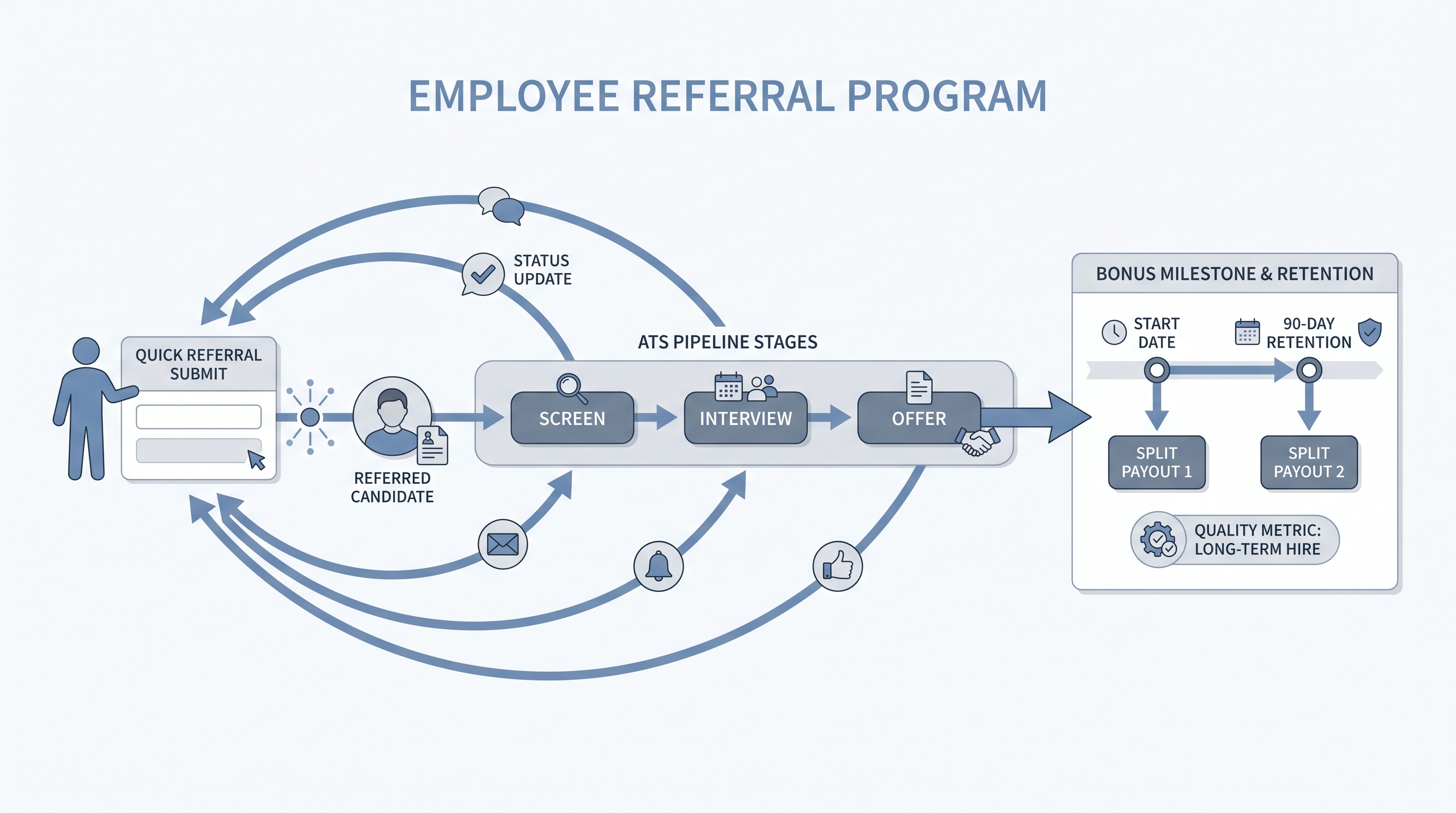
An employee referral program is a structured channel where current employees recommend candidates for open roles. The employer typically offers a bonus paid after the referred hire crosses a retention threshold, often 90 days. Referral hires consistently outperform other sources on onboarding speed, time-to-productivity, and first-year retention in studies across industries.
The reason is network quality. Employees who refer tend to know both the culture and the candidate's working style. They also have a social stake in the outcome. The program only delivers those benefits if the process makes referring easy, transparent, and worth the effort.
In practice
- When a recruiter says "we have a referral but HR does not have the form ready," the program is already broken. The submission path should take under two minutes and work on mobile.
- A TA ops team that audits their referral channel usually finds that 60 to 70 percent of submissions came from fewer than 10 employees. The other employees tried once, heard nothing, and never referred again.
- An HRBP reviewing year-end diversity numbers may find that a strong referral channel quietly reduced representation at certain levels because the referring population is not diverse enough to build from.
Quick read, then how hiring teams use it
This is for recruiters, sourcers, TA leads, and HR partners who own or contribute to a referral program. Skim the first section for a working vocabulary. Use the second when you are diagnosing low participation, rebuilding a broken process, or connecting the referral channel to your broader direct sourcing strategy.
Plain-language summary
- What it means for you: A referral program is only as good as the submission and follow-up experience. If employees cannot submit in two minutes and do not hear back, the program is a one-time event, not a channel.
- How you would use it: Map the current submission path end to end. Count the clicks, identify the first drop-off point, and fix that before you change the bonus structure.
- How to get started: Survey the last 20 employees who submitted a referral. Ask how long submission took and whether they received status updates. The answers will tell you exactly what to fix.
- When it is a good time: When time-to-fill for a repeating role type is consistently over 30 days and the team has a clear network in that talent pool.
When you are running live reqs and tools
- What it means for you: The referral channel can be wired to your ATS with automated status notifications back to the referrer, removing the manual follow-up burden from recruiters and increasing employee participation.
- When it is a good time: Any time you are rebuilding or launching a referral process, wire the automation before you launch. Fixing a broken notification loop after complaints arrive is harder than building it correctly from the start.
- How to use it: Configure your ATS to tag referred candidates with the referrer's employee ID. Set automated stage-change notifications to the referrer. Add a closing notification when the candidate accepts or declines. This is a one-time setup that changes participation rates measurably.
- How to get started: Pull the ATS data on your last 30 referred candidates. Check how many referrers received any communication after submission. If the answer is fewer than half, the automation loop is broken or missing.
- What to watch for: Referral programs that create unofficial sponsorship networks where managers push their connections through unfairly, GDPR consent gaps when personal data enters the ATS without the candidate's knowledge, and participation concentrated in a single department or demographic group.
Where we talk about this
On AI with Michal live sessions, referral program activation comes up when participants map their sourcing channels and find that the highest-potential channel has the lowest effort invested in maintaining it. The fix usually involves a combination of workflow automation for notifications and targeted outreach using AI to identify which employees to ask and when. If you want the room conversation with other TA practitioners building these systems, start at Sourcing Lab and bring your current referral conversion numbers.
Around the web (opinions and rabbit holes)
Third-party creators move fast. Treat these as starting points, not endorsements, and double-check anything before you wire candidate data to a new tool.
YouTube
- How to Build an Employee Referral Program That Works (search) covers program design, bonus structure, and common failure modes from practitioners who have run them at scale.
- Employee Referrals and Diversity (search) addresses the demographic replication risk and how program design can widen the referred talent pool.
- Automating Referral Program Notifications (search) shows how to wire status updates between the ATS and Slack or email so employees stay informed.
- How do you run your referral program? in r/recruiting is a frank practitioner thread on what actually drives participation versus what HR communications claim.
- Referral bonuses and tax treatment in r/humanresources covers the compliance angle that TA often leaves to payroll until it becomes a problem.
- Building an internal talent marketplace vs referral program in r/recruiting discusses when referrals and internal mobility overlap and how to distinguish the two.
Quora
- How do companies design successful employee referral programs? collects answers from HR leaders and TA specialists on bonus structures, participation mechanics, and common failures.
Referral channel vs agency vs job board
| Dimension | Referral | Agency | Job board |
|---|---|---|---|
| Cost per hire | Low after bonus | High (15-25% fee) | Variable by platform |
| Time-to-fill | Often faster (warm network) | Fast for surge capacity | Slower for passive talent |
| Quality signal | High: social endorsement | Depends on agency | Low: broad pool |
| Diversity risk | Higher: mirrors existing team | Neutral | Lower with broad posting |
| Maintenance required | High: process and communication | Low | Low |
Related on this site
- Glossary: Direct sourcing, Talent community sourcing, Employer value proposition, Workflow automation, Sourcing funnel metrics
- Blog: AI sourcing tools for recruiters
- Guides: Sourcers
- Live cohort: Sourcing Lab
- Self-paced: Starting with AI: the foundations in recruiting
- Membership: Become a member