Job description readability
How clearly and quickly a job posting communicates the role, requirements, and benefits to a qualified candidate. Plain language, short paragraphs, and bias-free wording increase apply rates and reduce mismatched applications.
Michal Juhas · Last reviewed June 14, 2026
What is job description readability?
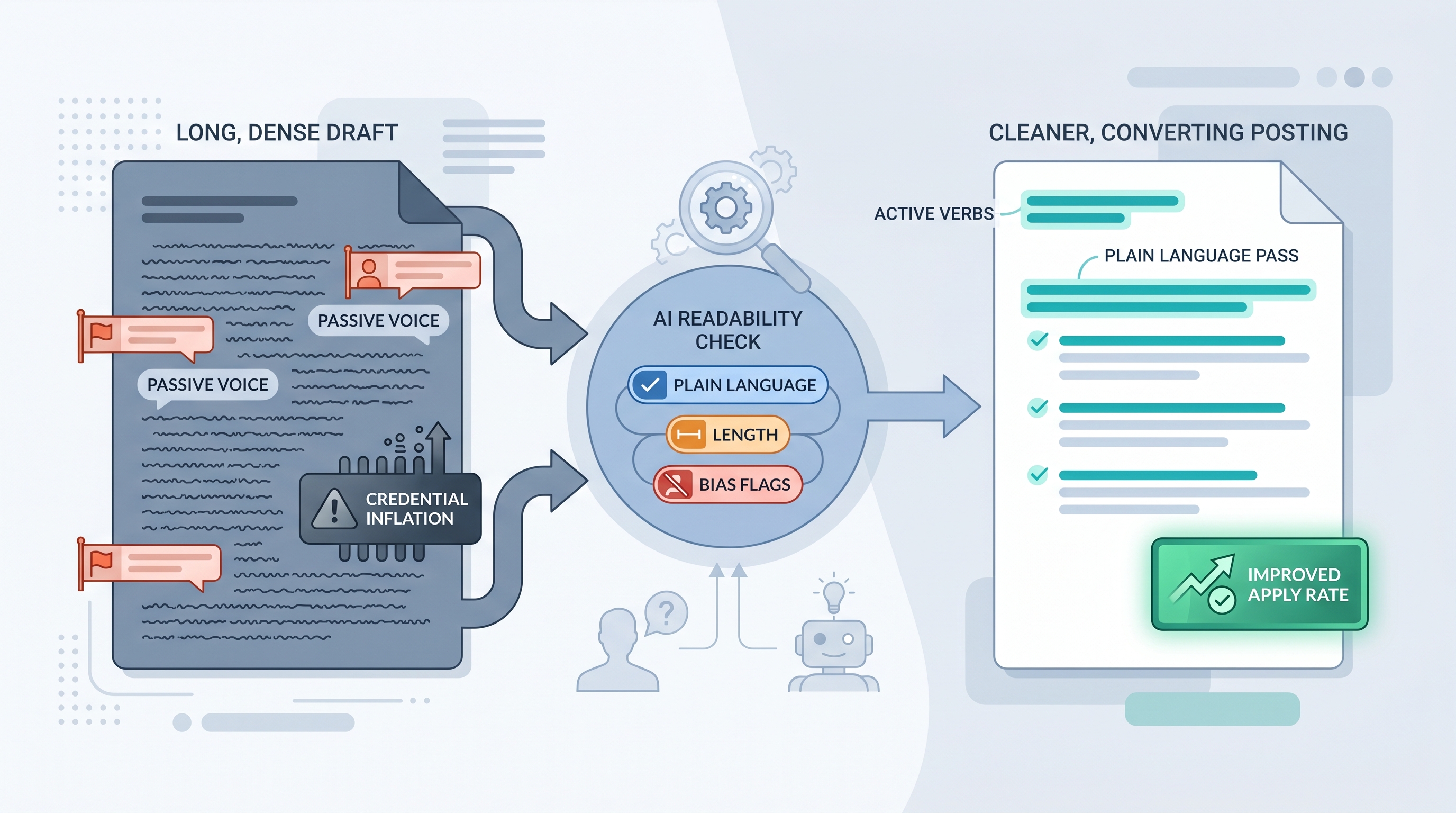
Job description readability measures how fast and clearly a posting communicates what a role is, who it is for, and why someone should apply. A recruiter can have the right keyword set and still lose qualified applicants because the JD reads like an internal requirements document rather than a compelling invitation. Readability tools and AI prompts help identify passive voice, excessive length, credential inflation, and language that skews away from certain groups.
In practice
- A sourcer copies a JD into a ChatGPT prompt asking for passive voice flags and a Flesch-Kincaid estimate. The output highlights 11 bullet points that start with "responsible for" and suggests active verb replacements.
- A TA ops lead runs every new JD through a shared Notion template checklist: job title, day-to-day tasks, required versus preferred criteria, and one compelling reason to apply. If a section is missing, it goes back to the hiring manager before posting.
- On a hiring manager call, a recruiter hears "I need someone proactive and driven." The recruiter translates that into specific, testable criteria in the JD rather than the buzzwords, which would have filtered out good candidates who don't self-identify with those adjectives.
Quick read, then how hiring teams use it
This is for recruiters, TA leads, and HR partners who review or approve JDs before they go live. Skim the first section when you need a shared vocabulary for a review meeting. Use the second when you are setting standards or auditing a JD batch.
Plain-language summary
- What it means for you: A readable JD converts more qualified visitors to applicants and fewer unqualified ones, reducing inbound noise and improving your pipeline quality from day one.
- How you would use it: Run every new JD through a plain-language checklist or AI prompt before posting. Flag credential inflation, passive voice, and anything that reads like a legal waiver.
- How to get started: Pick one JD posted in the last 90 days that produced a weak applicant pool. Run it through the two-minute scan test. List what information a qualified candidate could not find. Rewrite those sections and compare the next 30 days of applicant quality.
- When it is a good time: Before a JD goes live, not after apply rates disappoint. Set a 15-minute readability review as a standard gate in your intake process.
When you are running live reqs and tools
- What it means for you: Readability is a conversion rate lever at the top of the funnel. Improving one JD is an experiment; building a template governance system is a durable efficiency gain for every recruiter on the team.
- When it is a good time: When you are building or auditing JD templates, after a new req opens and before it hits the ATS, and when a role repeatedly attracts the wrong applicant profiles.
- How to use it: Connect JD drafting to your intake-to-JD AI workflow. Use a prompt that asks the model to flag gendered language, passive constructions, and lines a candidate already assumes. Store approved templates in your ATS or a shared repo so the governance is not manual.
- How to get started: Draft a blocked-phrases list with the hiring manager you work with most. Add five phrases that historically correlate with weak inbound, and five active-verb alternatives. Make that the starting point for your JD template library.
- What to watch for: Over-editing until the JD reads like no one wrote it. The goal is clarity, not corporate blandness. If every JD at your company sounds identical, candidates notice. Maintain role-specific voice within a readable structure.
Where we talk about this
On AI with Michal sessions, JD readability comes up in the intake-to-brief workflow in the AI in recruiting track. We work through live JDs from attendees, run them through readability prompts, and produce a cleaner version in the same session. If you want the full practical workflow, start at the AI Recruiting Accelerator and bring a JD you actually need to post.
Around the web (opinions and rabbit holes)
Third-party creators move fast. Treat these as starting points, not endorsements, and double-check anything before wiring candidate data.
YouTube
- How to Write a Job Description That Attracts the Best Candidates (SHRM) covers the fundamentals of job description structure for practitioners.
- Writing Inclusive Job Descriptions (LinkedIn Talent Solutions) walks through common language pitfalls with before-and-after examples.
- Why do job descriptions suck so much? in r/recruiting is a frank thread from both sides: recruiters who inherit bad templates and candidates who cannot decode them.
- Tips for writing better JDs? in r/humanresources collects practitioner tactics on credential inflation and plain-language rewrites.
Quora
- What makes a good job description? surfaces recruiter and candidate perspectives that rarely appear in vendor whitepapers.
JD red flags versus good signals
| Signal | Red flag | Good signal |
|---|---|---|
| Length | Over 800 words | Under 500 words |
| Opening section | Company history | Day-to-day tasks |
| Requirements | "Degree required" for non-specialist roles | "Experience with X" |
| Language | Passive voice, adjective stacks | Active verbs, specific criteria |
| Apply rate | Under 5% of visitors | Over 10% of visitors |
Related on this site
- Glossary: Intake to JD AI, AI bias audit, Job description bias detection, Scorecard, Human-in-the-loop
- Blog: Boolean search vs AI sourcing
- Guides: Sourcers
- Live cohort: AI Sourcing Lab
- Course: Starting with AI: the foundations in recruiting
- Membership: Become a member