Recruiting funnel analytics
Measuring how candidates move stage to stage (applied, screened, interviewed, offered, hired) so you can find where the funnel leaks, where it converts, and which sources actually deliver hires.
Michal Juhas · Last reviewed June 6, 2026
What is recruiting funnel analytics?
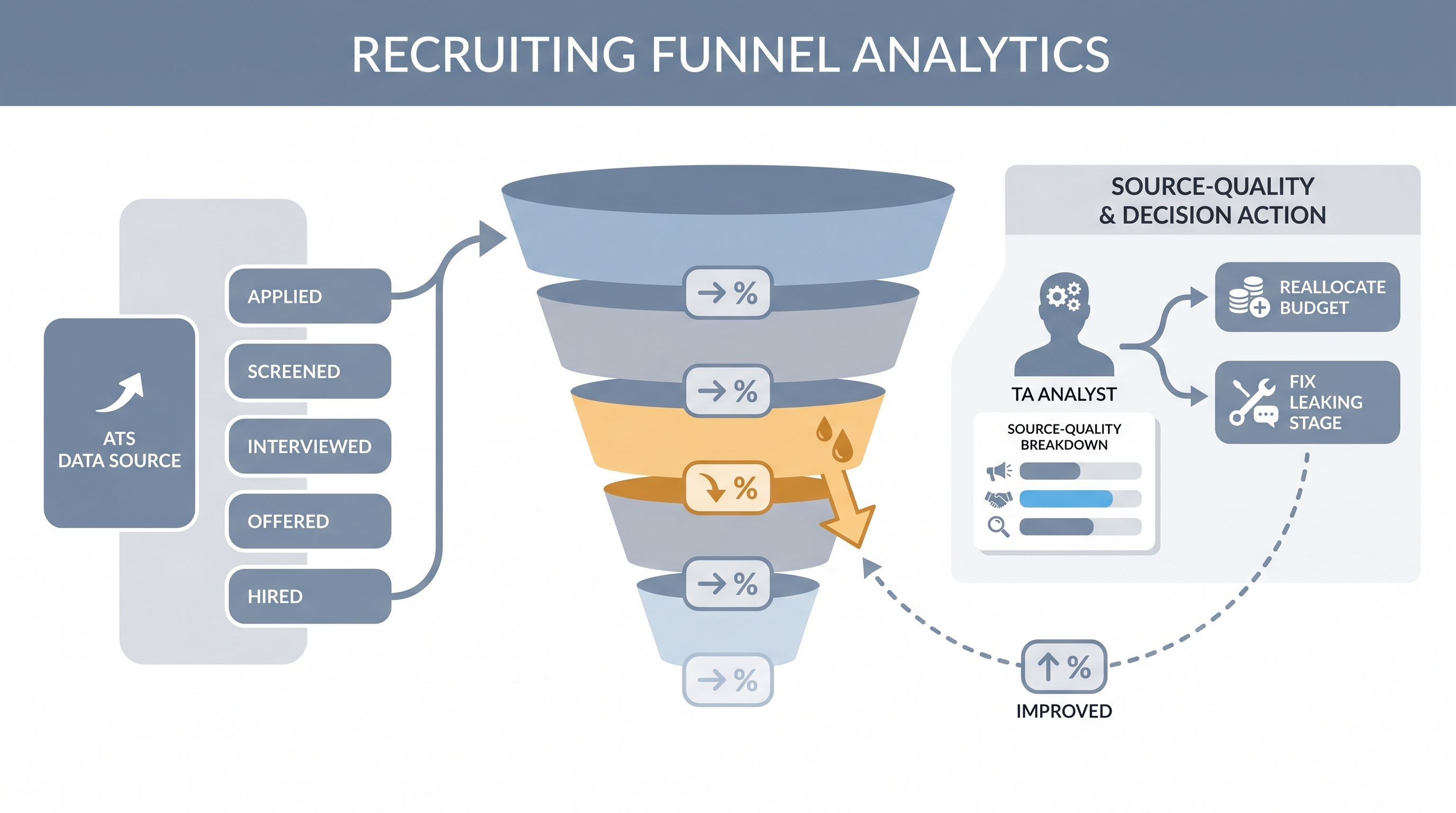
Recruiting funnel analytics is the practice of measuring how candidates move through each hiring stage, from applied or sourced through screened, interviewed, offered, and hired, so you can see where people drop off and which sources convert. The point is not the counts but the conversion rates between stages: that is where leaks, bottlenecks, and your best channels become visible.
In practice
- A recruiter says "the funnel looks healthy until the interview stage, then it falls off a cliff," and what they mean is the screen-to-interview pass-through rate dropped while the rest held steady.
- In a debrief, a TA lead pulls up stage counts next to last quarter's baseline and asks "why is offer-to-accept down ten points?" instead of celebrating raw application volume.
- A sourcing ops person calls a channel "expensive" when its source-to-hire rate is low, even if it floods the top of the funnel with profiles, because volume without conversion just adds screening work.
Quick read, then how hiring teams use it
This is for recruiters, sourcers, TA, and HR partners who need the same vocabulary in pipeline reviews, vendor calls, and planning meetings. Skim the first section when you need a fast shared picture. Use the second when you are deciding how funnel data shows up in the ATS, your reporting, and the weekly stand-up.
Plain-language summary
- What it means for you: Instead of asking "how many applied," you ask "what percentage moved to the next step." That single shift shows you where candidates fall out and where your real bottleneck is, not just where the noise is.
- How you would use it: Lay your stage counts in a row, turn each gap into a percentage, and look for the one stage where the drop is much steeper than the others. That is your leak.
- How to get started: Agree on stage names with your team, pull one clean export from the ATS, and calculate four ratios: applied to screen, screen to interview, interview to offer, offer to accept.
- When it is a good time: As soon as you run more than a couple of reqs at once, because then you can no longer hold the whole pipeline in your head.
When you are running live reqs and tools
- What it means for you: Funnel analytics turns the applicant tracking system from a storage box into a decision tool. Stage-to-stage conversion, time to fill per stage, and source-to-hire are the numbers that change where you spend hours and budget.
- When it is a good time: Review weekly for live reqs so you catch a stalling pipeline while you can still act, and monthly for trends like creeping cycle time or a channel that quietly stopped converting.
- How to use it: Define each stage once, treat the ATS as the single source of truth, and segment by source and seniority before you draw conclusions. A model can pull and summarise the data, but keep a human in the loop for any decision and never let it invent a number the ATS did not report.
- How to get started: Build one repeatable loop: export, clean, calculate ratios, flag the steepest drop, name an owner. Start from a clean weekly hiring funnel report rather than a 30-tile dashboard nobody opens.
- What to watch for: Tiny sample sizes that make conversion rates meaningless, inconsistent stage logging across recruiters, and GDPR drift when candidate-level lists get pasted into chat. Report aggregate stage counts and calibrate baselines each quarter.
Where we talk about this
On AI with Michal live sessions we work through this with real exports, not slides. Sourcing automation blocks focus on the export-clean-summarise loop and where AI safely speeds it up, while AI in recruiting blocks connect the numbers back to hiring manager trust and what you actually change after you spot a leak. If you want the full room conversation, start at Sourcing Lab and bring the one req that keeps stalling.
Around the web (opinions and rabbit holes)
Third-party creators move fast and definitions vary. Treat these as starting points, not endorsements, and reconcile any metric against your own ATS before you quote it in a review.
YouTube
- Recruiting Metrics That Actually Matter searches surface plenty of walkthroughs; favour ones that show real stage-to-stage rates over generic KPI lists.
- How to Build a Recruiting Funnel Dashboard clips are useful for layout ideas, though most assume a tool you may not have.
- What recruiting metrics do you actually track? threads in r/recruiting are candid about which numbers leadership asks for versus which ones change a plan.
- How do you report your pipeline? discussions in recruiting subs show how small teams build this without a data function.
Quora
- What are the most important recruiting funnel metrics? collects a wide range of practitioner answers, so read critically and keep what matches your stages.
Counts versus conversion analytics
| Question | Counting applicants | Funnel analytics |
|---|---|---|
| Top-line view | Total applied | Pass-through rate per stage |
| Finds the leak | No | Yes |
| Compares sources | By volume | By source-to-hire |
| Drives action | Rarely | Names the stage to fix |
Related on this site
- Glossary: Weekly hiring funnel report, Time to fill, Applicant tracking system, Human-in-the-loop (HITL), Candidate experience
- Blog: Boolean search vs AI sourcing
- Guides: Talent acquisition managers, Recruiters
- Course: Starting with AI: the foundations in recruiting
- Live cohort: Sourcing Lab
- Membership: Become a member