Top hiring platforms
Recruiting software suites that rank among the most widely adopted by TA teams, covering application intake, candidate tracking, and at least one adjacent stage such as sourcing or interview scheduling, with integrations into HRIS and analytics tools.
Michal Juhas · Last reviewed May 9, 2026
What are the top hiring platforms?
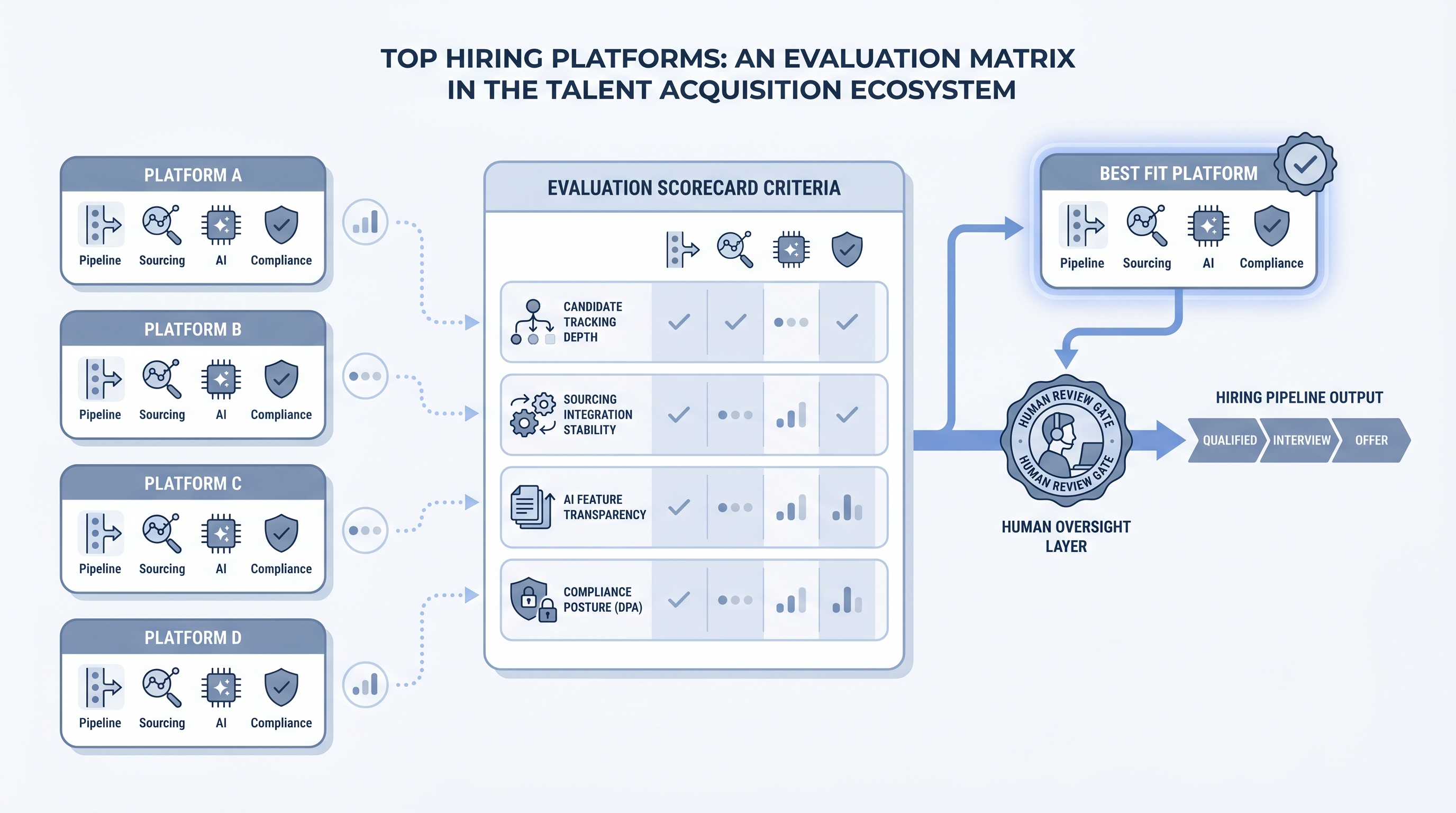
Top hiring platforms are recruiting software suites that cover the core applicant tracking function alongside at least one adjacent stage: sourcing, resume screening, interview scheduling, or analytics. The designation is not a fixed list. It shifts as vendors update features, acquire smaller tools, or change their pricing model. In practice, a platform earns the label when TA teams across company sizes consistently cite it in peer communities as something they still use and recommend 12 months after going live.
In practice
- A TA director running a mid-year stack review might say "we're on one of the top platforms but we still use a separate sourcing tool and a scheduling app," meaning the platform covers the ATS layer but not the adjacent stages it was sold on.
- A sourcer who can search candidates from inside the same system that logs interview feedback is getting the core value proposition of an integrated platform rather than a point solution.
- A recruiter who finds that a candidate who withdrew six months ago reappears as a new applicant is experiencing a data model problem that even top-ranked platforms ship with if deduplication is not configured correctly.
Quick read, then how hiring teams use it
This is for recruiters, TA leaders, and HR ops teams deciding which hiring platform to standardise on, evaluating whether to migrate, or auditing whether the current platform is still earning its contract. Skim the first section for shared vocabulary. Use the second when you are mid-evaluation or diagnosing a live operational problem.
Plain-language summary
- What it means for you: A top hiring platform is software that covers sourcing, tracking, and coordination in one place, so you do not re-enter the same candidate data in three tools every time a requisition opens.
- How you would use it: Pick the funnel stage that breaks most often today, whether that is the handoff from sourcing to screening or from interview to offer, and check whether the platform owns that stage natively or relies on an integration you will need to maintain.
- How to get started: List every tool your team uses today and draw one line per handoff. Any manual step in that map is either a platform gap or an opportunity the platform claims to close. Test the claim on a live req before you sign.
- When it is a good time: Before a headcount jump that will expose integration limits, before renewing a contract on a platform your team actively works around, or before adding another point solution that a platform might already cover.
When you are running live reqs and tools
- What it means for you: Every stage a platform automates is a data processing decision with legal weight. If the platform ranks, scores, or filters candidates using AI, you need a log of which model version ran and a reviewer before that output influences who advances.
- When it is a good time: Before enabling any AI feature that affects early-funnel filtering at volume. Platform AI is usually on by default once activated; confirm what it does and who owns the output before it processes real candidates.
- How to use it: Map which platform module owns which stage. Confirm which candidate fields are authoritative in the platform versus a connected HRIS or background check tool. Add a human-in-the-loop review before any AI-generated shortlist, score, or message reaches a candidate.
- How to get started: Pull one data flow diagram per stage: input, platform action, output destination, and reviewer. Most teams find at least one stage where the platform acts on candidates without a logged approval step.
- What to watch for: Vendors that add AI features mid-contract without re-opening the data processing agreement. Integration changes that silently drop or overwrite candidate fields. Scoring outputs that influence shortlists but are never recalibrated after the initial setup. Workflow automation gaps where the platform fires a webhook but does not log a failure if the downstream tool is unreachable.
Where we talk about this
On AI with Michal live sessions, top hiring platform choices come up in both Recruiting OSs. AI in recruiting blocks cover evaluation criteria, how to stress-test AI features before turning them on at volume, and where compliance gates belong in a platform-managed funnel. Sourcing automation blocks go deeper into the ATS API layer, field mapping reliability, and what breaks when a platform vendor ships a schema change without notice. Bring your current platform shortlist and your highest-friction stage to Sourcing Lab and get grounded feedback from teams who made the same call.
Around the web (opinions and rabbit holes)
Third-party coverage of hiring platforms moves fast as vendors update features and pricing. Treat these as starting points, not endorsements, and verify compliance postures and data residency directly with vendors before any purchase decision.
YouTube
- Top applicant tracking systems compared surfaces recent demo walkthroughs across company sizes so you can see actual UI before a sales call.
- How to choose a hiring platform for your team covers evaluation frameworks from practitioners, not vendor sales pitches.
- ATS migration lessons from TA teams captures honest accounts of what data portability looked like when teams moved between top platforms.
- Which ATS or hiring platform does your company use? in r/recruiting collects candid peer comparisons across company sizes and industries.
- We just migrated to a new platform in r/recruiting captures what teams discovered post-migration that vendor demos did not show.
- AI features in hiring platforms - real use or hype? in r/recruiting separates daily reality from the feature sheet.
Quora
- What are the best hiring platforms for mid-sized companies? collects practitioner and vendor perspectives across company stages (quality varies; read critically).
Top hiring platforms vs related terms
| Term | What it covers | Where it stops |
|---|---|---|
| Top hiring platforms | Broadly adopted multi-stage recruiting suites | "Top" varies by company size, region, and use case |
| Hiring platforms | Any multi-stage platform regardless of market share | Does not imply peer adoption or integration maturity |
| Applicant tracking software | Application intake, stage tracking, recruiter coordination | Typically stops before sourcing or scheduling |
| AI recruitment platform | Platform with AI sourcing, screening, or copilot features built in | Narrower: implies AI-first architecture as a differentiator |
| Hiring tools | Any software used in the hiring process, including point solutions | No shared data model across stages by default |
Related on this site
- Glossary: Hiring platforms, Applicant tracking software, AI recruitment platform, Hiring tools, AI recruiting tools, Human-in-the-loop, Workflow automation, AI bias audit
- Blog: AI sourcing tools for recruiters
- Glossary: Best applicant tracking software, Best applicant tracking system
- Guides: Sourcers
- Workshops: Sourcing Lab
- Membership: Become a member
- Courses: Starting with AI: the foundations in recruiting