HR tools for recruitment
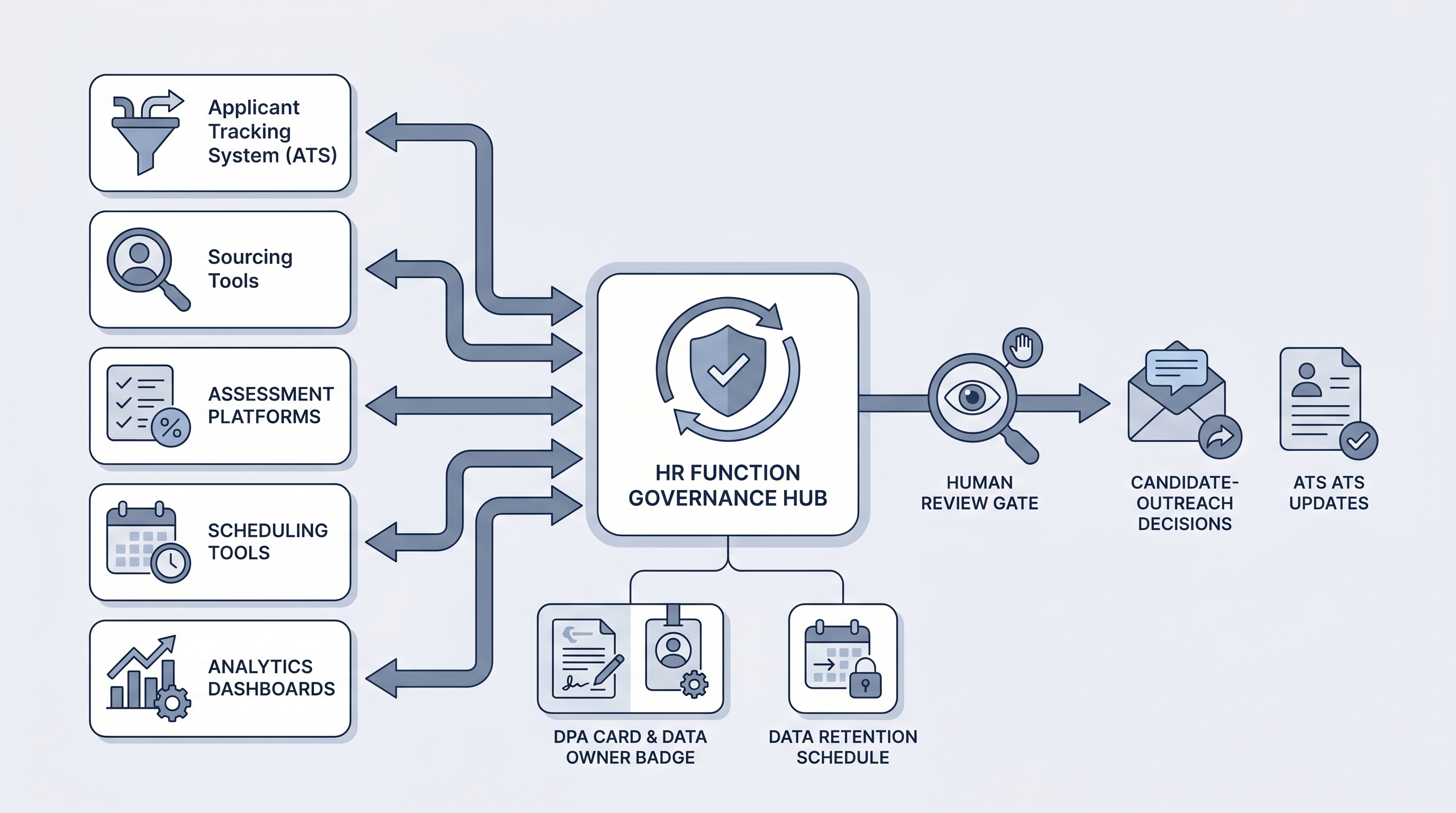
The software platforms, applications, and AI-assisted services that the HR function deploys to run the recruitment process, including applicant tracking systems, sourcing tools, assessment platforms, interview scheduling, compliance monitoring, and workforce analytics.
Michal Juhas · Last reviewed May 10, 2026
What are HR tools for recruitment?
HR tools for recruitment are the platforms and applications the HR function uses to run the hiring process from requisition approval to offer acceptance. The category is broader than what individual recruiters use day to day: it covers the full technology stack that People Ops and HR leadership own, govern, and pay for.
At its core, the stack starts with an applicant tracking system as the central record of every open role and every candidate. Around it sit sourcing tools for finding passive talent, assessment platforms for early qualification, interview scheduling software, and analytics dashboards. AI is now embedded in each of these categories, adding resume scoring, draft generation, and anomaly detection alongside the traditional routing and storage functions.
The HR framing matters because it shifts where accountability sits. An individual recruiter who runs outreach through a sourcing tool owns their own workflow. The HR function that procured that tool, signed the data processing agreement, and defined the retention policy owns the compliance posture for every candidate record in it.
In practice
- An HR director presenting the technology budget to a CFO uses "HR tools for recruitment" as the umbrella covering eight vendor contracts, three integration projects, and two renewals up for review, not as a reference to any single product.
- A People Ops lead running a stack audit discovers that the ATS, the sourcing tool, and the assessment platform each store candidate PII under separate retention schedules that have never been reconciled into a single GDPR response plan.
- When a recruiter says "our tools don't talk to each other," the underlying problem is usually an HR tools governance gap: no one mapped data flow between vendors at procurement, so candidates fall out of the pipeline when fields don't match.
Quick read, then how hiring teams use it
This is for HR leaders, People Ops managers, HRBPs, and TA leads who make tooling decisions, manage vendor contracts, or need to explain their recruitment technology stack to finance or legal. Skim the first section for shared vocabulary. Use the second when you are auditing, procuring, or governing tools in production.
Plain-language summary
- What it means for you: HR tools for recruitment are the software products your HR team uses to run hiring, from posting a job to signing an offer. You own the contracts, the compliance obligations, and the decision about what each tool can do with candidate data.
- How you would use it: Audit once a year: what does each tool touch, who owns it, and does the vendor DPA still match your data residency requirements? That audit is more valuable than any feature comparison.
- How to get started: List every tool that touches a candidate record, who owns the contract, and where the data lives. That list is your compliance exposure map before you evaluate anything new.
- When it is a good time: Before any new hire joins the TA team (so they inherit a documented stack, not tribal knowledge), before any renewal where the vendor changed their data sub-processors, and before AI features are enabled in tools that previously only routed and stored.
When you are running live reqs and tools
- What it means for you: HR tools for recruitment create data obligations at every integration point. Each API connection is a place where candidate PII moves between vendors, and each movement needs a lawful basis, a retention limit, and an owner who can answer legal's questions within a GDPR response window.
- When it is a good time: After you have mapped data flow and assigned tool owners. Adding new tools to an ungoverned stack accelerates compliance exposure rather than solving it.
- How to use it: Treat each tool category (sourcing, assessment, ATS, scheduling) as a separate data processing record. Use workflow automation to connect tools rather than building manual exports, and route all AI outputs through a review queue before they reach candidate records. See ATS API integration for stable integration patterns.
- How to get started: Pick the tool that has the most candidate data and the least governance documentation. Write a one-page data flow record for it: what goes in, what comes out, where it lands, how long it stays. That is the template for the rest of the stack.
- What to watch for: Vendor model updates that change AI scoring behaviour without notice; HRIS disconnects where new hire records take days to sync; and assessment tools that store raw psychometric data beyond the retention period agreed at procurement. HR analytics in recruitment covers how to build clean reporting on top of this stack.
Where we talk about this
On AI with Michal live sessions, HR tools for recruitment appear in the AI in recruiting track when teams work through which tool categories to buy, govern, and connect, and in the sourcing automation track when they wire sourcing and outreach tools into pipeline workflows. Both tracks spend time on what sustainable integration looks like and what breaks when governance is skipped. Start at Sourcing Lab and bring your current vendor list and the compliance question your legal team raised most recently.
Around the web (opinions and rabbit holes)
Third-party creators move fast and tooling changes monthly. Treat these as starting points, not endorsements. Do not connect candidate data to tools based on a YouTube tutorial alone.
YouTube
- Search "HR technology stack 2025 review" for independent evaluations of how teams at different sizes structure their recruitment tool category, which vendors survived renewal, and which integrations created more admin than they removed.
- Search "ATS comparison for HR teams" to find practitioner walkthroughs that go beyond feature grids into data residency, API stability, and what the vendor does when a model update changes screening behaviour.
- r/humanresources covers HR tool evaluations from the HR function perspective: which products work for compliance, which vendors have responsive support, and which integrations broke after a system update.
- r/recruiting carries the recruiter-side view: which tools save time in production versus in demos, and what the failure modes look like when the stack is under high-volume load.
Quora
- What are the best tools for HR recruitment? collects varied practitioner answers across company sizes; useful as a first scan before entering a procurement process, not as a final recommendation.
HR recruitment tool categories at a glance
| Category | Primary function | Key governance question |
|---|---|---|
| Applicant tracking system | Pipeline state and candidate records | Who has admin access and what is the retention schedule? |
| Sourcing tools | Passive candidate discovery and outreach | Does GDPR first-touch consent cover the source you are using? |
| Assessment platforms | Early qualification and skills evaluation | What is the group pass-rate across protected categories? |
| Interview scheduling | Calendar coordination and meeting management | Where does attendee data and transcript content land? |
| Analytics dashboards | Pipeline metrics and sourcing ROI | Are individual candidate records anonymised before aggregation? |
| AI layers | Draft generation, scoring, anomaly detection | Which model version ran and who reviewed the output? |
Related on this site
- Glossary: Hiring tools, HR AI tools, Applicant tracking software, HR analytics in recruitment, HR hiring software, HR recruitment system, Human-in-the-loop, Adverse impact, AI bias audit, Talent acquisition metrics, Workflow automation, Diversity recruiting tools
- Blog: AI sourcing tools for recruiters
- Live cohort: Sourcing Lab
- Membership: Become a member
- Course: Starting with AI: foundations in recruiting