Prompt engineer sourcing
The targeted process of finding and engaging people who design, test, and operationalize prompts for large language models: a hybrid role whose strongest signals live in shared prompt libraries, model evaluation write-ups, and public LLM projects rather than in a tidy job title.
Michal Juhas · Last reviewed June 27, 2026
What is prompt engineer sourcing?
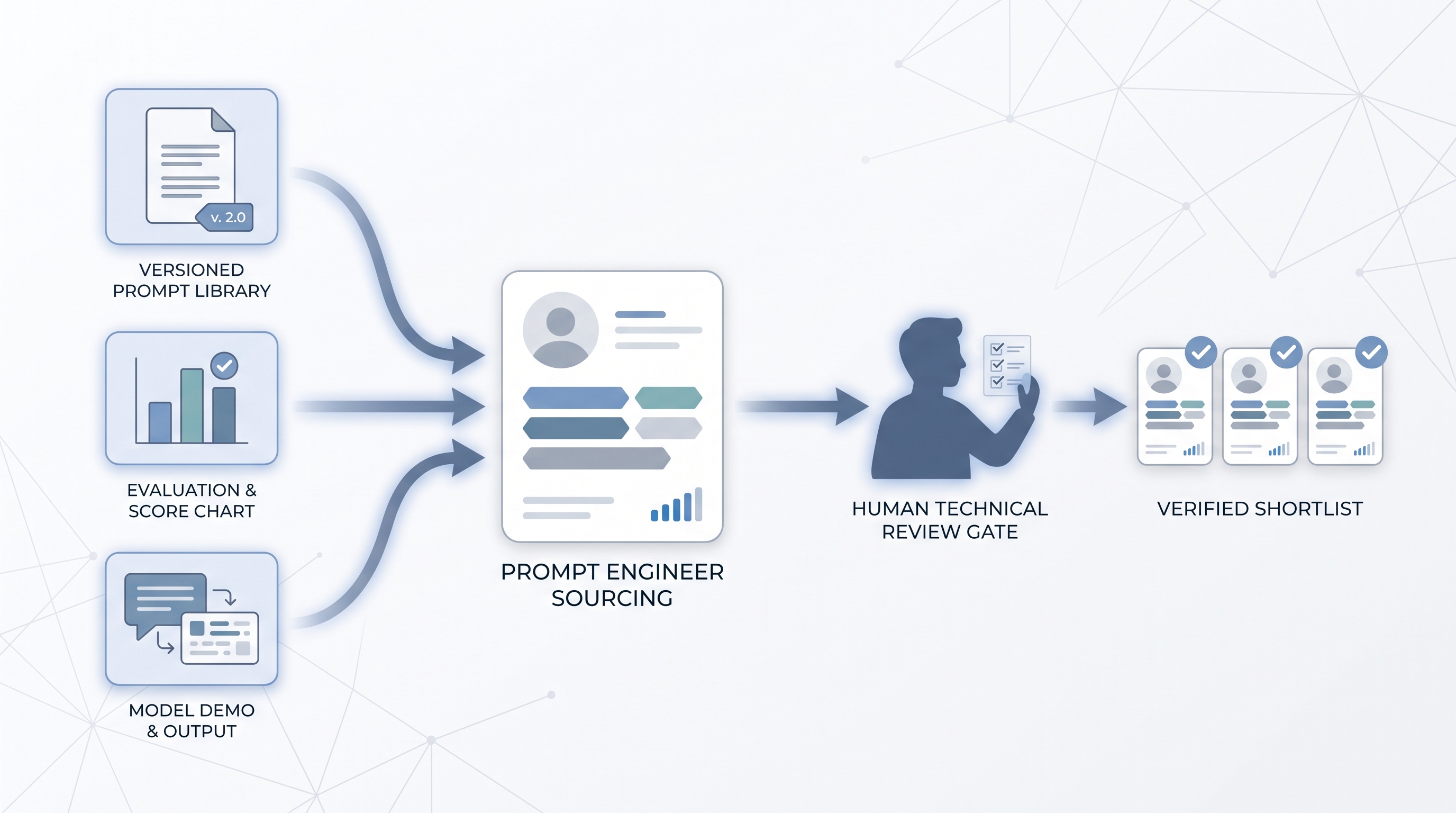
Prompt engineer sourcing is the targeted process of finding and engaging people who design, test, and maintain the instructions that steer large language models in production. Unlike most tech sourcing, the title is young and inconsistent, the candidate pool blends self-taught practitioners with applied ML engineers, and the strongest signals live in shared prompt libraries, evaluation write-ups, and public demos rather than in a clean job history on LinkedIn.
In practice
- A sourcer filling a prompt engineer req might start on GitHub and Hugging Face, looking for versioned prompt repositories and evaluation notebooks, rather than keyword-searching LinkedIn Recruiter for the exact title.
- At a hiring standup, someone might say "we need a prompt engineer" and mean anything from a content-side prompt writer to an engineer who owns a retrieval pipeline and a token budget. Clarifying the scope before sourcing saves weeks of misaligned outreach.
- Tools like LinkedIn Recruiter AI-assisted search, GitHub search, and semantic profile matching are the platforms most teams evaluate first for this still-forming role family.
Quick read, then how hiring teams use it
This is for recruiters, sourcers, TA, and HR partners who need the same vocabulary in req intake, vendor calls, and hiring manager debriefs. Skim the first section when you need a fast shared picture. Use the second when you are deciding how it shows up in your sourcing stack and outreach cadences.
Plain-language summary
- What it means for you: Prompt engineer sourcing is not generic tech sourcing with "AI" keywords added. The title means different things at different companies, the talent pool is mixed, and the clearest skill signals are unfamiliar: prompt repos, evaluation methodology, shipped LLM features.
- How you would use it: Start with a req intake meeting that defines the actual scope: prompt design only, or end-to-end LLM feature ownership including retrieval, evaluation, and cost. Then build sourcing channels around where that scope is visible.
- How to get started: Ask your hiring manager to name three people whose LLM work they respect and where they found them. Those answers reveal the real signal sources before you open a single tool.
- When it is a good time: When the role genuinely needs someone to own model behavior and reliability. If it mostly needs a frontend engineer who occasionally calls an API, it is a product engineering req, not a prompt engineer req.
When you are running live reqs and tools
- What it means for you: The sourcing funnel is noisy: many people claim the title after a few weekend projects, so the work is separating depth from demos. The yield from a well-qualified shortlist is high because few candidates can show real evaluation rigor.
- When it is a good time: After the hiring manager has confirmed the scope, the model family, and whether production reliability or rapid prototyping matters more. Sourcing before this produces pipelines full of mismatched profiles.
- How to use it: Pair semantic search with Boolean search strings that target frameworks and evaluation terms, not just the word "prompt." Run outreach through a candidate data enrichment step to verify contact details before personalizing at scale.
- How to get started: Write one search string for your scope, test it against five profiles your hiring manager respects, and calibrate before scaling. Add a human-in-the-loop review for any shortlist above 20 profiles so a technical reader can filter tinkerers from engineers.
- What to watch for: Treating a viral prompt or a high follower count as proof of engineering skill. Over-indexing on tool familiarity instead of evaluation discipline. And skipping the scope conversation, which is the single biggest cause of wasted outreach in this role family.
Where we talk about this
On AI with Michal live sessions, prompt engineer sourcing comes up in sourcing automation blocks and AI in recruiting tracks. We walk through what works in practice: building Boolean strings for GitHub and technical communities, reading a prompt repository and an evaluation write-up as skill signals, and structuring outreach that respects how this candidate pool judges companies. Start at Sourcing Lab for the hands-on technical track, or join the main AI Sourcing Lab for the broader sourcing and hiring context.
Around the web (opinions and rabbit holes)
Third-party creators move fast. Treat these as starting points, not endorsements, and verify any process before you wire candidate data across tools.
YouTube
- Search "sourcing prompt engineers" and "hiring LLM engineers" for recent walkthroughs. Practitioners post live sourcing sessions for AI roles regularly; favor uploads from the last six months to avoid outdated tool advice.
- Technical recruiter channels often demo GitHub and Hugging Face profile analysis alongside outreach sequences for LLM-adjacent roles.
- r/recruiting threads on AI and prompt engineer hiring are an honest source of practitioner frustration and workarounds when generic tools fail. Search "prompt engineer" within the subreddit.
- r/MachineLearning and LLM-focused communities surface what engineers think of the "prompt engineer" title, which is useful context for writing credible outreach.
Quora
- Search "how to hire a prompt engineer" on Quora for answers from both recruiters and practitioners, which shows both sides of the outreach dynamic.
Prompt engineer sourcing vs. general tech sourcing
| Dimension | General tech sourcing | Prompt engineer sourcing |
|---|---|---|
| Primary signal | LinkedIn title, years of experience | Prompt repos, evaluation write-ups, shipped LLM features |
| Title reliability | Reasonably stable | Inconsistent across companies |
| Candidate pool | Wide and well-defined | Mixed depth, many self-claimed |
| Outreach trigger | Role and compensation | Specific model-level problem |
| Screening focus | Experience and stack fit | Evaluation rigor vs. demo polish |
Related on this site
- Glossary: AI engineer sourcing, ML engineer sourcing, AI candidate sourcing, Boolean search, Semantic search, Candidate data enrichment, AI outreach drafting, Human-in-the-loop (HITL), Hallucination
- Blog: AI sourcing tools for recruiters
- Guides: Sourcers
- Live cohort: Sourcing Lab
- Course: Starting with AI: foundations in recruiting
- Membership: Become a member