Recruitment tracking system
The full set of tools, stage definitions, disposition codes, and accountable people that together record and monitor candidate progress, spanning the ATS, sourcing tools, interview platforms, and any automation that connects them.
Michal Juhas · Last reviewed May 15, 2026
What is a recruitment tracking system?
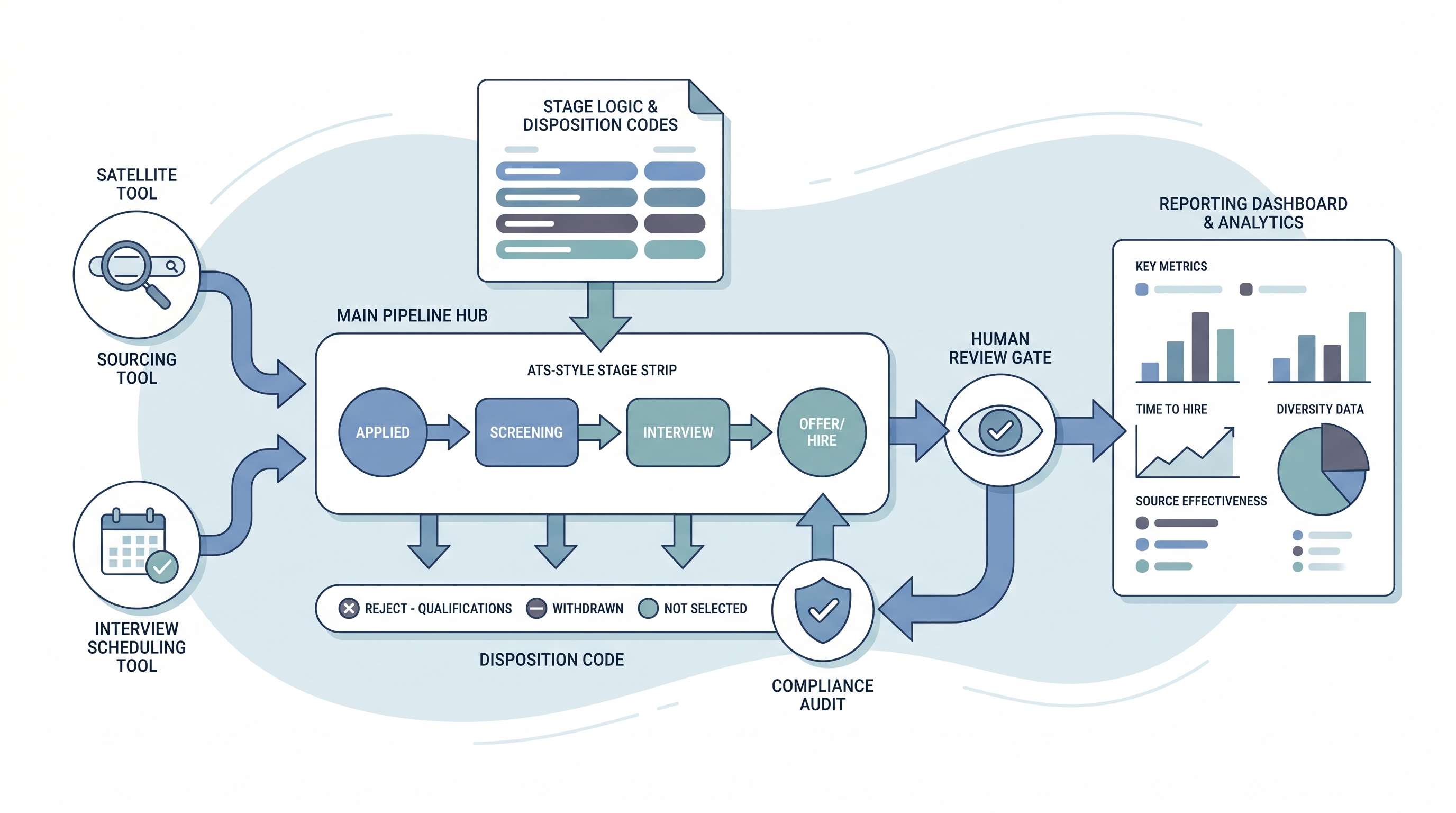
A recruitment tracking system is the full set of components a hiring team uses to record and monitor every candidate and requisition: the ATS or pipeline tool at the center, the stage logic that defines how candidates move, the disposition codes that explain why they exit, and the people accountable for keeping each piece accurate.
The distinction from standalone software matters when something breaks. A perfectly configured ATS cannot compensate for a team that does not log disposition codes, a hiring manager who reviews candidates in a spreadsheet instead of the pipeline, or three sourcing tools with no sync to the main record. The system includes the human and process layer, not just the technology.
In practice
- In a sourcing automation cohort, a recruiter described finding 40 candidates stuck in a "phone screen" stage for over 60 days after the role had already closed. The ATS was fine; the system had no owner for stage cleanup after a req closed.
- Hiring managers who answer candidate status questions from memory rather than the pipeline record are a signal the system is not trusted. When it is not trusted, it stops being updated, which confirms the distrust.
- A TA ops lead at a 400-person company said their tracking reboot began when legal asked for a GDPR deletion report and nobody could produce one. Every tool in the system held its own record with no unified suppression list connecting them.
Quick read, then how hiring teams use it
This is for recruiters, sourcers, TA, and HR partners who need the same vocabulary in audits, vendor calls, and debrief sessions. Skim the first section for the shared picture. Use the second when configuring systems, evaluating tools, or answering compliance questions.
Plain-language summary
- What it means for you: A recruitment tracking system is the whole thing: the software, the stage logic, the people who update it, and the habits that keep it accurate. Not just the ATS.
- How you would use it: You maintain it by logging every stage move, adding disposition codes at every exit, and reviewing stale records regularly. The system is only as accurate as the team's least consistent updater.
- How to get started: Run a one-req audit. Pull the last closed role and count how many stage changes have no timestamp, no owner, or no disposition code. Fix what you find there before adding more tools.
- When it is a good time: When a recruiter cannot answer a hiring manager's status question from the pipeline without checking email or Slack. That gap is the system failure signal.
When you are running live reqs and tools
- What it means for you: The tracking system is the audit trail between your sourcing work and your compliance obligations. Every connected tool adds a new data destination and a new GDPR surface to govern.
- When it is a good time: Before you connect AI scoring, auto-tagging, or stage-advance automation to your pipeline. If the base tracking is inaccurate, automation amplifies the problem across every downstream report and every AI recommendation.
- How to use it: Keep one candidate record per person across all tools. Define which system is the record of truth and enforce sync discipline when other tools must exist. Log disposition codes at every exit, not only for candidates who advance.
- How to get started: Map every tool that holds candidate data. For each, confirm who owns the data processing agreement, what the retention policy is, and how deletion flows when a candidate invokes their right to erasure.
- What to watch for: Disconnected satellite tools that accumulate candidate data outside the main record. Interview scheduling platforms, LinkedIn InMail archives, and video interview libraries are common blind spots in GDPR deletion workflows.
Where we talk about this
On AI with Michal live sessions, the recruitment tracking system comes up across both tracks: the AI in recruiting track covers how AI layers depend on pipeline data quality, and the sourcing automation track covers how webhooks and integrations extend the tracking system beyond the ATS without creating compliance gaps. Start at Sourcing Lab with your current tool list and your top pipeline reporting questions so the feedback fits your actual setup, not a generic demo.
Around the web (opinions and rabbit holes)
Third-party creators move fast and tooling changes monthly. Treat these as starting points, not endorsements, and check anything before you connect candidate data to a new system.
YouTube
- Search "ATS configuration best practices" on YouTube for practitioner walkthroughs of stage logic and disposition code decisions. Filter by upload date: a two-year-old review may describe a product that has since been acquired or repriced.
- Search "talent acquisition ops tracking" for TA operations-focused content from independent practitioners who discuss real pipeline failures, not only vendor success stories.
- r/TalentAcquisition surfaces TA leader conversations on pipeline setup, disposition code standards, and what teams wish they had tested before signing a platform contract.
- r/recruiting has recurring threads on ATS tool selection and pipeline discipline that are more candid than any vendor case study.
Quora
- What is a recruitment tracking system? collects practitioner answers that cover both the software and process dimensions, which is useful when explaining the difference to a hiring manager who asks why the ATS "doesn't work."
Recruitment tracking system versus recruitment tracking software versus ATS
| Aspect | Recruitment tracking system | Recruitment tracking software | Full ATS product |
|---|---|---|---|
| Scope | Tools, stages, people, and processes | The software product category | The complete software platform |
| Failure source | Process and ownership gaps | Feature or configuration limits | Integration or configuration gaps |
| GDPR coverage | All connected tools combined | Per-vendor DPA | Per-vendor DPA |
| Audit surface | Full pipeline lifecycle across tools | Single-platform records | Varies by vendor |
| Fix location | Team habits and stage logic | Vendor support or config | Vendor support or config |
Related on this site
- Glossary: Applicant tracking software, Recruitment tracking software, Recruitment management software, Pipeline coverage reporting, Time to fill, Hiring funnel conversion rates, GDPR first-touch outreach, Workflow automation, Human-in-the-loop (HITL)
- Blog: AI sourcing tools for recruiters
- Tools: Best recruitment tools
- Live cohort: Sourcing Lab
- Membership: Become a member