Subcontractor and sourcer compliance for agencies
The obligations a recruitment agency takes on when it uses independent sourcers, freelance recruiters, or sub-agents to deliver work on behalf of clients, covering contract structure, data processing agreements, employment classification, client consent requirements, and liability passthrough.
Michal Juhas · Last reviewed May 8, 2026
What is subcontractor and sourcer compliance for agencies?
When a recruitment agency brings in an independent sourcer, freelance recruiter, or sub-agent to deliver work on a client engagement, the agency does not shed its obligations to the client. It picks up new ones. The agency remains the primary party under the client contract, which means every failure by the subcontractor lands on the agency: missed data obligations, a misrepresented candidate, an unpaid employment tax, or a breach of the confidentiality clause the client negotiated into the master services agreement.
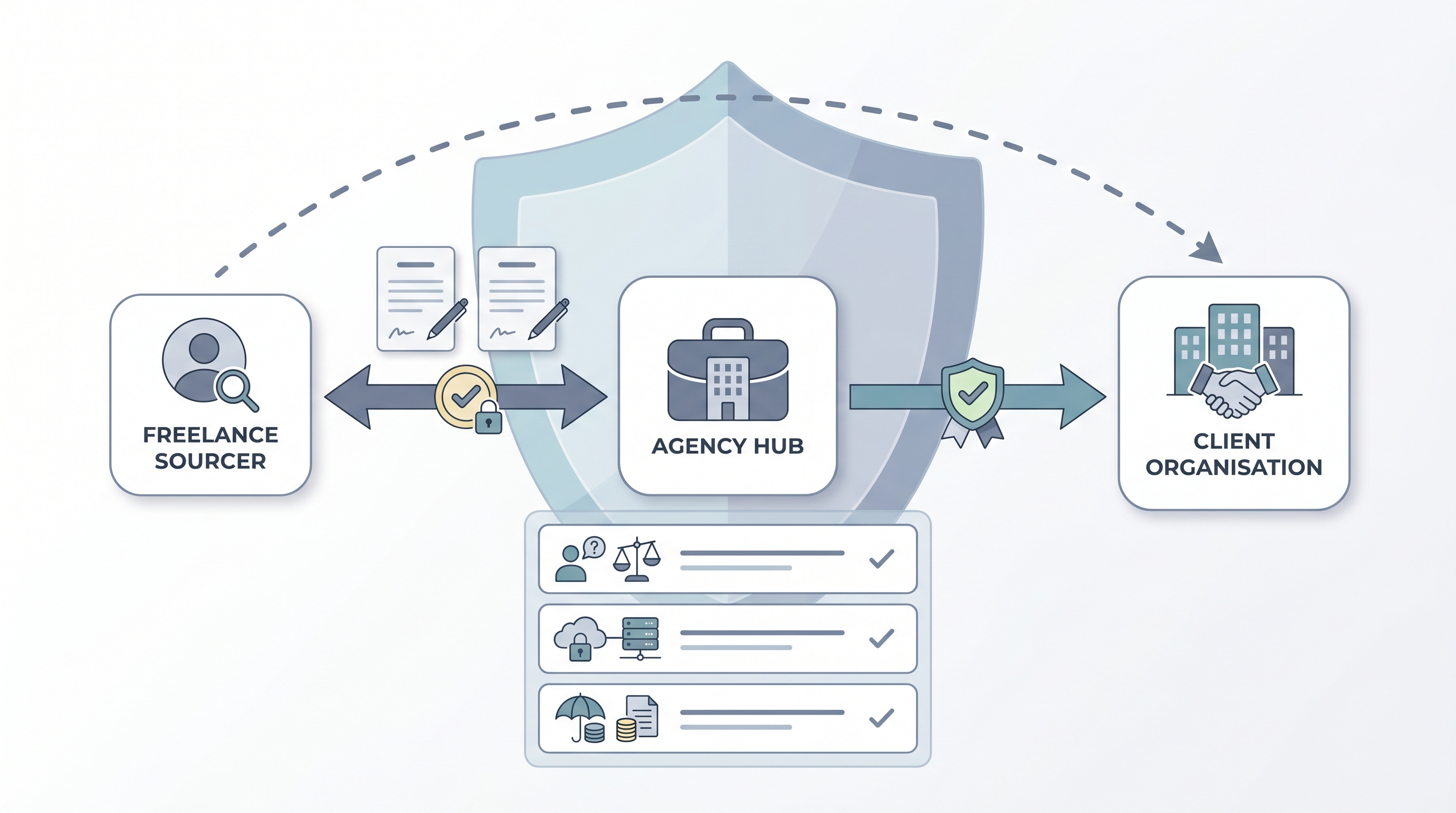
Subcontractor compliance is the set of controls that sits between "I need extra sourcing capacity" and "I am exposed to a claim." Those controls cover four main areas: whether the client has consented to the subcontracting arrangement, whether the contract between the agency and subcontractor mirrors the key obligations in the client agreement, whether a data processing agreement is in place for GDPR-regulated candidate data, and whether the subcontractor's employment classification is defensible under the applicable tax law.
Agency owners who work with freelance sourcers regularly often treat this as informal until a dispute or audit surfaces. Getting the paperwork in order before the first brief is sent out is cheaper than resolving a misclassification inquiry or a GDPR complaint after a placement.
In practice
- An agency owner adds a specialist sourcer to a retained executive search. Before briefing her, she checks the client MSA, finds a written-consent clause, and sends the client a one-paragraph notification. The client replies with approval in writing. When the candidate is placed, there is no basis for the client to dispute the fee on the grounds that an unauthorised third party was involved.
- A staffing agency uses a network of freelance sourcers in three countries. An HMRC inquiry arrives asking whether the sourcers should have been treated as employees. The agency can produce signed agreements documenting the basis for independent contractor classification, reducing exposure to a penalty.
- An RPO team subcontracts data enrichment to a vendor based outside the EU. Because the subcontractor agreement lacks a data processing clause and standard contractual clauses, the agency receives a data subject access request it cannot answer cleanly. The situation would have been avoided with a compliant DPA signed before the first candidate record was shared.
Quick read, then how hiring teams use it
This page is for agency principals, agency ops managers, and in-house TA leaders who work with freelance sourcers, sub-agents, or external search partners. Skim the first section for the definition. Use the second when you are deciding how to structure, document, and monitor a subcontractor relationship on a live engagement.
Plain-language summary
- What it means for you: Every time you use a freelance sourcer or sub-agent to deliver client work, you inherit compliance obligations you may not have thought through: client consent, a contract that mirrors your client agreement, data handling rules, and employment classification.
- How you would use it: Before briefing any subcontractor, check the client MSA for consent requirements, issue a subcontractor agreement with back-to-back terms, and sign a data processing agreement if the subcontractor will touch candidate data.
- How to get started: Pull your most recent freelance sourcer engagement. Check whether you have a signed agreement, a client consent record, and a data processing clause. If any of those are missing, draft them before the next engagement starts.
- When it is a good time: Before you share the first brief, not after the placement is made and an invoice is questioned.
When you are running live reqs and tools
- What it means for you: The agency is on the hook to the client for what the subcontractor does, including data mishandling, a misrepresented candidate, or a GDPR complaint. Back-to-back terms and a data processing agreement shift that exposure back to the subcontractor in writing.
- When it is a good time: Before any briefing call with a freelance sourcer or sub-agent, especially if the client MSA has a consent or subcontracting clause. For retained search or RPO engagements, treat this as part of project set-up, not an afterthought.
- How to use it: Use a standard subcontractor agreement template that mirrors your client-facing master services agreement. Add a data processing annex for any engagement where the subcontractor will receive candidate personal data. Get client consent in writing before the subcontractor starts work.
- How to get started: Draft a one-page subcontractor onboarding checklist covering consent obtained, agreement signed, DPA signed, insurance confirmed, and classification documented. Run it for every new subcontractor regardless of engagement length.
- What to watch for: MSA clauses that prohibit subcontracting entirely, cross-border data transfers without standard contractual clauses, freelance sourcers whose working pattern starts to resemble employment, and subcontractor agreements that do not include a matching guarantee or claw-back clause if the placed candidate leaves inside the guarantee window.
Where we talk about this
On AI with Michal live sessions, the compliance and commercial structure of agency operations comes up in the AI in recruiting track, particularly when agency owners discuss scaling sourcing capacity with freelancers and managing the documentation that client relationships require. The Sourcing Lab cohort covers both the operational and legal side of agency agreements so principals understand where they are exposed and how to structure subcontractor relationships before a dispute surfaces.
Around the web (opinions and rabbit holes)
Third-party content on subcontractor compliance for recruitment agencies spans employment law commentary, agency owner forums, and HR operations resources. These are starting points, not endorsements. Verify any legal position with employment counsel before relying on it in a live arrangement.
YouTube
- IR35 for recruitment agencies explained walks through how off-payroll working rules apply when agencies use freelance sourcers and sub-agents.
- How to write a subcontractor agreement for staffing agencies covers the key clauses that protect the agency when third parties are delivering client work.
- GDPR data processing agreements for recruitment agencies explains how DPAs work in practice when candidate data moves between an agency and a sub-processor.
- Using freelance sourcers on client engagements in r/RecruitmentAgencies surfaces practitioner perspectives on consent, documentation, and what happens when a placement goes wrong and a sub-agent was involved.
- IR35 and recruitment subcontractors in r/LegalAdviceUK includes accounts from agency owners dealing with employment classification questions on UK-based freelance sourcing arrangements.
- GDPR and third-party data processors in r/gdpr covers DPA requirements for organisations that share personal data with external vendors, directly applicable to candidate data shared with subcontractors.
Quora
- What obligations does a recruitment agency have when using a freelance sourcer? collects practitioner and legal perspectives on subcontractor documentation and liability.
Subcontractor compliance tier comparison
| Arrangement | Client consent required | DPA required | Classification risk | Fee split document |
|---|---|---|---|---|
| Freelance sourcer (short term) | Check MSA | Yes, if handling candidate data | Medium (IR35 or state test) | Referral or split agreement |
| Sub-agent (extended engagement) | Usually yes | Yes | Higher (hours, direction, tools) | Formal sub-agent agreement |
| RPO sub-vendor | Almost always | Yes, plus SCC if cross-border | Depends on jurisdiction | SOW-level schedule |
Related on this site
- Glossary: Master services agreement (MSA) for agency services, Statement of work (SOW) for recruiting projects
- Glossary: Agency indemnification clauses, Co-employment and staffing agency liability
- Glossary: Joint employment liability for agencies, Client pass-through compliance for agencies
- Glossary: Split placement fees in recruitment agencies, Backfill periods and replacement guarantees
- Glossary: GDPR and first-touch outreach, Retained search vs contingency recruiting
- Glossary: Agency data room and due diligence, Recruitment factoring and agency cash flow
- Workshops: Sourcing Lab
- Course: Starting with AI: the foundations in recruiting
- Membership: Become a member