Recruitment tools in HR
The software, platforms, and AI-assisted features that HR departments deploy specifically to run the recruitment function, from headcount approval and job posting through candidate sourcing, screening, interviewing, and offer management, governed under HR policy.
Michal Juhas · Last reviewed May 15, 2026
What are recruitment tools in HR?
Recruitment tools in HR are the platforms, applications, and AI-assisted features that the HR function deploys to run the full hiring lifecycle, from headcount approval and job posting through candidate sourcing, screening, interviewing, and offer management.
The phrase signals who owns and governs the technology. When recruitment tools sit inside HR, the HR department holds the vendor contracts, the data processing agreements, the compliance posture, and the policy decisions about what each tool can do with candidate data. This is different from a TA team that procures its own sourcing stack outside HR oversight, or a hiring manager who runs screening through an unofficial tool nobody else knows about.
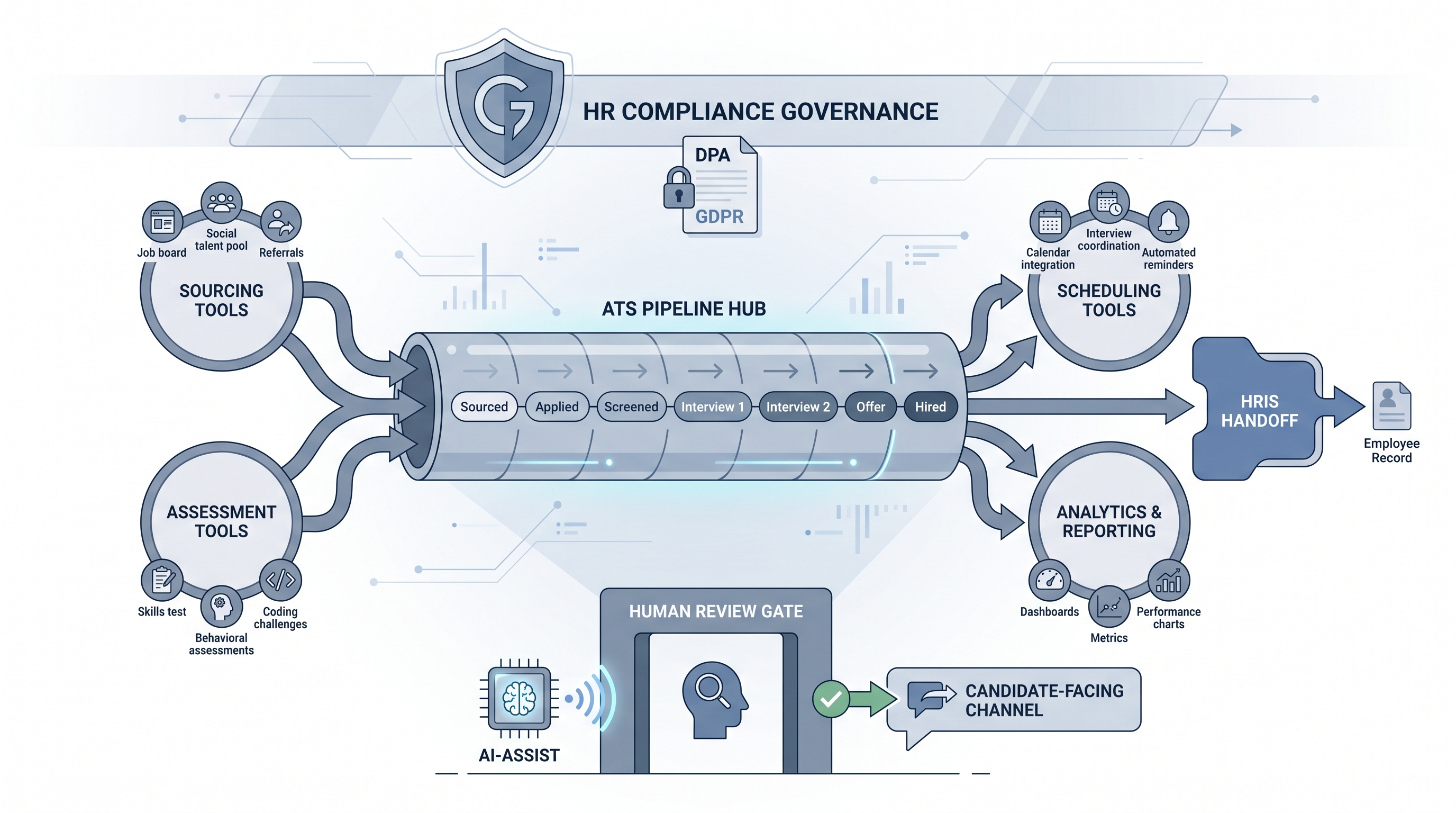
At the operational centre sits an applicant tracking system as the candidate record of truth. Around it sit sourcing tools for finding passive talent, pre-employment assessment platforms, interview scheduling software, and analytics tools that report on pipeline health. AI is now embedded in most of these categories, which makes the governance question sharper: HR must document processing purposes, run AI bias audits, and keep human review in place at decisions that affect who advances.
In practice
- An HR director presenting the annual technology budget to a CFO uses "recruitment tools in HR" to cover eight vendor contracts: the ATS, two sourcing platforms, an assessment tool, a scheduling integration, an analytics dashboard, a video interview product, and an onboarding platform, each with its own DPA and renewal date.
- A People Ops lead auditing the stack discovers that the sourcing tool and the assessment platform both store candidate PII under different retention schedules that have never been reconciled into a single GDPR deletion workflow.
- When a recruiter says the tools feel disconnected, the root cause is usually an HR governance gap: nobody mapped candidate data flow between vendors at procurement, so records fall out of sync when field names do not match between systems.
Quick read, then how hiring teams use it
This is for HR leaders, People Ops managers, HRBPs, and TA leads who own tooling decisions, manage vendor contracts, or need to explain the recruitment technology stack to legal or finance. Skim the first section for shared vocabulary. Use the second when you are auditing, procuring, or governing tools in a live hiring environment.
Plain-language summary
- What it means for you: Recruitment tools in HR are the software products your HR department uses to run hiring. Owning them means you own the compliance obligations that come with them, including GDPR, bias monitoring, and human review requirements for any AI-assisted decisions.
- How you would use it: Select tools that connect reliably to your ATS through a stable API, require a data processing agreement that names sub-processors and server regions, and assign a named internal owner to every contract before you go live.
- How to get started: Map your current stack by drawing the candidate data journey from sourcing tool to HRIS handoff. Identify where records have to be re-entered manually, where AI outputs reach candidates without a human review step, and where retention schedules are undefined.
- When it is a good time: At annual vendor renewal, when compliance or legal raises a question about how candidate data is stored, or when the HR team is scaling hiring volume faster than the current stack can handle without adding headcount.
When you are running live reqs and tools
- What it means for you: Recruitment tools in HR govern what data each vendor holds on every candidate in your funnel, what they can do with that data, and whether your team can delete it on request. That scope is wider than most procurement checklists assume.
- When it is a good time: Before signing a new vendor contract, when a model update comes from an existing AI tool, when a candidate submits a subject access request, or when a court or supervisory authority requests documentation of your hiring decision process.
- How to use it: Require a structured output from every tool that produces AI scores: what model ran, which version, what criteria, and which human reviewed before the candidate advanced. Keep that log for at least the duration of your GDPR retention period. Run a group pass-rate comparison at least quarterly for any tool that scores or ranks candidates.
- How to get started: Audit your current DPAs for sub-processor lists and data residency clauses. Compare them against your organisation's approved vendor policy. Close the gaps before the next model update arrives from a vendor who updated their terms in a changelog email nobody read.
- What to watch for: Silent model updates from AI vendors that change scoring behaviour without notifying HR. Sourcing tools that enrich contact data through third-party databases whose sub-processors are not named in your DPA. Assessment platforms that report group pass rates at the aggregate level only, hiding stage-level adverse impact. And workflow automation scripts that pass AI drafts directly to candidates without a review gate because the happy-path demo never showed an error.
Where we talk about this
On AI with Michal live sessions the governance framing runs through both the AI in recruiting and sourcing automation tracks. HR leaders and People Ops leads bring their current vendor stack and compliance questions so the room can work through real data flow problems rather than hypothetical ones. If you want the full peer conversation with practitioners who own tools at companies ranging from 50 to 5,000 employees, start at Sourcing Lab and bring your most recent vendor renewal question.
Around the web (opinions and rabbit holes)
Third-party resources move fast. Treat these as starting points, not endorsements. Verify anything before wiring candidate data to a new tool.
YouTube
- HR Tech Stack Explained for Beginners (search YouTube for recent uploads) surfaces vendor-neutral overviews of how ATS, sourcing, and analytics tools connect in small and mid-size HR teams.
- SHRM Annual Tech Showcase recaps often feature candid HR practitioner commentary on which tool categories delivered value versus which ones were bought on demo buzz.
- AI in HR: Practical Governance covers the compliance side that most vendor comparison videos skip: data processing agreements, bias monitoring, and human oversight requirements.
- r/humanresources discussions on HR tech include frank posts from HR generalists who own tool stacks without dedicated TA ops support, describing what actually breaks in production.
- r/recruiting posts on tool selection mix recruiter and HR perspectives on which integrations fail first and which vendor support teams are actually responsive.
- r/legaladvice threads on GDPR and hiring data give a practitioner view of data subject access requests that catch HR teams off guard when tools store more than expected.
Quora
- How do HR departments choose recruitment software? collects a range of practitioner answers on procurement criteria, integration requirements, and the governance steps most teams skip until a compliance question forces them back.
Recruitment tools by HR function area
| HR area | Tools typically owned | Primary compliance concern |
|---|---|---|
| Talent acquisition | ATS, sourcing tools, assessment platforms | GDPR, adverse impact monitoring |
| HR operations | Scheduling, onboarding, HRIS sync | Data residency, retention periods |
| HR analytics | Funnel dashboards, pipeline reports | Group representation, metric accuracy |
| HR leadership | Vendor contracts, DPA governance | AI Act compliance, audit log access |
Related on this site
- Glossary: HR tools for recruitment, HR AI tools, Applicant tracking software, Hiring tools, Recruitment management software, Recruitment analytics software, AI bias audit, Human-in-the-loop
- Blog: AI sourcing tools for recruiters
- Guides: Sourcers
- Live cohort: Sourcing Lab
- Membership: Become a member